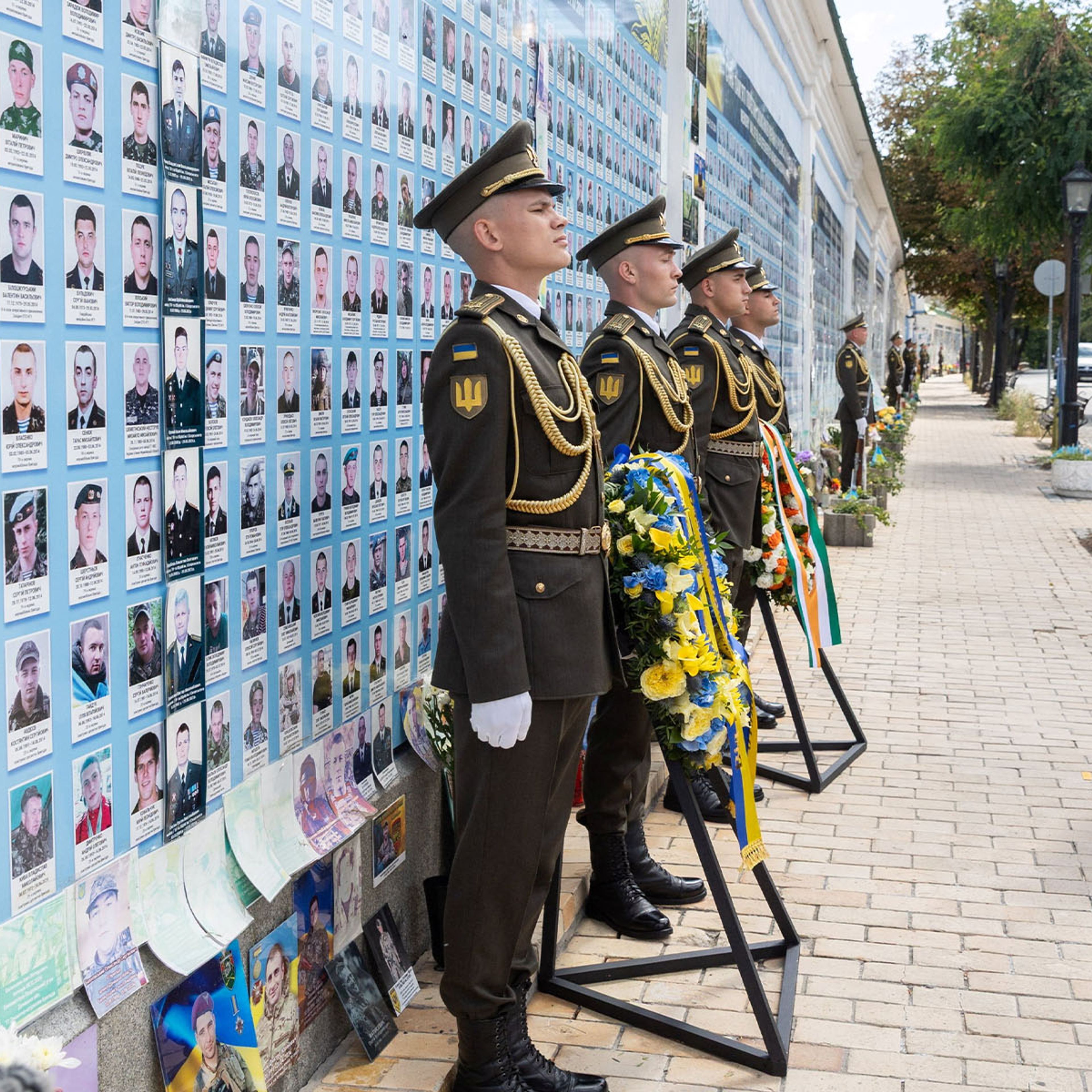
Notes & Asides, makes some good logical points in arguing that we should say “the Ukraine,” not “Ukraine.” However, idiomatic convention is not always logical. English-speakers all say “the Netherlands,” which makes good sense; however, we don’t say “the Austria,” although that country’s name in its own language is as much a description (“eastern realm”) as is “nether lands.” Peter Lunn (son of Arnold), in one of his great books on skiing, writes, as an Englishman, about “the Lebanon”; but when President Eisenhower sent American troops, he sent them to “Lebanon.” The French call their own country “la France,” but we aren’t inspired by their definite article to say “the France.” Actually, even in logical terms Mr. Dempsey’s argument doesn’t quite work. The phrase from which the name derives, “u krainy,” doesn’t mean “the frontier”—it means “on the frontier.” So saying “the Ukraine” is like saying “the on the frontier.” Language also has political power. The reason our Ukrainian-American friends asked us, during the Cold War, to drop the “the” that we had inexplicably adopted was that, in their view, doing so made it clearer that “Ukraine” was a proper name and not merely a description—or, to put it another way, that it denoted a real country, and not merely a region of the Union of Soviet Socialist Republics. Best, Linda [Bridges] Dear Mr. Buckley: Your March 22 issue includes a review of your new book, The Fall of the Berlin Wall, by Peter Robinson, which includes the following passage: Recounting a visit he made to Checkpoint Charlie, for example, Buckley writes: The Vopos [East German police] stalled me for a full twenty minutes… a way of saying that although formal diplomatic concessions were being made, there was no reason for the visitor not to feel the heavy heel of the commanding entity, the German Democratic Republic. I don’t conceal that I thought the Germans who were enforcing the laws appeared especially well qualified to do so, in the square-set resolution of their heads, the grimness of their expressions, and their disembodied attention to duty. Exquisite diction and, in the mounting wave of dependent clauses that ends the second sentence, a use of rhythm that Macaulay would have approved. I really have serious reservations regarding the proposition that Macaulay would have approved of clauses, dependent or otherwise, lacking verbs. Also the writer’s final sentence (actually a paragraph) does contain two dependent clauses but lacks any independent clause with subject and verb! Sincerely, Dale Sparling, Brookings, N.D. Dear Mr. Sparling: I shall insert verbs in the next edition! Cordially, —WFB THE NATION
70 Year Magazine Archive
Notes & Asides
Share this story
Featured Tags
Advertisement
Advertisement


Comments