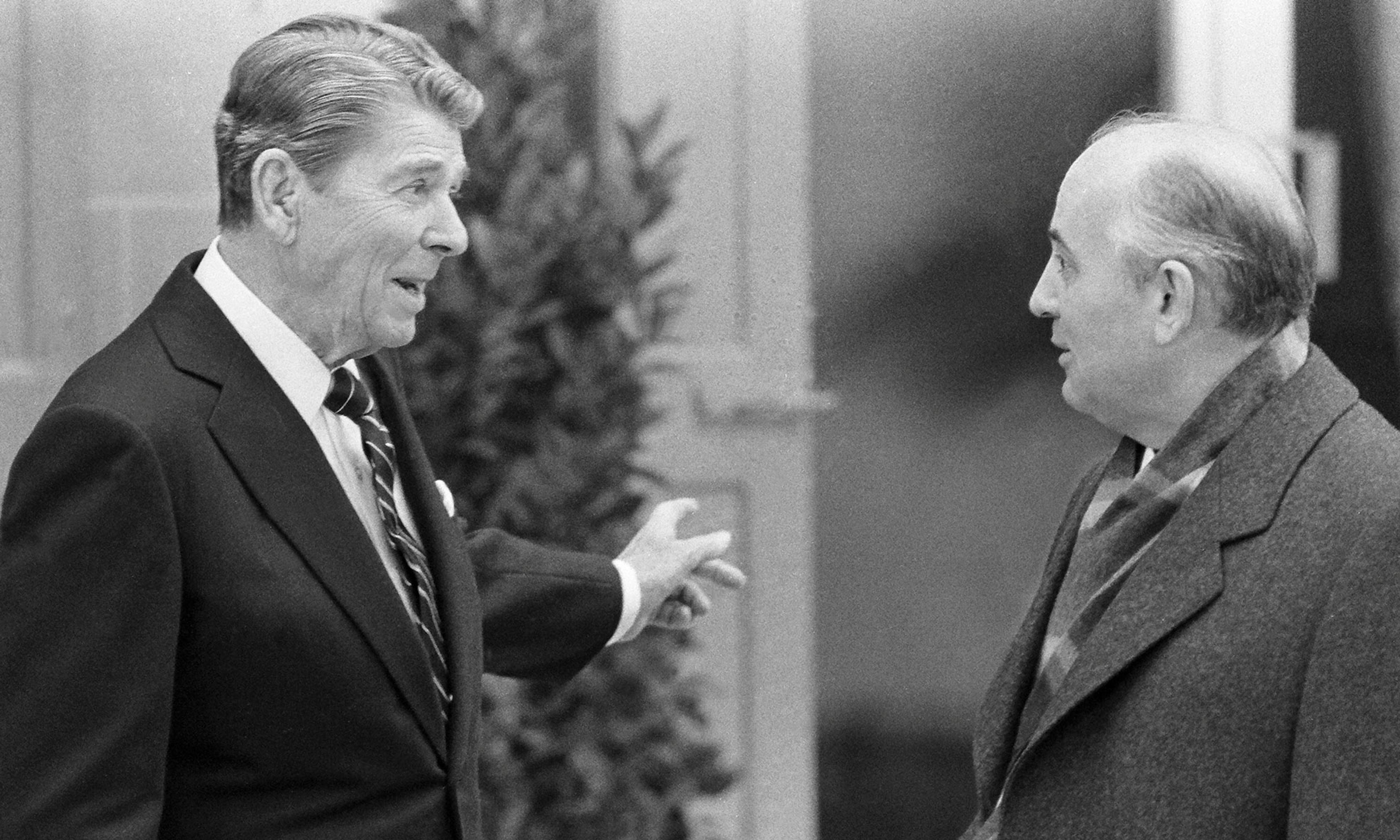
In the early innings after the end of the Cold War, the media and much of the foreign-policy community wanted to give Mikhail Gorbachev the full credit for its surprising and abrupt end, portraying President Ronald Reagan mostly as a hindrance. After Gorbachev was awarded the Nobel Peace Prize, Strobe Talbott’s 5,000-word treatment in Time magazine’s “Man of the Decade” valentine devoted but a single sentence to Reagan, chiefly to shove him offstage. But as was the case with Eisenhower, another Republican president dismissed as a simpleton during his time, subsequent revelations about Reagan spawned a significant upward revision even among many liberals. Princeton’s Sean Wilentz, no friend of conservatives generally, wrote in 2008: “[Reagan’s] success in helping finally to end the Cold War is one of the greatest achievements by any president of the United States — and arguably the greatest single presidential achievement since 1945.” This revisionism is taken as vindication of what conservatives knew all along: Margaret Thatcher was right when she said Reagan won the Cold War without the firing of a single shot.
The revisionism about Reagan, however, has deepened rather than resolved a number of puzzles about him, and Gorbachev also remains out of focus in some important ways. Although it is unlikely that major new revelations or startling archival documents will appear in the future, revisionism about the Cold War’s endgame is likely to grind on for a long time because new interpretations will propose intuitive and speculative insights into the contradictions and unknowable innermost thought processes of Reagan and Gorbachev. This is a tall order, requiring a combination of biographical and political genius, qualities that are almost as rare as genuine statesmanship.










Comments