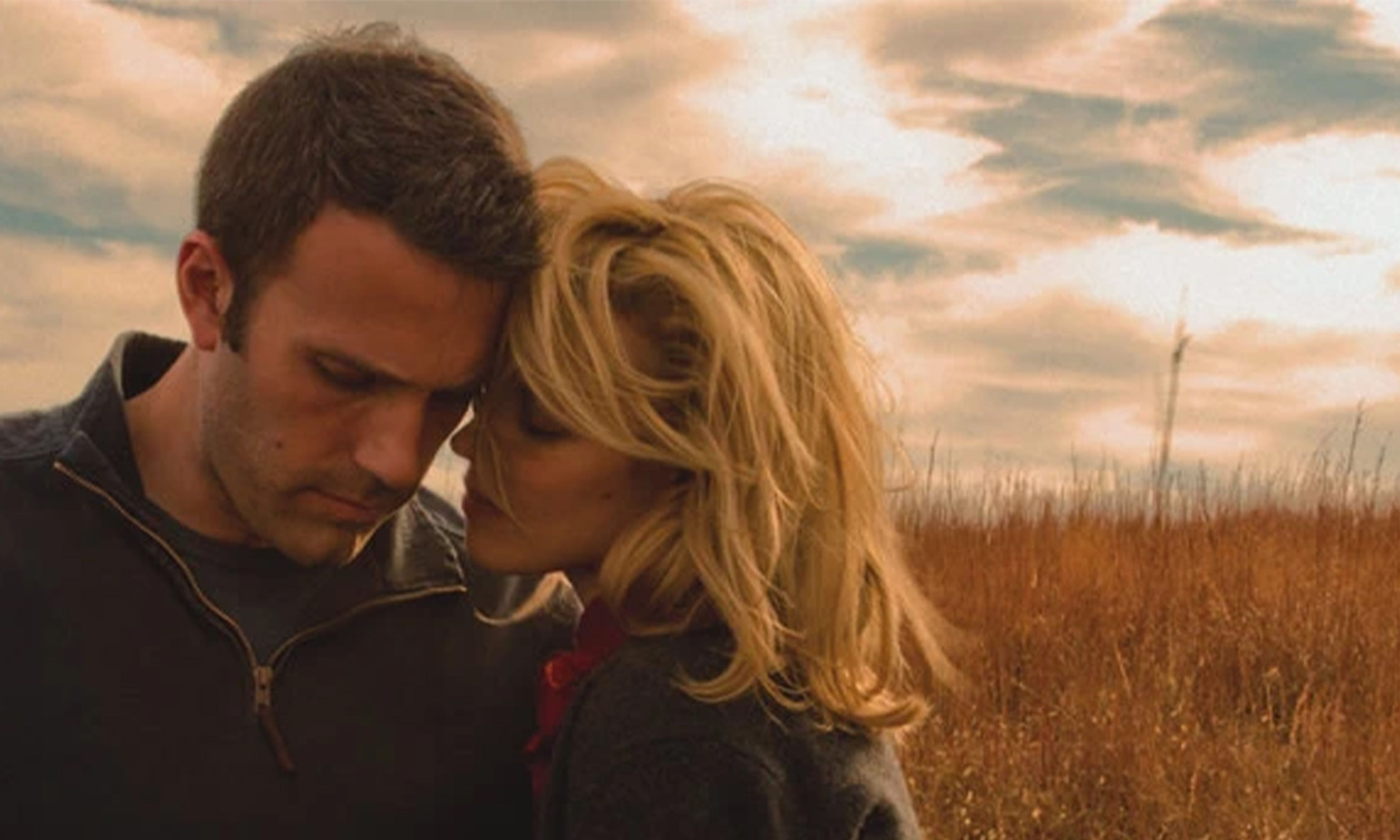
Terrence Malick’s To the Wonder, his follow-up to the rapturous and rapturously reviewed Tree of Life, has been treated unkindly by the critics, and I’m sorry to say that it deserves that treatment. I had hoped, before seeing it, that the reactions to Malick movies simply moved in cycles, and that the new film was facing a backlash only because Tree of Life had earned so much praise — much as Malick’s The New World, a true masterpiece, was underrated by critics who had overpraised The Thin Red Line a few years earlier.
But no, this time the complainers have it right. With To the Wonder, the master has delivered a work whose beauty is the beauty of surfaces, with no clear way into the depths that it aspires to plumb.
Those depths, as always with Malick, have to do with God and nature, doubt and belief, sin and grace, suffering and transcendence. But his chief preoccupation this time is love — the love of men and women in the foreground, and then the divine love that our human loves both resemble and fall short of.
The falling short is, for the most part, what happens to the main characters, Neil (Ben Affleck) and Marina (Olga Kurylenko), who meet in Paris, become enraptured with each other on a luminous trip to Mont St. Michel, and then decamp, along with her daughter from a previous marriage, for the wide expanses and subdivisions of Oklahoma. There things crumble, slowly: They live in half-furnished homes where suitcases are always open, her daughter wearies of the States and pines for la belle France, they fight and he withdraws from her, and the transcendence of their romance survives only in fragments of memory, shards of vanished time.
There is another woman, a rancher played by Rachel McAdams, as blonde and American as Kurylenko’s Marina is dark and European. She may be an old flame of Neil’s, and he takes up with her while Marina makes what proves to be a temporary return to France. There is a priest to whom Marina goes for counsel, played by Javier Bardem, who is struggling with his own crisis of faith, feeling Jesus’s love slip from him as he tries to minister to his congregation and to the poor. And as always with Malick, there is the extraordinary beauty of the everyday, offering intimations of eternity not only in prairies and rivers, but in ranch houses and fast-food parking lots as well.
All of this may be autobiographical, as was some of the family drama in Tree of Life. (Malick had a temporary ’70s romance with a Frenchwoman, and is now married to his former high-school flame.) It’s certainly meant to be Christian, in a more explicit way than some of Malick’s earlier films (though never a didactic one). His vision of the sacred now feels more sacramental than pantheistic, and where Tree of Life evoked Genesis and Job, To the Wonder reaches more often for the New Testament.
What it doesn’t reach for, unfortunately, is personality, individuality, psychology — the stuff of character, a human element around which big themes and ideas and intimations can revolve. Malick’s admirers are used to his taking a traditional narrative architecture — in this case a romance, a love triangle, the story of heartbreak — and stripping away much of the dialogue and exposition that filmgoers usually expect. But the stripping goes further this time: There is almost no dialogue apart from mumbles and fragments, and the voice-over belongs exclusively to the women and the priest — Affleck’s voice is barely heard at all. The characters’ back stories are nonexistent; their motivations opaque; their problems mysterious. We know they all want to love and be loved, but their yearnings lack individuality, personality, detail.
I understand that they’re archetypes — male and female, light and dark, the Couple and the Priest. But Malick’s characters are always archetypal, and in his best films he’s managed to infuse at least some of them with individuality as well. Tree of Life was discursive, meditative, nonlinear, but it had the difficult, disappointed father (played by Brad Pitt) at the center of the action — a recognizable, all-too-human human being, sketched precisely in a few swift scenes. Likewise Colin Farrell’s John Smith in The New World — a figure out of myth, yes, but also a persuasive human type.
In To the Wonder, Kurylenko and McAdams, working only with physicality and voice-over, come the closest to giving us glimpses of individuality. Bardem is less effective, mournful and hangdog; Affleck is a nullity, a black hole. A mediocre actor even in easier parts, he is completely at sea in a story that asks him to convey personality through gesture and movement alone.
But I don’t want to be too hard on Affleck. It was Malick who cast him, Malick who directed him, Malick who decided to use To the Wonder to push his personal aesthetic to its limits. He’s reached them. Here’s hoping he realizes it.












Comments