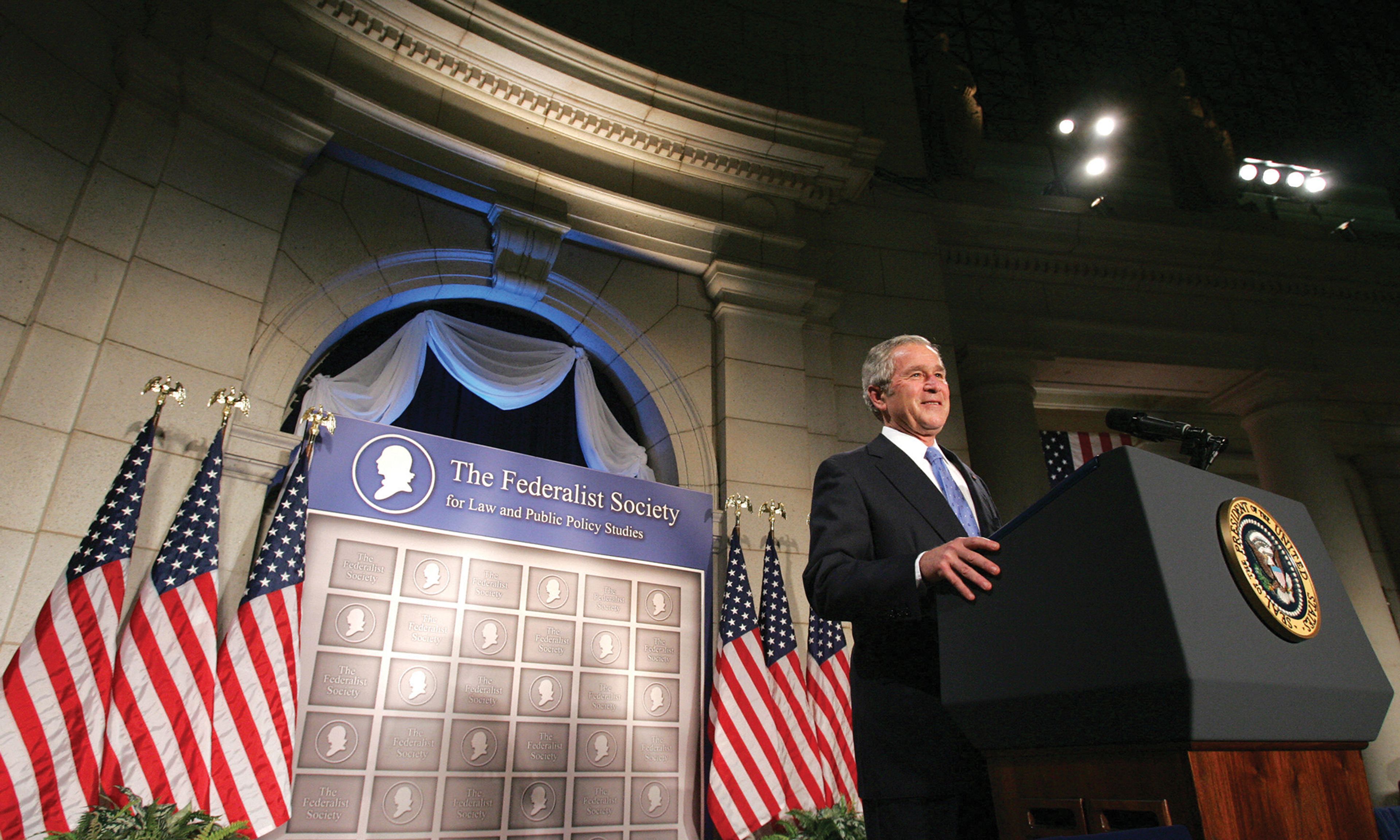
The ruling in Dobbs v. Jackson Women’s Health Organization will come in 2022, exactly 40 years after the founding of the Federalist Society, the association that has promoted conservative jurisprudence and originalism throughout the legal profession and judiciary.
And that’s fitting. Because if the Court overturns the supposed constitutional right to an abortion in Roe v. Wade, or if it weakens it beyond recognition, it will do so when a majority of the Supreme Court’s justices are members and products of the Federalist Society. The press and the public will notice this fact and quickly proclaim such a ruling the crowning legacy of the conservative legal movement.
Such a ruling would be the product of decades of political organization and activism at every level of American society. Moral horror at abortion has driven millions of Americans into the Republican Party because that is where they could oppose it. Roe v. Wade stood in the way of state and federal legislatures that would regulate, circumscribe, or outright abolish the practice of abortion. The Republican Party and allied conservative institutions taught these voters, many of them refugees from the Democratic Party, that electing conservative presidents, who could appoint originalist judges, would restore the constitutional order and put the question back into the hands of the people and their legislatures. In a way, this meant that electing Republicans and appointing originalists was just the precondition for a truly democratic anti-abortion movement to come into existence.
Until the long-awaited ruling, the cause has been in the hands of legal elites. Justice Samuel Alito began his career before the founding of the society but soon joined it and has remained very active since. After his confirmation, Neil Gorsuch gave a swaggering speech to the Federalist Society. He said its work showed that “a person,” namely himself, “can be both a committed originalist and textualist and be confirmed to the Supreme Court of the United States.”
Just twelve years after the Federalist Society was formed, one of its members, professor John Garvey, identified Amy Coney Barrett as a great talent. And the recommendations from him and other admiring professors helped Barrett obtain a clerkship with Justice Antonin Scalia, building the appropriate résumé for authority at the highest levels of the judiciary. Judge Brett Kavanaugh joined the Federalist Society in 1988. Leonard Leo, the Federalist Society’s most prominent activist, was deeply involved in recommending and supporting the nominations of Alito, Gorsuch, Kavanaugh, and Barrett to the Court.
That link between the popular passions of Republican Party members and results in the high court was for years an implicit bargain, but under the presidencies of George W. Bush and Donald Trump it became something else. Republican nominees could once get away with saying they would simply “call balls and strikes,” and their nominating presidents could say to the press that there were no “litmus tests.” Judges would be nominated for their philosophy, not for its application. But, after the scuttling of Bush’s nomination of Harriet Miers in favor of Samuel Alito, Republican politics began to change. Donald Trump explicitly promised that Roe v. Wade would be overturned if he was elected and got the chance to appoint justices. This promise made him the top choice of many social and religious conservatives. And it came to pass that he appointed three justices, all with Federalist Society credentials, to a Court that appeared to already have two, possibly three, justices who looked askance at Roe.
Because presidential politics turns on more than just the issues of judicial restraint and constitutionalism, and because the Court has its unusual structure of lifetime appointments, the chance for a single movement to shape the Court for this purpose was treacherous and difficult. And it has come at a serious price. As liberals began to understand conservative intentions, the process of judicial nominations, normally governed by deference to the executive branch, turned into an absolutely degrading and draining slugfest, full of hideous smear jobs and the subjecting of conservative nominees to personal and political torture. For millions of conservatives, the sacrifices, compromises, and difficulties endured along the way will all be worth it if the Court does its job in Dobbs.
Acting on their deepest moral impulses and shrewdest calculated risks, conservatives have made it possible to appoint six members of the Court over the past two decades. In appointing Amy Coney Barrett in the last days of the Trump administration, conservatives were giving themselves insurance against a possible-probable defection by Chief Justice John Roberts, who has made the fatal error of trying too conspicuously to control the popularity of the Court, at the expense of the integrity of its decisions and the functioning of the American republic.
Considering all these facts, and the complete lack of “originalist” or “textualist” support for a constitutional right to abortion, a failure to overturn Roe v. Wade would do incalculable and irreversible damage to the Republican Party, the conservative movement, and the Federalist Society. The penalty for failure would be, fittingly, a form of dismemberment.
One should expect potential splits in the conservative legal movement, at the intellectual and organizational level. Some of these fissures are already appearing. Textualism and originalism as practiced have had trenchant conservative critics, such as Hadley Arkes, for decades. But a larger cohort of activists would almost certainly use the failure to overturn Roe as a lever to form new legal associations that aim not for originalism and liberal neutrality but for something else. You can expect the open promise of juridical victories based on a philosophy of the common good that draws its strength not just from the Constitution and the text of laws enacted, but beyond these sources. At the intellectual level, this would bill itself as an attempt to bring “truths” back into the practice of law. At the political level, it would be sold as an attempt to fight the fire of progressive judicial activism with conservative fire rather than a fire extinguisher.
The problems with such an approach are obvious. It would divide loyalties and lead to a desperate and exhausting scramble for resources, aimed now at infighting, and to a search for new political and financial patronage.
Failure to overturn Roe would amount to political malpractice as well. While much of the legislation that would be enacted in a post-Roe America is already written and waiting to go into effect, the efforts to defend state abortion regimes, were Roe overturned, would soak up political capital that progressives could no longer spend on further diminishing religious liberties and on promoting other forms of secularism and cultural revolution.
Failure would also demoralize traditional conservatives at the popular level. The infighting and confusion would likely result in the continued diminishment of their concerns in favor of a broader but shallower form of cultural populism. A conservative judicial elite that could not champion the freedom of the American people to govern themselves on abortion might nonetheless try to offer the consolations of other liberties: the right to own firearms in any configuration or the right to post whatever you like on social media. Or, as in the case of the highly idiosyncratic “textualism” offered by Justice Gorsuch in the Bostock decision, there is freedom to redefine your sex in contravention of reality.
If the conservative justices and the people attached to the broader conservative legal movement have political concerns about the forthcoming decision in Dobbs, it should be this: that without true self-government and the ability to regulate and prohibit abortion, the entire movement begins to lose its claim to be serving the public good, and good itself. Without the pro-life movement, conservatism would be more justly accused of being the ideology of mere privilege within the status quo. Conservatism is about preserving the good of a civilizational legacy, and so it requires not just the preservation of our constitution but the protection of posterity itself, the unborn who have been reduced from their rightful position as our heirs to a vulnerable and defenseless position as disposable applicants for the protection of our laws and society.
Note that I do not say that pro-life activism will cease if the Court fails. In fact, I expect that one day, here or in a society that replaces ours, it must triumph. Ultimately, the risk for the Federalist Society, the Supreme Court, and America is the judgment of history, the wrath of God, and the opprobrium of our descendants. Any society that wishes to exist centuries hence will have found a way to repudiate this peculiar institution. The Court’s modest task in Dobbs is to get out of the way and let this process begin.












Comments