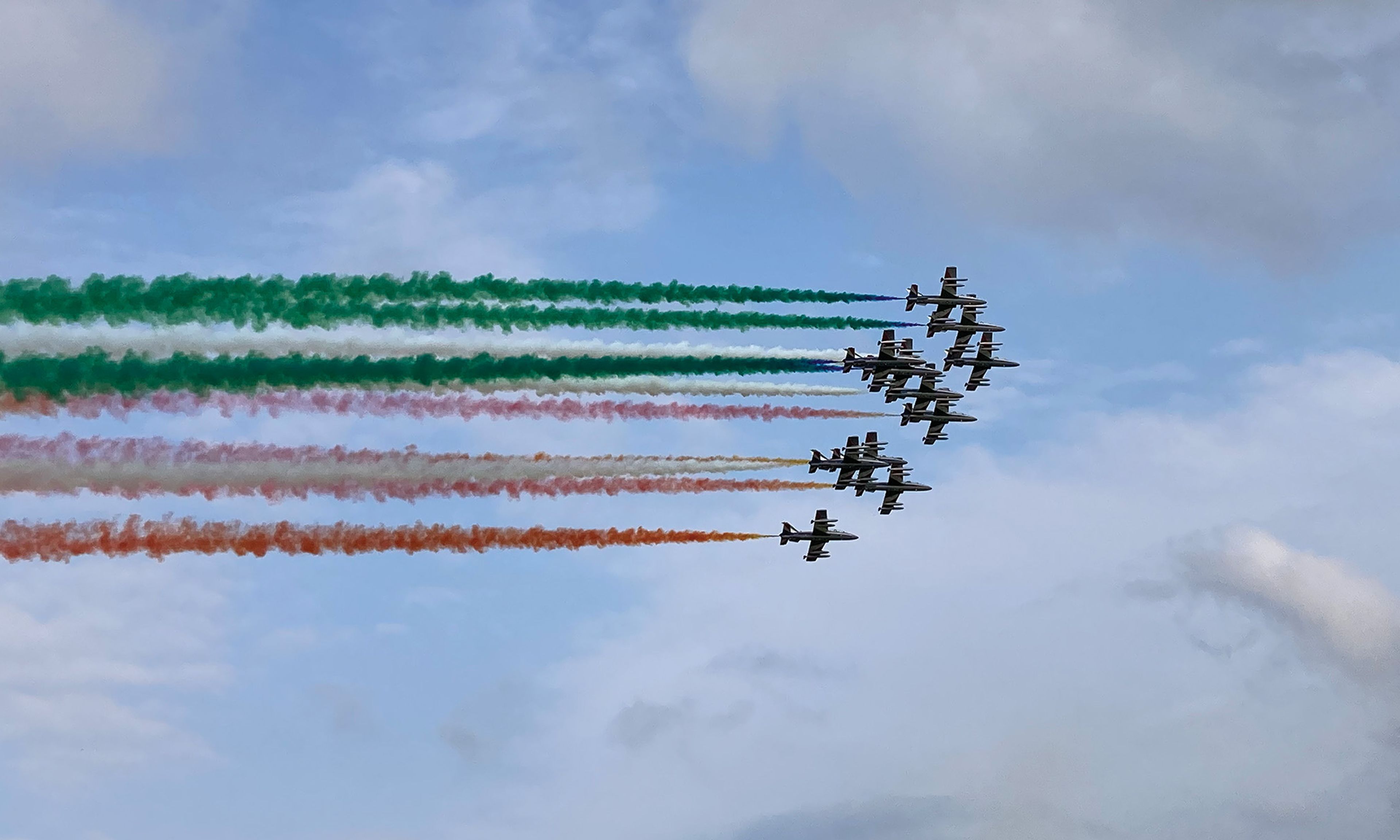
Oshkosh, Wis.
If we hadn’t tried to leave, we might’ve missed it completely. At 4 p.m. during the air show here, worried that I’d worn out my siblings and friend with one too many airplanes, I headed with them to the exit. We’d been at the event since 9 a.m., walking the expansive grounds and gazing in awe at hundreds of aircraft, but we still had two more days and I thought we needed to pace ourselves. So it was that we found ourselves near the show’s centerline when the announcer started acting strange.
It sounded like he was yelling at someone to get off the runway area. Unsure whether he was joking or not, we stepped closer. A black tailwheel sat on the runway, its female pilot out of the cockpit at that moment and checking something on the plane’s tail. Suddenly, a guy in a white tank top dashed past her, hopped into the cockpit, and roared down the runway as pilot and announcer yelled excitedly. Leaping into the air, the rogue plane seemed to skim across the runway, barely clearing its surface, and then went into a terrifying nosedive.
To most people, Oshkosh brings to mind baby and toddler clothing, but say the name to almost anyone in the general-aviation community and you’ll probably elicit a long sigh of joy, anticipation, and excitement. This annual weeklong celebration is legendary. What began as a small gathering of under 150 people has now grown to over 680,000 aviation enthusiasts.
That first gathering happened in Milwaukee in 1953. Owing to ever-greater attendance numbers, the Experimental Aircraft Association (EAA) decided in 1969 to move the show to Wisconsin’s Wittman Regional Airport, where the surrounding area allowed further expansion. Seventy-one years after that first gathering, my siblings and I were a part of the enthusiastic crowd, eyes wide with surprise and glee as we watched that seemingly rogue pilot — who was actually famed aeronautical performer Kyle Franklin exhibiting a well-rehearsed routine — dance across the sky in that black tailwheel.
A planner by nature, and well aware (I thought) of Oshkosh’s tendency to overwhelm newcomers, I began my preparations early. Summer 2024 has been busy in the Schutte family, which saw one graduation, one grad party, one birth, one major move, and one cross-country wedding in the span of two and a half months. That wedding overlapped with the final weekend of Oshkosh and foiled my plans to camp at the event (though I would never guilt my brother over this — definitely not). Thanks to a fellow NR writer and editor, however, I soon found lodging for myself and two siblings, ages 16 and 13, who would be sharing this adventure with me. And what an adventure we had.
First off, you have to understand how absolutely massive the 1,500-plus acres of the AirVenture grounds are. Even if you stayed all week and were on the grounds from dawn to dusk, there simply wouldn’t be enough time to see everything. Love warbirds? There’s a section for them — complete with its own tram tour. Curious about ultralights? Watching seemingly flimsy bits of wire and fabric rise gracefully into the sky during the Wisconsin golden hour is a treat. If you prefer, there is the homebuilt section or the vintage area. The displays in Boeing Plaza (the main area before you reach the flight line) change continually throughout the week. Oh, and don’t forget the four hangars full of vendors, the entire KidVenture section, and the EAA Aviation Museum.
The first day started strong as my siblings and I, along with one of my college friends, met up with George Daelemans III, a National Review reader who’s also a pilot and plane-builder. He gave us a crash course (no pun intended) in Oshkosh geography and shared insights into the world of homebuilt airplanes. Unlike other air shows held around the country, this one is geared toward home builders: that innovative, creative, intense group of individuals who rivet, weld, and sew their own aircraft. Ask 100 home builders what possesses them to spend years constructing their own planes and you’ll get 100 different answers.
It’s difficult to explain the event to someone without running out of breath, a fact that earned me some gentle teasing from my family during the wedding weekend. But here are some fast facts:
Yes, more than 680,000 people attended Oshkosh this year, but did you also know that more than 10,000 aircraft arrived here? And over 40,000 campers? Additionally, there were over 1,600 forums and 861 exhibitors. And all of this was accomplished through the dedication of almost 6,000 volunteers, who donated around 250,000 hours of their time so that the show could run smoothly. That was one of the most astonishing things about Oshkosh: how well run everything seemed to be. The traffic direction alone — both inside and outside the grounds — was incredible, and over my three days there I saw an amount of coordination that would’ve made FEMA proud.
One of the coordinators, Charlie Becker, was kind enough to meet up with us that evening and enchant my siblings with his car. This venerable machine, and 39 others like it, is a VW “Thing” and a relic of earlier Oshkosh days when golf carts were nonexistent and VW was everywhere. Mr. Becker zipped us around the grounds and showed us various areas — particularly Camp Scholler, where attendees could rough it for the week while staying close to the action, and the ultralights landing strip. Everywhere we went, he introduced us to new people, and whether they were home builders from another continent, a Ray Aviation Scholarship winner from Texas, or a 15-year-old female ultralight pilot, each had a fascinating aviation story and a love of Oshkosh.
Ninety-eight foreign countries were represented at the event. South Africa had quite a contingent, and Mr. Becker explained how a large group of them came each year and camped out in the same location. My favorite part? An aboveground pool that was a new addition to their setup this time. One gentleman, who had only one arm, has built two planes. Building, for him, is a family affair. I also met Arddyn, one of the country’s premier rally pilots. This fascinating type of flying originated in Scandinavian countries between the world wars as a way to combine skiing, hunting, and flying. I was corrected after calling it a race — it’s not one. It’s flying that involves amazing skill in pilotage, problem-solving, puzzle-solving, and exactness, and I could’ve stayed there all evening asking Arddyn questions.

Everyone told me before my trip that “it’s the people” who make this event come to life, but I hadn’t really believed them. Well, after spending three days with over 600,000 people, rarely hearing curse words or yelling, and encountering smiles and professionalism at every turn, I was proven wrong. We were deeply grateful for the hospitality of our hosts (a major shout-out to Luther Abel and his wife), the informative floatplane pilot who answered my sister’s questions, and the lovely couple in line behind me for dinner one night who told me how they bring their daughters to Oshkosh each year, just to name a few people.
The best part? Every day, at the start of the afternoon air show, the national anthem played and everything came to a halt. Hats came off, hands went to hearts, and everyone turned toward the flight line.
The second day had its ups and downs (an amazing aerobatics presentation and heavy rain showers, respectively), but the third offered another two highlights: my B-25 ride and the famed night air show.
The B-25 ride, long on my bucket list, began at the Appleton airport, away from the main Oshkosh grounds. These rides take place thanks to EAA. During our briefing, I learned that the plane I would fly in, known as the “Berlin Express,” never saw combat. Built in Kansas in 1943, she was first a trainer for eager young pilots. Post-war, she found herself a Colombian playboy’s private jet, shuttling the likes of Eva and Zsa Zsa Gabor. She joined the ranks of movie stars herself in the 1970s, with a role in Catch-22, and eventually settled down to a life with EAA. We also learned a little about Roosevelt’s Lend–Lease program — how the U.S. would fly planes to the Canadian border, leaving them there for the Canadians to tow across.
If you’ve heard of General James Doolittle and the bombing of Tokyo, you may know that this is the type of plane he and his team used on their daring, morale-boosting, and self-sacrificial mission. From a piloting perspective, what shocked me most about the B-25 was how it was steered while on the ground. The tiny planes I usually fly have nosewheel steering, meaning that when I push on the rudders, the nosewheel shifts direction on the ground. This plane, however, is directed with differential power and braking, a technique that must’ve been quite the feat for our pilots to master.
Our lead pilot was a petite woman named Julie. It was such a pleasure talking to this joyful, knowledgeable pilot after the flight. She even invited me up to sit in the plane’s cockpit, ask all the questions I wanted, and handle the controls. It made my day to discover that, because of her height, she too has to sit on cushions when she flies. Her fellow pilots tease her for it, but she doesn’t care. She knows she’s good at her job, and she’ll be as girly as she wants.
What was most striking about this experience, however, was the noise. I’d forgotten earplugs, so after boarding the flight I settled in and prepared to hear what our brave flight crews of old heard. At first, it was merely like being inside a washing machine. But as Julie pushed the throttle forward and we began our taxi down the runway, the noise transformed. It became one mighty wash of sound, a combination of TV fuzz turned to ten and quarter-sized hail bombarding a tin roof. The sound didn’t dampen the views, though, and despite nearly losing my breakfast sitting in the tail gunner’s seat, I thoroughly enjoyed the nose-gunner position and wished I could’ve stayed there a while longer.
One of the beauties of these flights is their ability to move people emotionally. Julie spoke of passengers who come with pictures or dog tags of family members who flew missions in B-25s. They’ll ask to sit in the positions once occupied by their loved one, or as close to them as possible, and remain there for the flight, pondering the past and sometimes even crying.
My B-25 flight over, the three of us hurried off to spend our last few hours in Oshkosh proper, hoping to catch both the afternoon and night air shows. Unfortunately, we lost a few hours because of traffic: The night air show draws massive crowds from surrounding areas. Undaunted, we waited patiently, eating snacks and tuning in to the local AirVenture radio broadcast to learn what was flying above us during the part of the afternoon show we missed. Upon reaching the grounds, we secured a lovely spot on the flight line that, even though it wasn’t near the show’s center, gave us a perfect vantage for almost every takeoff. There was so much more to see, from the Warbirds Tram Tour to the Seaplane Base to the welding and sewing workshops. We missed the press conference of Madison Marsh — Miss America 2024 and the first active-duty Air Force member to win the title — and a live broadcast by my favorite podcasters from Opposing Bases (both of which would occur after we’d left). We’d seen so much already, though, that running around through the vast crowd — which had swelled significantly since Monday — would probably have left us stressed and exhausted. So we did what we’d enjoyed the previous two afternoons: settled onto our picnic blanket and marveled at planes.
We’d seen floatplanes, electric planes, and gargantuan military planes. We’d been urged to buy grills and asked whether we’d accepted Jesus. We’d thought about dropping everything to go track animals in remote Alaska, attempted to pilot a simulator of the Wright Flyer, and talked to that cool YouTube pilot I follow (thanks, Stevie!). Now, on our last day, we simply watched.
We watched the awe-inspiring aerobatic feats, teared up at the heritage flights, and gasped at the paratroopers’ jumps. We applauded the near-last demo of the A-10, covered our ears at the roar of the F-35, and cheered the warbirds exhibition. And this was only the afternoon show. The evening demonstration proved to be beyond my wildest imagination.
That show, which began around eight, became more and more spectacular with each successive act. After the mighty military jets and the fireworks-laden aerobatic planes, the evening culminated with a literal bang thanks to the most dazzling pyrotechnic display I’ve ever seen. It was accompanied by 500 drones that blinked in and out of sight, creating images in the air as if by magic.
My sister, always appreciative but never effusive, turned to me, eyes shining.
“This,” she said, “is amazing.”
Yes, it was. And I can’t wait to come back next year.
Correction: The “Berlin Express” is an EAA aircraft, not a CAF aircraft as was originally stated in this piece.











Comments