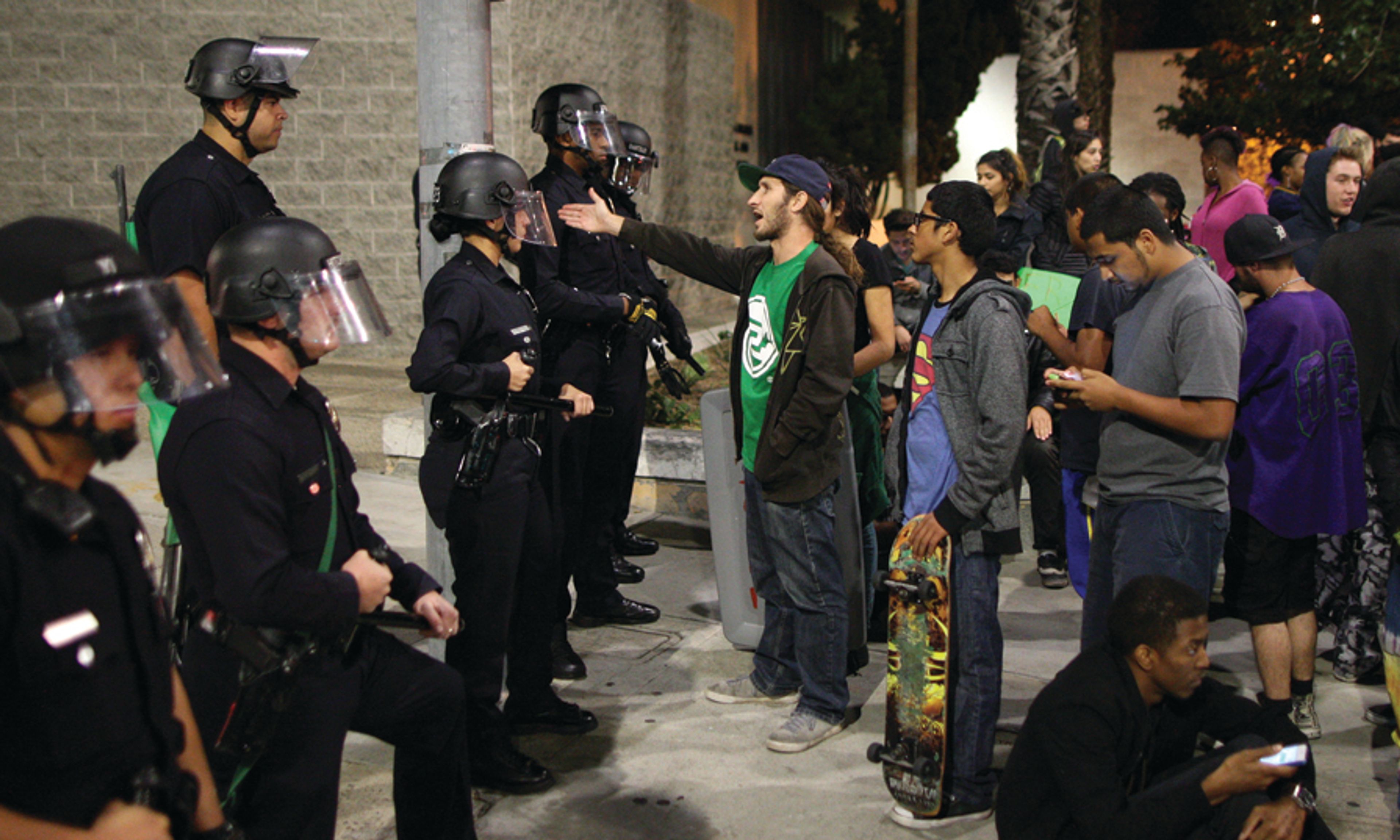
U.S. police officers complain that they are under siege: In Las Vegas, four officers were shot in less than two months; Darren H. Goforth, a sheriff’s deputy, was gunned down at a gas station in Harris County, Texas, while pumping gas; Lieutenant Joe Gliniewicz — the Army veteran was “G. I. Joe” to his friends — was murdered in Fox Lake, Ill., after radioing in a report of three suspicious-looking men. At a press conference following the murder of Deputy Goforth, Harris County sheriff Ron Hickman linked the shooting to “dangerous national rhetoric.” “We’ve heard ‘black lives matter,’” he said. “Well, cops’ lives matter, too.” He called the killing “senseless” and an act of “absolute madness.”
About the madness, he very well may be correct: It will come as no surprise to those familiar with the facts of American murder that the suspect in the killing, Shannon J. Miles, had a history of violent crime, including violent crimes involving firearms, or that he had been declared mentally incompetent to stand trial on charges of aggravated assault with a deadly weapon in 2012 after a fight over the television remote control at an Austin homeless shelter. The great majority of the identified murderers in the United States — more than 90 percent in one survey, undertaken by the New York Times, of New York City crime — have prior criminal records. The link between violent crime and mental illness is well documented; a 2014 report commissioned by Representative Tim Murphy (R., Pa.), who is a psychologist by training, estimates that 40 percent of Americans with serious mental illness receive no treatment, and that those who do not receive treatment are 15 times more likely to commit violent crimes. Often these are the ordinary crimes that do not make the front pages, but sometimes they are criminal spectaculars: Mental illness was a factor in the carnage in Newtown, Conn., Aurora, Colo., Tucson, Ariz. (where Representative Gabby Giffords was shot), the Washington Navy Yard, and the 2014 shootings at Fort Hood, Texas (not to be confused with the 2009 act of “workplace violence” at the same facility by jihadist Nidal Malik Hasan, whose military portfolio was mental health). We have dangerous criminals walking the streets for the same reason that we have people with serious mental illnesses walking the streets: because we, through our policymakers, choose for this to be so.











Comments