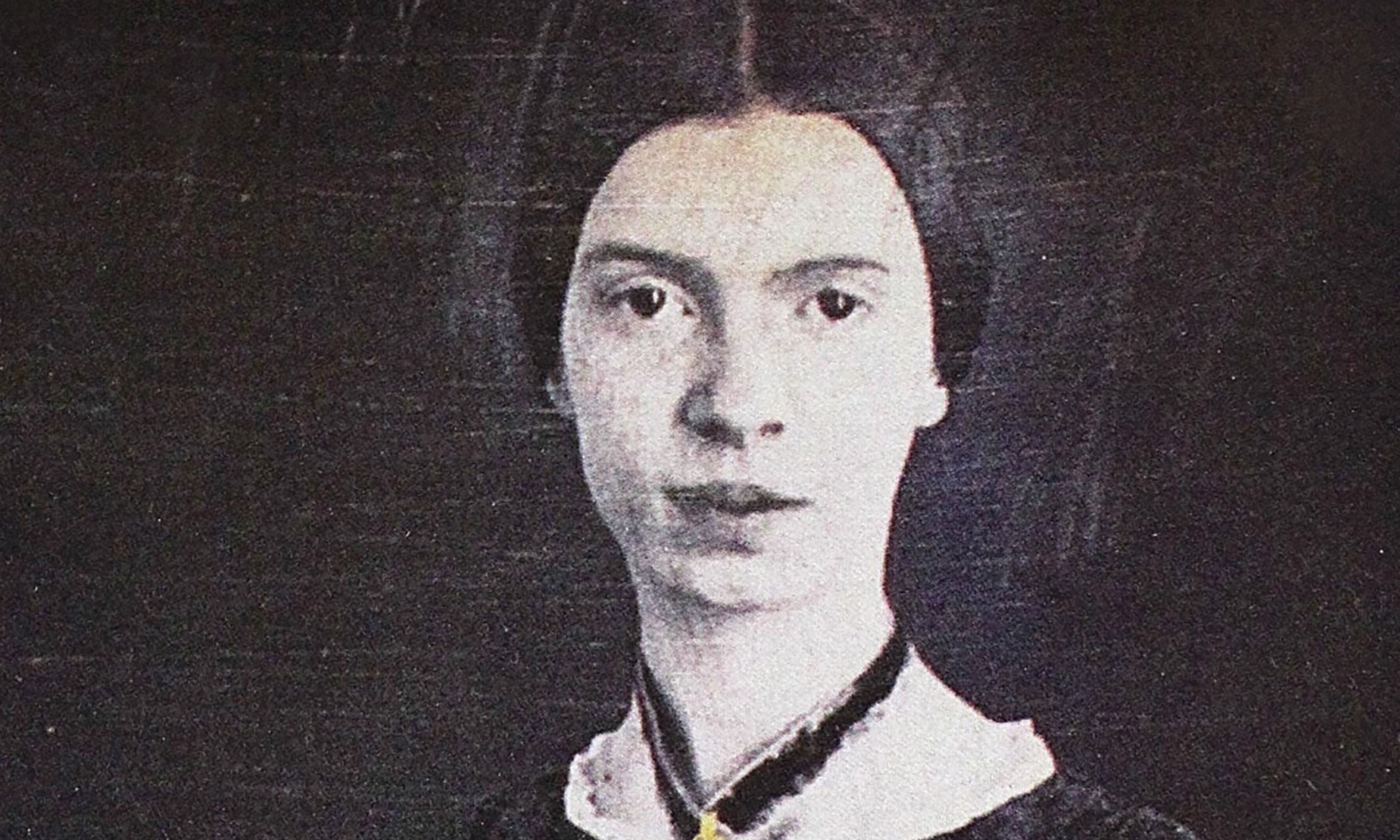
‘My mind to me a kingdom is,” wrote the 16th-century English poet Edward Dyer, whose lifetime encompassed the paradigm-changing era of New World exploration. Three centuries later, an obscure poet in Amherst, Mass., would write similarly of dwelling “in Possibility.” Like Dyer’s, Emily Dickinson’s mind to her a kingdom was: an unbounded place of observation and synthesis, a numinous space illuminated by mysteries of matter and spirit alike. Two recent books — The Letters of Emily Dickinson, edited by Cristanne Miller and Domhnall Mitchell, and Renée Bergland’s Natural Magic: Emily Dickinson, Charles Darwin, and the Dawn of Modern Science — open that kingdom anew to contemporary readers.
Miller and Mitchell’s The Letters of Emily Dickinson represents the first new collection of Dickinson’s correspondence since 1958. The previous edition, edited by Thomas H. Johnson and Theodora Ward, leaned heavily on the work of Mabel Loomis Todd, an Amherst neighbor and friend of the Dickinsons, as well as a writer and editor herself. In the 1890s, with the Atlantic Monthly writer Thomas Wentworth Higginson, Todd produced the first posthumous collections of Dickinson’s poetry. She also provided an invaluable service in collecting and transcribing the poet’s extant letters — no easy task, as Miller and Mitchell point out, given the custom at the time to destroy personal papers following a death.
Mabel Todd’s motives, however, were not entirely altruistic. Since 1882 she had been conducting a clandestine love affair with Austin Dickinson, the poet’s brother, who died in 1895. Understandably, she was estranged from Austin’s wife, Susan Gilbert Dickinson, Emily Dickinson’s friend and soulmate and the recipient of many “letter-poems,” poems sent as correspondence without any other text. When Lavinia, the youngest Dickinson sibling, gave her sister’s papers to Todd, Todd assiduously (some might say heavy-handedly) arranged and edited the poems. She also assiduously but heavy-handedly edited the letters. Among other alterations and omissions, she made obvious erasures, mostly of Susan Dickinson’s name, and frequently changed the pronoun she to he when Susan was the clear antecedent, all in an apparent effort to excise Austin’s wife from the narrative of Emily Dickinson’s life.
Meanwhile, other correspondence has come to light since 1958. In their introduction, Miller and Mitchell describe discoveries of Emily Dickinson’s letters framed as art on people’s walls, for example, and in one case even laminated. The compilation of this collection represents an impressive level of detective work and reconstruction. It’s also an illuminating contextualization of many poems originally sent as correspondence. What we might previously have read as freestanding poems we now see as part of a flow of conversation.
We may come away from these letters still feeling that we “know” Emily Dickinson only in fragments. But we also come away feeling that Theodora Ward, one of the editors of the previous edition, knew her even less. Conclusively, the Miller and Mitchell edition overturns Ward’s claim that Dickinson “did not live in history and held no view of it, past or current.” Miller and Mitchell’s Letters situates Dickinson, first, in her local community: her own household and family, including a web of cousins, as well as immediate neighbors and townspeople. Increasingly she would correspond with figures connected to a larger intellectual world: the novelist and Lincoln biographer Josiah Holland, with his wife, Elizabeth; journalist and publisher Samuel Bowles, with his wife, Mary; Thomas Wentworth Higginson, who became her literary mentor. Late in her life, she would also write unabashed love letters to Massachusetts supreme court justice Otis Lord, her father’s closest friend and, following his wife’s death, her own declared suitor from 1880 until his death in 1884.
In addition to locating Emily Dickinson in history — that she had a view of the Civil War, for example, is made clear — these letters place her in the great conversation of literary tradition. She alluded frequently to the Bible and to Shakespeare, but also to writers of her own day: Charles Dickens, George Eliot, Henry Wadsworth Longfellow, James Russell Lowell, and Robert and Elizabeth Barrett Browning. Dickinson’s prose moved effortlessly in and out of these other voices, as though by instinct she wrote as their equal. She moved instinctively, too, between prose and poetry. While some letters consist of or contain obvious poems, others include prose lines that could, with the smallest of tweaks, be cast as verse. “We read the words but knew them not. We are too frightened with sorrow,” she wrote to her friend Elizabeth Holland in October 1881, on the sudden death of Holland’s husband. “Our hearts have flown to you before — our breaking voices follow.” These characteristic lines, falling naturally into common meter, might easily have been the lines of an Emily Dickinson poem. In Dickinson’s mind, as so many letters illuminate, prose and poetry were not two separate languages but close dialects of the same mother tongue.
In this massive volume, every letter is potentially of interest and importance. Still, some particular motifs emerge. Ambivalence toward religion, for example, recurs as a major theme in the poet’s sphere of concern throughout her life. A series of letters to a girlhood friend, Abiah Root, highlights the young Dickinson’s struggle with the Christianity her immediate context offered, if not outright pressed upon her. In Amherst, the scene in 1845 of a major religious revival, but most notably during her time at Mount Holyoke Female Seminary, in 1847 and 1848, she experienced pressure to “join the church.”
She confessed her conflicted feelings to Abiah. In a brief time at Amherst Academy, the other girl had become a trusted friend, whose own easy faith Dickinson envied. “I wished that I had found the peace that has been given to you,” she wrote to her friend. Dickinson had briefly experienced that solace herself. “The few short moments in which I loved my Savior I would not exchange for a thousand worlds like this,” reads an 1846 letter to Abiah. The 16-year-old Emily continued, “It was then my greatest pleasure to commune alone with the great God. . . . But the world allured me & in an unguarded moment I listened to its syren voice.”
The crux for her seems, truly, to have been the way that Christianity and the material world — the beloved cosmos of sun, stars, and moon, plants, animals, and human beings — were presented as binaries. In writing of friends who had “joined the church,” Dickinson’s most reached-for phrasing was that these people had “renounced the world.” Such phrasing complicates the popular image of Dickinson as a white-clad rebel, who wrote smugly that “Some keep the Sabbath going to church — / I keep it, staying at Home.” What seems likelier is that the requisite renunciation, the absolute trade of concern for the material world, to care for an immaterial world of the soul, struck her as a stark impossibility. The church as she knew it offered not a “spacious place,” but a diminishment, a disintegration, and a disenchantment of reality.
It’s perhaps mere historical serendipity that Emily Dickinson lived at the same time as Charles Darwin, in a century whose spirit of scientific discovery was present even in Amherst. Her obscurity during her lifetime meant that Darwin could not possibly have known of her or read her poems. Her knowledge of him was of the same species as her knowledge of Elizabeth Barrett Browning and George Eliot — but if her letters are any indication, Darwin was a distant also-ran in conscious importance to her. In all her correspondence, Darwin merits only two mentions. Writing to Elizabeth Holland in 1871, Dickinson remarked in typically gnomic fashion, “Why the Thief ingredient accompanies all Sweetness Darwin does not tell us.” To Otis Lord in 1882 she wrote, “Mrs. D. Stearns called to know if we didn’t think it very shocking for Butler to ‘liken himself to the Redeemer,’ but we thought Darwin had thrown ‘the Redeemer’ away.” By the 1870s, the last decade of his life, Darwin’s reputation had expanded to the point that his name could be invoked in Amherst, Mass., as synonymous with an explanation of reality — and bandied as a joke.
Nevertheless, the literary scholar Renée Bergland, in Natural Magic, teases out significant strands connecting the poet of Amherst with the English naturalist, beyond the historical overlap of their lives. Darwin was born in 1809; in December 1831, when he set sail from Plymouth Harbor in the Beagle, Emily Dickinson was not quite two years old. She was nine when The Voyage of the Beagle first appeared in print, and well into adulthood before Darwin’s ideas became commonplaces of conversation in the circles in which she moved. She was 52, with four years left to live, when he died.
Much of Natural Magic is devoted to charting the developments of these parallel lives: family, education, the growth of what would become each figure’s great vocation. It’s fascinating to read of Dickinson’s enthusiasm for her studies in botany, astronomy, and other physical sciences, all considered the province of girls and amateurs. It’s equally fascinating to read of Darwin’s failures at school, under roughly the same educational model, which for boys provided no scope for interests in those disciplines that would so delight the young Emily Dickinson. A sense of both these people as, paradoxically, knit into and out of step with their shared era pervades and animates Bergland’s side-by-side study.
Yet, as Bergland argues, the real overlap between the two occurs not only in their shared century, but in their desire for integration and synthesis of the things of the material world, without sacrificing the sense that the physical universe remained a place of mystery and marvel. For both, the Christianity of their respective societies was a problem, in the way that it posited physical and spiritual truths as oppositions, not elements in union with each other. Darwin found that the story the earth told about itself was a different, stranger, and more miraculous narrative than either the church or the old tradition of natural philosophy had imagined. With anxiety he trod his way between his contemporaries’ attempts to bend this newly revealed narrative to fit the Christian one or else to declare him the antichrist. Like Dickinson, he sought to leave the doors of possibility open, a stance for which, as Bergland shows us, his mental and physical health suffered.
Dickinson, meanwhile, as Bergland asserts in her afterword, “built on” Emerson’s conception of the poet. Where Emerson viewed the natural world as a set of “signs” for transcendent ideals, Dickinson, seeing no separation between matter and the spiritual realities that haunted it, “thought that poetry should press things together.” To look at the things of the world as themselves, not as signs or figures for something else, was to marvel at their mystery. Bergland writes: “Prevailing cultural assumptions had made it hard for late nineteenth-century thinkers to recognize that Darwin responded to the natural world with emotions of wonder that recalled older conceptions of natural magic. These assumptions also made readers blind to Dickinson’s scientific acuity.” As, continually, on both sides of the Atlantic, the languages of science and mainstream religion seemed to atrophy in their capacity to account for each other, both Darwin and Dickinson sought, intuitively, to transcend those conventional paradigms, to apprehend a larger unity: things seen and unseen, empirically proven and marvelously unexplained.
Setting Dickinson beside Darwin amplifies our sense of these two thinkers and the capaciousness of vision that they shared. It amplifies, particularly, Dickinson’s connectedness to the intellectual concerns and conversations of her era. Setting Bergland’s Natural Magic beside Miller and Mitchell’s new edition of Dickinson’s letters grants us, as well, an expanded view of a great poet, admitting us as never before to the kingdom of possibility that was her mind.












Comments