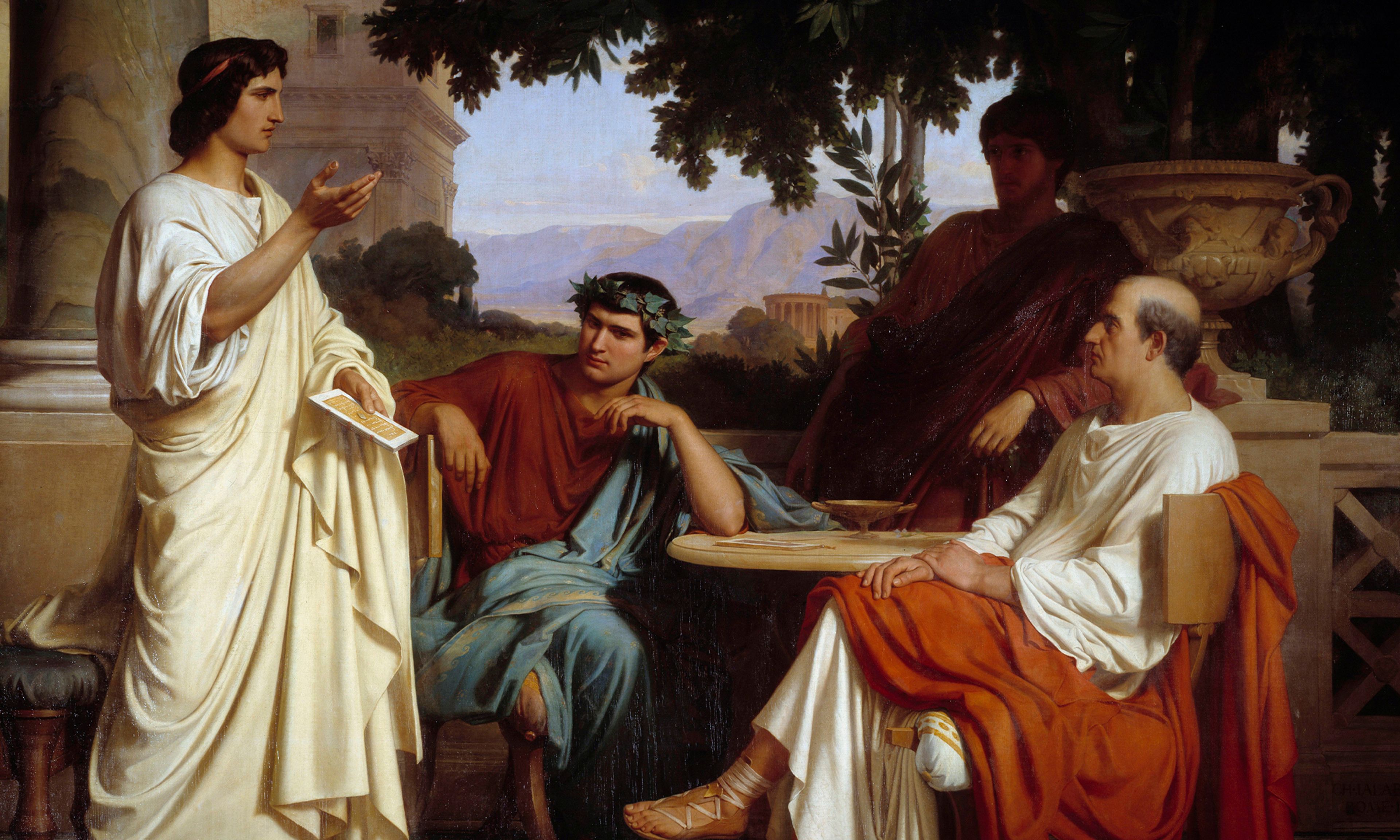
The poet Horace, born Quintus Horatius Flaccus in 65 b.c.e., was the W. H. Auden of his day. Like Auden, Horace eschewed both sentimentality and grandiosity, and feared pretentiousness. Like Auden again, he was often profound but rarely obscure. Horace would have approved Auden’s denigration of the most memorable line he, Auden, ever wrote: “We must love one another or die,” which concludes his poem “September 1, 1939,” and which Auden later changed to read “We must love one another and die” (italics mine). Even though Horace is far from being a dark poet, the fact, the overriding datum of death is at the center of his poetry. We must try to live well, he contends in several of his poems, because the only certainty in life is that we all shall die.
Birth and status were central in Rome, both in the republic and under the empire. Here Horace drew a complicated card. He was born in or near the town of Venusia in southeast Italy to a father who was a former slave become a freedman. His father sold fish and meats and worked as an auctioneer of the property lost by proscription during the last days of the Roman Republic. He expended ample money on his son’s education, first in Rome and then in Athens, the graduate school of antiquity. In 42 b.c.e., Horace joined the forces of Brutus after the assassination of Julius Caesar, forces that went down to defeat at the Battle of Philippi at the hands of Mark Antony and young Octavian Caesar. Never strongly political, Horace nonetheless sided with the assassins over Julius Caesar. Owing to the clemency of Octavian, soon to become Augustus, the first emperor of Rome, Horace was saved from a brutal death. He was 24 at the Battle of Philippi.










Comments