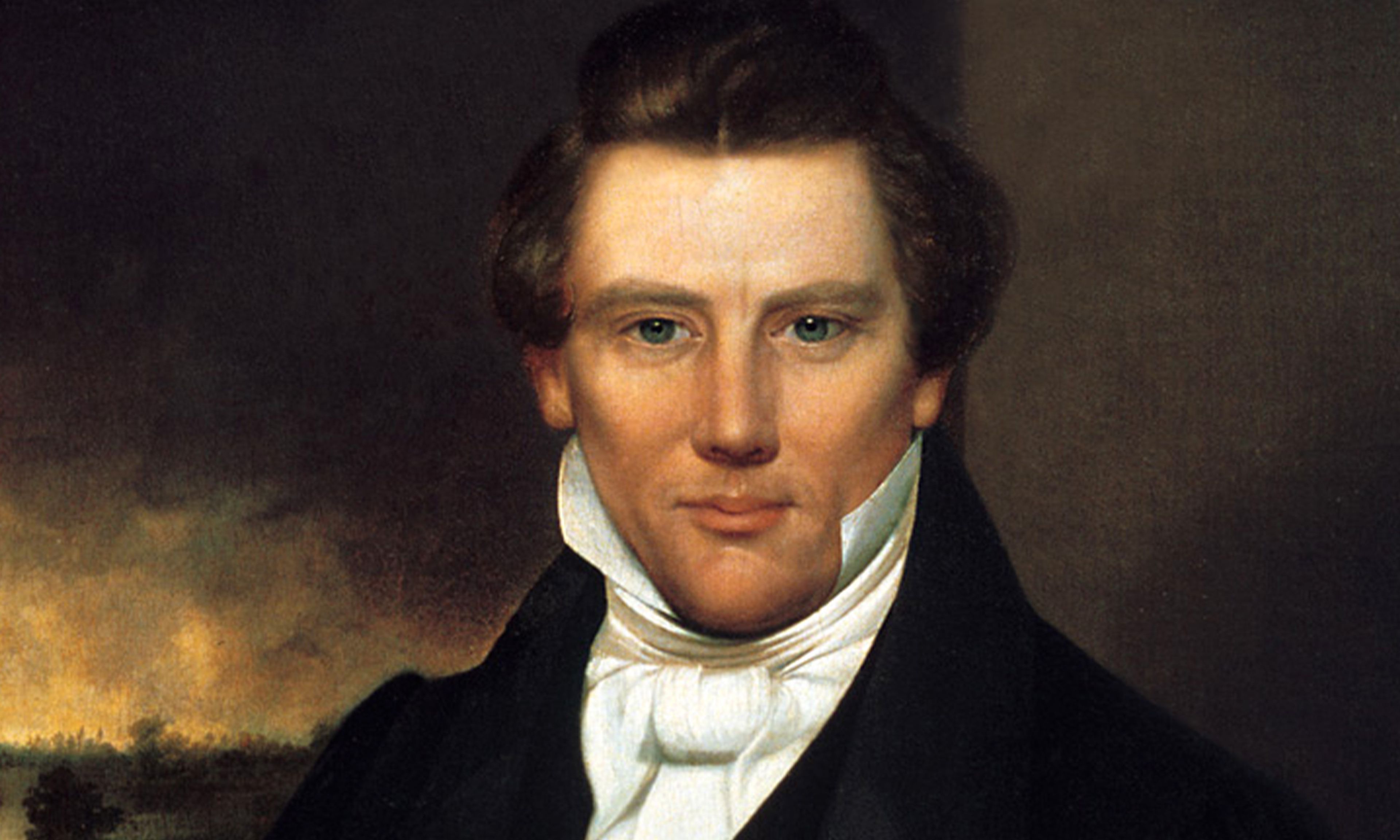
Born in 1805 to a hardscrabble Vermont family and raised amid the fervor of the Second Great Awakening, Joseph Smith claimed at age 14 to have seen God the Father and Jesus Christ in a grove of trees. He later reported angelic visitations that led him to golden plates buried on a hillside, from which he transcribed, and in 1830 published, the Book of Mormon — a new scripture proclaiming further revelation of Jesus Christ, a revised plan of salvation, and a divine record of ancient Americans. From his mid-twenties to early thirties, Smith led a rapidly growing religious movement, established cities, built temples, and founded a theocratic kingdom on the Mississippi frontier called Nauvoo. In addition to his religious exploits, he launched a bank that collapsed spectacularly and, after enduring violent persecution, organized a private militia to protect his followers. At the height of his power, he served simultaneously as Nauvoo’s mayor, chief justice, and postmaster, all while presiding over the Church of Jesus Christ of Latter-day Saints. In 1844, he even mounted a quixotic third-party campaign for the U.S. presidency. Perhaps most famously, or infamously, he married over 30 women (including some already married), claiming a divine mandate to restore the practice of plural marriage in the tradition of the biblical patriarchs. By the end of his life, he was hailed as a prophet and denounced as a fraud. He was killed by a mob while awaiting trial in Carthage, Ill., on June 27, 1844, at just 38 years old.
Since his death, few Americans have attracted as much sustained fascination. The continued growth of Mormonism testifies to not only his legacy but the enduring significance of Joseph Smith’s life and works. But assessing Smith has always posed a formidable challenge for historians, both within the church he founded and beyond it. Sources are as abundant as they are fraught, often shaped by Smith’s elusive and theatrical persona and colored by the distortions of devoted believers as well as hostile critics. His detractors often wrote with polemical venom, while the institutional Mormon Church was, for much of its history, reluctant to grant access to key documents. Given the nature and variety of these sources, disentangling history from hagiography, slander, and even outright fabrication (such as the infamous “salamander letter,” a 1980s hoax that recast his earliest divine encounter as involving a magical white salamander instead of Jesus) has inevitably produced a wide range of interpretations. Over the years, Smith has been portrayed as a self-invented prophet, a pious fraud, a cunning deceiver, a sincere visionary, and a religious genius.











Comments