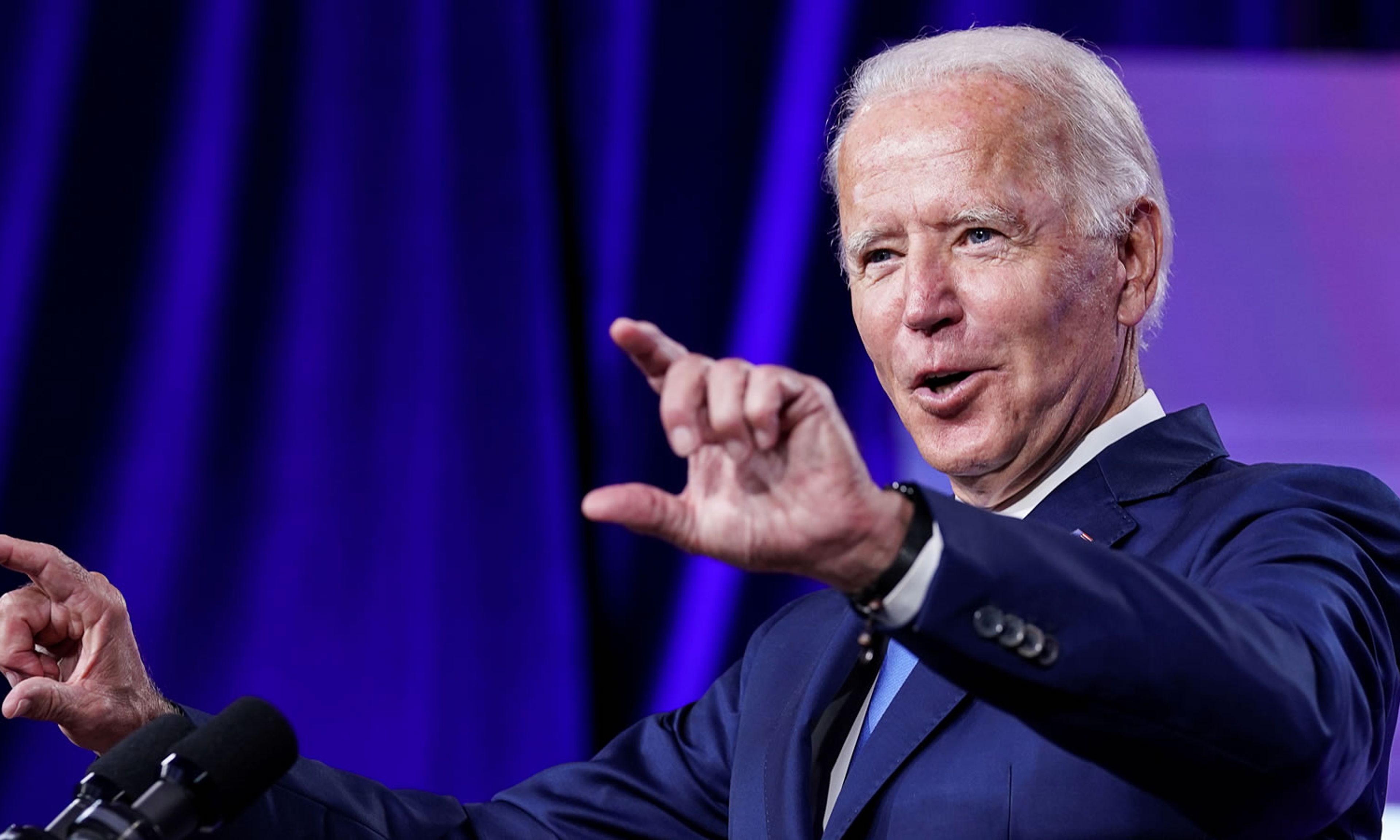
Democrats dodged several bullets when they nominated Joe Biden instead of Bernie Sanders. One of the deadliest was Medicare for All, the health-care plan that Sanders championed. Biden’s health-care ideas sound much more attractive — at least before the election. If he wins and tries to move them through Congress, however, the Democrats may find that those ideas are more troublesome than they initially believed.
Health care has been voters’ most pressing concern for most of President Trump’s time in office, and opposition to Republican attempts to reduce benefits was widely seen as a key reason Democrats took control of the House of Representatives in the 2018 midterms. Sanders’s strong showing in the 2016 Democratic presidential primaries, and in the early 2020 primaries, made advocates of Medicare for All think their time was at hand. At various points in the contest, other top-tier Democratic candidates — Pete Buttigieg, Kamala Harris, and Elizabeth Warren — endorsed the idea of a “single payer” for all Americans’ health care.
Two issues dashed the advocates’ hopes: cost and disruption. Enrolling everyone in a federal health-insurance program would require a massive increase in federal spending. Sanders was willing to say that middle-class taxes would go up, although lower out-of-pocket spending on health care would supposedly produce net savings. But even he couldn’t specify enough tax increases to pay for his plan, and the other Democrats refused to acknowledge that the middle class would pay higher taxes at all.
Medicare for All also entailed outlawing the private health-insurance plans that cover most Americans, including plans that unions have painstakingly negotiated. Polls always find that most Americans are satisfied with their health insurance and fear of Washington-imposed disruption to existing health arrangements has repeatedly harmed both Democrats and Republicans when they have pushed for big changes.
It was this feature of the plan that led Biden, and eventually Buttigieg, to oppose it. They defended an alternative that Buttigieg, who became its most articulate spokesman, called “Medicare for All Who Want It.” Nobody would be required, but everyone would be allowed, to get their insurance from the federal government. President Obama proposed a similar idea, then called the “public option,” in the original version of the Affordable Care Act, except that it would have been open only to those who had no access to coverage from their employers. It didn’t survive opposition from moderate Democrats.
An enlarged version of the most left-wing feature of Obama’s proposal came to look moderate itself when Medicare for All dominated the discussion. Buttigieg’s sales pitch was that his plan would yield all the gains of Medicare for All without the coercion, and thus with much less controversy. He was confident enough in this plan, he said, that he was willing to have it compete with private insurance.
The public option consistently outpolls single payer among both Democrats and the public at large. It might not be quite so popular in practice. Like Medicare for All, if on a smaller scale, it would increase federal spending and disrupt private health insurance. But those drawbacks are for now better disguised, and their extent will not be clear until the details of a proposal are filled in.
Biden is proposing multiple pathways to expand health coverage. There’s his public option. Obamacare encouraged states to expand Medicaid, the health program for people with low incomes. Anyone who doesn’t have Medicaid coverage because he lives in a state that didn’t expand the program would have premium-free access to the public option. Biden would also allow people aged 60 to 64 to enroll in Medicare. And he would also increase subsidies for Obamacare’s insurance exchanges.
Biden’s campaign says that all of this coverage expansion will be accompanied by cost control. The public option will save money the same way Medicare supposedly does, by “negotiating” with doctors and hospitals. What Medicare actually does is set low rates. Medical providers make up for them by charging private insurance more. So there are two related questions for the public option: How well will it pay providers, and how much freedom will they have to decide whether to participate? For example, will the law stipulate that any doctor who takes Medicare patients has to take public-option patients, too?
If the public option pays stingily and providers don’t have to participate, costs will be low, but so will enrollment. There’s no point in paying for a plan that doesn’t let you see doctors. Expanding coverage while keeping costs under control will be possible only if doctors and hospitals accept lower incomes. Even then, the long-term effect might be a smaller supply of medical services. But how likely is it that doctors and hospitals will put up with being forced into a low-paying plan to begin with?
The fate of legislation to eliminate “surprise billing” suggests the answer is: not very. Surprise billing — in which people get stuck with medical bills, sometimes large ones, that their insurance doesn’t cover — is unpopular, is hard to defend, and implicates only a subset of medical providers. The provider lobbies have nonetheless been able to block any action on it in Congress, in part by running ads that portray any cost controls as attacks on patients’ access to care. They have also pushed legislation that purports to solve the problem by paying providers even more. Many congressmen have backed that legislation. Some of them are also co-sponsors of Medicare for All.
Congress, in short, has no appetite for cutting funds to doctors and hospitals. Neither do any of the proponents of a public option. It’s not as though Biden or Buttigieg has ever gone out of his way to explain that rosy cost projections depend on cutting payment rates to health-care providers.
Lowering the age of eligibility for Medicare would run into a similar problem. People who are just below that age are a major source of revenue for the health-care industry. And most of those people are already insured, which means that the federal government would not generate much increased coverage in return for all the spending it would have to do.
But if these plans somehow worked — if they really did produce high-quality, low-cost options by squeezing providers — they would be enormously disruptive. As people left private coverage for the public option, prices could well rise for those remaining. Some lines of coverage could disappear because they would no longer be profitable. When the Center for American Progress, a progressive think tank, got Avalere Health to model a proposal for a strong public option, the consultants found that 18 million people would choose to drop their employer-provided coverage. They also found that another 14 million people would join the new program because their employers had stopped offering coverage.
The Biden plan also punches a third hole in employer-provided coverage. Biden says that, in addition to creating a public option and lowering the eligibility age for Medicare, he wants to offer new subsidies for people with employer coverage to buy individual policies on Obamacare’s exchanges. That idea could be even more damaging to employer coverage, since it could enable people with lower health risks to defect from their employer plans to get lower premiums. If that happened, the sicker population in employer plans would have to pay higher premiums or see the quality of their coverage degrade.
Would a President Biden really want to spend much of his first year in Congress in this briar patch? He had a ringside seat to the years of political damage that enacting Obamacare inflicted on his party. Some of the congressional Democrats of that era who are still around may not be eager to relive their experiences. When Speaker of the House Nancy Pelosi released a set of health-care proposals for the tenth anniversary of Obamacare, a public option wasn’t on the list.
When President Trump found himself unable to get an Obamacare replacement through Congress, he took more modest legislative wins (such as the abolition of fines on the uninsured), added some regulatory changes of his own, and declared victory. The more the implications of progressive health-care policies come to the fore, the more tempting a similar strategy might look to a Biden White House.
It may already be tempting the candidate and his advisers. In his convention speech, his program on health care was reduced to “building on the Affordable Care Act [that Trump’s] trying to rip away.” It is certainly possible to describe a public option and an expansion of Medicare as building on Obamacare. But he may have had a reason for vagueness. If he’s elected, watch this blank space.








Comments