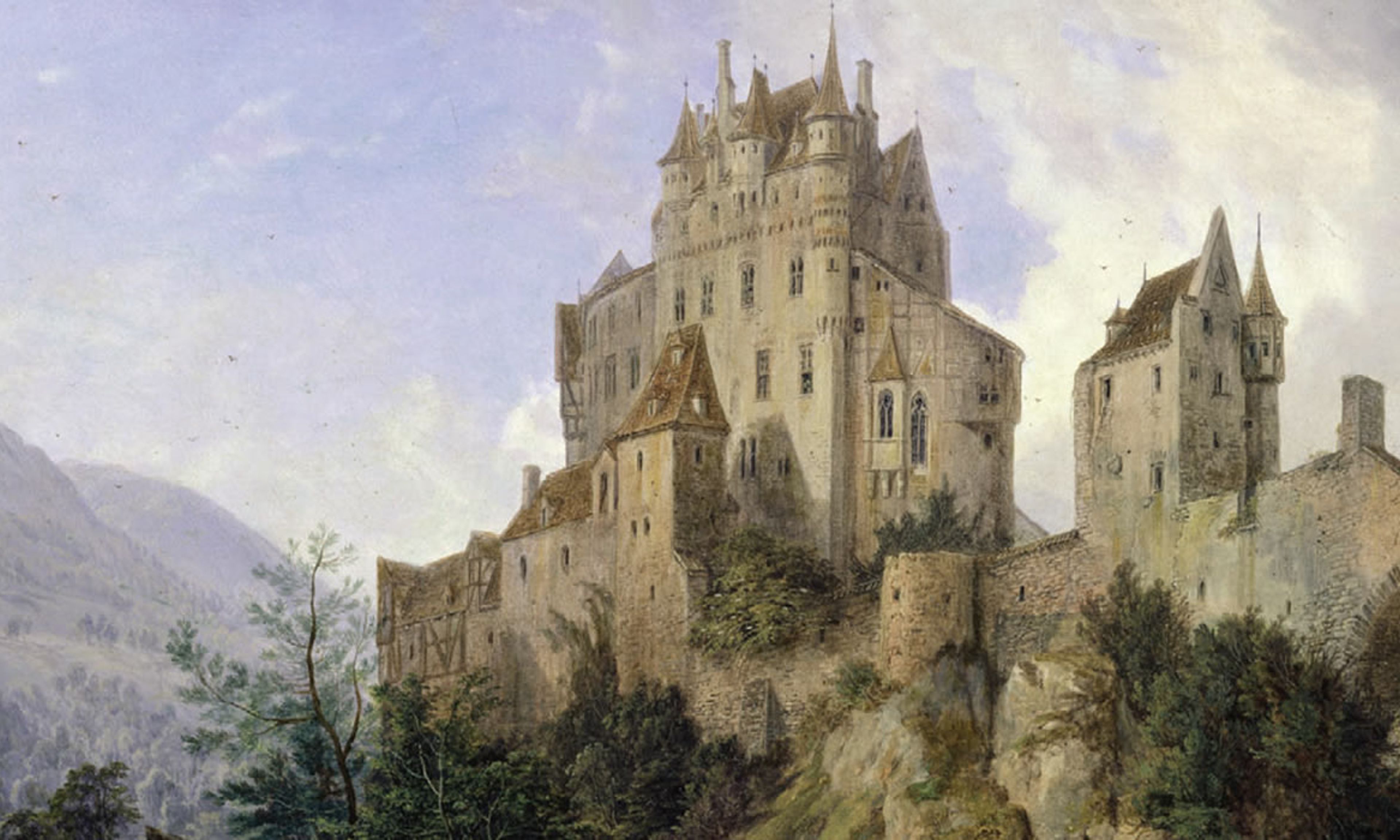
Relations between the aristocrat and the common man have never been easy. The antipathy between castle people, who dwell in the manor house, and agora people, children of the marketplace, runs like a fault line through the moral landscape of the West. The chasm is already evident in the Iliad, in the thrashing Odysseus gives Thersites; Proust, in the 20th century, was as conscious of the gulf when he insisted that the “misunderstanding” between the upper castes and their bourgeois inferiors was “complete.”
The marketplace came out on top. Democracy vanquished feudalism. Or so we like to pretend: There are suburbs of New York and Philadelphia in which you might, with only a slight exertion of imagination, fancy yourself in the world of the medieval dukes. The persistence of castle culture is one of the curiosities of the country’s social archaeology, another of the cultural contradictions of capitalism, if not of democracy itself. The Gilded Age robber barons, living in fear of the industrialized masses, built neo-Romanesque castles like the Hay-Adams houses (since demolished) on Washington’s Lafayette Square. The thicker the masonry, the more likely the fortress would withstand the anticipated Jacquerie. Later, a more confident generation of castle people found inspiration in the vanilla-ice-cream neoclassicism of Cass Gilbert and John Russell Pope. The 1980s brought the first prefabricated McMansions.
Just now a fresh breed of castle builders is spawning, ready to replace the fallen castellans who earned their turrets on Wall Street and built their McCastles during the credit bubble, but whose ideal of the financier-sage has, in the light of the Crash, come to seem dubious. Robert Rubin and Hank Paulson, dragon-slayers of this now-defunct castle romance, are giving way to a different species of aristocrat, the administrative “czars” who are rising to power in Washington and London.
The newly ascendant castle people are closer in their politics to the New Deal mandarins of the 1930s than they are to the financial wizards of the last two decades. But however egalitarian their rhetoric, the new castle people, like their predecessors, will almost certainly conform to the proprieties of castledom. They will set themselves up in gaudy châteaux in prosperous suburbs, will send their children to private schools done up in revived Gothic, and will not probably refuse invitations to appear in America’s stud book, the Social Register. President Obama sends his daughters to Sidwell Friends, the most exclusive school in the capital, while Michelle Obama, who was rumored to look coldly on Britain on account of the Empire, has become a pal of Queen Elizabeth. Not far from the Palace, a host of Labour MPs, who in theory carry on the tradition of Jack Cade and Wat Tyler, have fudged their expense accounts in pursuit of chauffeur-driven cars, Farrow & Ball wallpaper, and insurance for antiques.
That those who rhetorically oppose the privileges of the castle should covet its little vanities is on the whole good. Such hypocrisy preserves the equilibrium of society. It is not pleasant to see empty beer cans lying on the roadside, but the prospect brightens when you find that many of them today are brands of light beer. The good old boy, unashamed to toss his empties out of the pick-up, frets over his beer belly, with its low-caste bulge. He covertly aspires to the slenderness of the underfed, tofu-chewing upper crust. By a similar paradox the most hardened progressive will join a fancy club, sail his yacht in regattas, and even flirt with polo, as Ted Kennedy did before old Joe shook his head. Humble or great, each of us cherishes his little theory of distinction. The stability of society depends on this weakness in our natures — on people who, however populist their sentiments, have a little place in their souls where Jay Gatsby spits in the democratic well from which he drinks.
For a complete overthrow of the aristocratic element in society would be a catastrophe. The castle was born in crude strength, and was at first merely an instrument of power, and perhaps a kind of wooing plumage. But over time it became a civilizing force. Castle people, at their best, smooth the rough edges of life. They refine its pleasures. The threshold problem of existence, Evelyn Waugh observed, is not wealth, or health, or even death, but boredom. Waugh’s portrait of Hooper, the uncultured plebeian in Brideshead Revisited, is unfair. Yet just about everyone who reads the book sympathizes, not with Hooper the everyman, but with the Flyte-Marchmains, the aristocratic exceptions, the sensuous vanquishers of drabness. In vain did Edmund Wilson argue that “Waugh’s snobbery, hitherto held in check by his satirical point of view, has here emerged shameless and rampant.” Hooper is a bore. The Marchmains are fun. They have behind them centuries of practice in the art of killing time tastefully, an art no civilization can do without.
The problem is not that castle culture thrives in a democratic soil, but that it thrives too abundantly. Its growth, Dickens showed, has come at the expense of another, no less valuable plant. Dickens was struck by the way common folk in his day, whose heritage was the village and the market square, so often set up, in suburban plots, as squires and knights errant. In Great Expectations, he depicts Wemmick, a clerk, getting up his cottage as a castle, complete with turret, drawbridge, and Gothic windows. This castle culture, Dickens makes clear, was very different from that of the village in which Pip, the book’s hero, grows up, with its civic and communal atmosphere. But communities like Pip’s, Dickens saw, were fast disappearing. Where the communal cords have snapped, where the market square has become a strange and bewildering place, where one no longer knows, or trusts, one’s neighbor, one will prefer, as Wemmick does, the security of the suburban keep. And not merely its physical security: In the vast, impersonal metropolis, the exclusive house, the exclusive school, the exclusive club offer spiritual security, a means of distinguishing oneself from the crowd.
What was in danger of being lost, Dickens believed, was the common culture of the market square, the agora that goes back to the Greeks. If the castle has from time out of mind been the seat of aristocratic culture, the marketplace was once the crucible of a no less vital culture of the common man. The standard was pretty high: If the aristocrats had the heroic poetry of their epic bards, the agora people had their tragic poets, whose dramas were initially staged in the Athenian agora, and more recently in Shakespeare’s Globe in Southwark. The Greek marketplace that inspired the Oresteia was succeeded by a Gothic one that midwifed Chartres and The Divine Comedy; this medieval marketplace, in turn, gave way to a Renaissance one, the agora-piazza of Michelangelo and Leonardo.
Theognis said of the common people, “They have no tradition.” He was wrong. They have the agora. Unlike castle culture, agora culture is inclusive. No one is turned away. The Athenians called the late morning and noontide the time of the “full agora” (agora plethousa), a time when citizens are “in good agora form.” The expression comes from the Greek verb agorazein, a word “not to be translated by one word of any other language,” the historian Jacob Burckhardt wrote. “Dictionaries give to traffic in the market place, to buy, to talk, to deliberate, etc., but cannot reproduce the combination of business and conversation mingled with delightful loafing and standing around together” that the Greek word conveys. In the Gothic marketplace, Erwin Panofsky said, “the priest and the layman, the poet and the lawyer, the scholar and the artisan could get together on terms of near-equality.” In the Renaissance piazza, Walter Pater wrote, artists, philosophers, and men of action “do not live in isolation, but breathe a common air, and catch light and heat from each other’s thoughts.”
Much of what is democratic in the culture of the West is closely connected to the life of these civic focal points. Go to the Place de la Maison Carrée in Nîmes, or the Piazza del Campo in Siena, or the Place de la Comédie in Montpellier, or any of a thousand lesser forums, and you find, in the buildings, the statues, the paintings, a sort of civic jewel box. And this plastic art is but the remnant of a more comprehensive artistry: It is a skeleton that, in its prime, was clothed by music and poetry. The rhythms and harmonies of the plastic art of the marketplace were reinforced by those of the choral hymnody and dramatic verse, the folk ballads and folk dances, which once brought the civic space to life (and still do, in out-of-the-way places like Dalmatia and eastern Crete).
No civilization, even the most bovine, can entirely do without this cathartic machinery. Aristotle credited the poetry of the agora with forming the character of citizens and easing the psychic burdens of common life. Modern scientists have only now begun to catch up with him. They speculate that music and gossip, the lifeblood of the marketplace, meet a human need. Anthropologist Robin Dunbar supposes that music, language, and gossip evolved as “vocal grooming” tools in early hominid groups which had grown too large to rely on touchy-feely grooming techniques to promote cohesion. If Dunbar is right, Virgil and Theocritus were on to something when they made their shepherds use poetry as a grooming tool and music as a means of keeping their flocks together. Plato applied the same pastoral insight to the grooming of citizens. If the herdsman is “the master of the music best suited to his herd,” so the agora culture of the polis perfected the music best suited to the human flock that constitutes the community.
The civic focal point, the central institution of marketplace culture, has for some time been dying, dying even as the democratic man its culture nurtured has gained his victories over aristocracy. The poetry that brought coherence to the market square, a poetry that had its place both in the market square’s grammar school and in its dramatic and liturgical art, no longer animates the West’s public spaces. A rapid growth in population and a vast expansion of commerce overwhelmed the old centers. At the same time the rise of the nation-state and its metropolitan elites made the provincial agoras seem, well, provincial. The provinces, Tocqueville wrote, “had come under the thrall of the metropolis, which attracted to itself all that was most vital in the nation.” The traditional patrons of agora culture, the merchant princes who were once proud of their market squares, abandoned them to ape the gentry. The man of business found it infra dig to live near his shop; he built himself a mansion in a fashionable aristocratic district. New technology further diminished the appeal of the old forums as people turned to radio, cinema, and television for amusement.
Even so, the civic focal point might have survived if people had cared about it. But the rationale was forgotten. During the last few centuries the traditional artistry of the marketplace has come to seem merely quaint and even irrational. Modern planners who studied the old market squares failed to see, beneath a surface of heterogeneous activity, the unity of a civic whole. They sneered at a space in which people ate and drank, shopped and prayed, worked and played together in the shadow of a unifying art; such a forum was not, for them, an instance of coherent poetic form but (in the words of Lewis Mumford) “an amateurish combination of simple undifferentiated space and functions.”
The novelists who composed the agora’s epitaph saw that something more than a method of organizing civic space was being lost. So too was an art of forming civic character. Monseigneur Myriel in Hugo’s Les Misérables, Alyosha in Dostoevsky’s The Brothers Karamazov, and Josiah Crawley in Trollope’s The Last Chronicle of Barset are the successors of the good shepherds who figure in the agora art of Sophocles and Euripides. These pastoral characters, kindly and sensible, ministered to young people, as Alyosha ministers to Ilyusha in Dostoevsky’s book, and they helped strayed souls, as Monseigneur Myriel helps Jean Valjean in Hugo’s novel.
But already in the 19th century the pastoral sages began to seem archaic. So did the grooming tools thy used. Liturgies were revised and degraded; the poetic initiation rites of the grammar school were abolished. The guardians of civic life looked to the social sciences to make up for the loss of this pastoral tuition. When Disraeli, Bismarck, and Roosevelt established their social-welfare regimes, their lieutenants drew on the new social techniques to minister to their post-agora charges, much as their successors would draw on the planning ideals of Le Corbusier. Whatever the virtues of these methods, they were easily abused. In The Human Condition, her 1958 defense of agora culture, Hannah Arendt argued that, as a result of the replacement of agora methods by those of sociologists, psychologists, and planners, man’s civic capacities were being diminished. The new “behavioral sciences,” Arendt concluded, were subtly authoritarian, and if unchecked would eventually “reduce man as a whole, in all his activities, to the level of a conditioned and behaving animal.” In socializing away man’s “anti-social” tendencies, the masters of the new social mystique nurtured, not independent citizens, but passive conformists who would more easily acquiesce in the social-planning mandate.
Like Arendt, another New York intellectual, Lionel Trilling, believed that the post-agora faith in social progress concealed a desire for control. In his 1947 novel The Middle of the Journey, Trilling makes Gifford Maxim, a character modeled on Whittaker Chambers, unmask the “hope of power” that drove the post-agora prophets of “society and social justice and sociology” to promulgate a new code of castle prerogatives, a bureaucratic ethos that, like the old feudal one, had its coercive sting. The more we talk of welfare, Maxim argues, the crueler we become. Even where modern administrative elites have not (like the socialists of Russia and Germany) used cruelty to manipulate behavior, their programs have perpetuated what Trilling called a “facile sociological” point of view that undermines the higher forms of human flourishing. As the agora shepherd gives way to the post-agora guidance counselor, as the civic focal point ceases to transmit culture, the cruder democratic personality Waugh associated with Hooper comes to the fore.
It is precisely when the marketplace ceases to groom citizens that the castle becomes a threat. For there is then very little to prevent the castle people, whether seigneurial or bureaucratic, from having their way. Kafka’s The Castle is among other things a meditation on how a renovated castle culture, with all the resources of modern bureaucracy at the disposal of its “Control Authorities,” humbles the common people of the village. The villagers come to worship the castle people much as the landlady in Kafka’s book adores the castle functionary Klamm, or as the Brangwen women in Lawrence’s The Rainbow adore the squire’s lady at Shelly Hall.
Ronald Reagan and Margaret Thatcher restored the marketplace as an economic ideal. They did not revive its historic culture. Liberals have done no better. Though he exalts community, the liberal is skeptical of the agora; he is suspicious of association that lessens the individual’s reliance on the state. In his 1953 book The Quest for Community, Robert Nisbet showed how “intermediate associations” such as families, neighborhoods, and places of worship — prime constituents of agora culture — have been gradually undermined by progressive statism and the intrusive regulatory machinery of ever nosier elites. No less crippling are the liberal’s artistic inclinations. Being a child of Rousseau, the liberal believes, deep down, that progress can be made only after the old artistic forms — the corrupt and archaic poetries of the past — are overthrown. He wants to make a community from moral and aesthetic scratch.
Can conservatives do better? The only hope of regeneration, it seems to me, lies in experiments in civic artistry undertaken by philanthropists eager to refurbish the culture of the marketplace. One thinks of Poundbury, the little city, rich in civic focal points, that the Prince of Wales commissioned the architect Léon Krier to build in Dorset. Poundbury has attracted a good deal of attention, and it and the model towns of such “new urbanist” architects as Andrés Duany and Elizabeth Plater-Zyberk might conceivably inspire a broader civic movement, much as Thoreau’s experiment at Walden Pond inspired the environmental movement. Most people today recognize the importance of conserving natural resources, though naturally they differ concerning the means. A time may come when people will insist as passionately on the necessity of conserving cultural resources.
But people must first be persuaded that the agora can give them satisfactions they now associate with the castle. At present the castle is the only instance of a higher manner, a more generous standard of cultivation, conveniently to hand. From the fake Gothic parapets of Princeton to the fake castellated towers of Yale, from the prep school to the summer resort, castle spirit monopolizes much of what is attractive in the culture. It has become the main source, not merely of tone and breeding, but of that urbanity that comes with large perspectives and knowledge of the world. Liberal-arts colleges come to resemble finishing schools, imparting just enough of the old aristocratic culture to make their charges clubbable. Even if you yourself have no interest in the character-molding conventions of the castle, you wonder whether they will not smooth a path for your children. And however much you admire the democracy of the agora, you find it not easy to refute Waugh’s argument that, if you want to escape the inanities of popular culture, you must forsake the vin ordinaire and drink claret with castle people.
Flaubert’s diagnosis of the problem is as cogent as ever. His homage, in Salammbô, to the agora culture of Carthage, with its domes, its obelisks, its voluptuous mysticisms, is overdrawn, but for all that, the city is alive in a way that Yonville-l’Abbaye, the marketplace in Madame Bovary, is not. We succumb to castle fever, Flaubert suggests, in part because the alternative agora tradition is dead, and we cannot bring ourselves to believe that it ever lived. “Civic” is for us a synonym for “dull.” What Milton called the “mirth, high cheer, and wine” of life seems to us to be concentrated in the castle. Emma Bovary dreams of Scottish lords and Parisian duchesses. She falls in love with a landowner whose hair curls like Lord Byron’s. Yet Emma is not a fool. “Madame Bovary,” Flaubert said, “c’est moi.” Both he and his most famous character would have fared better, he implied, had there been in their time another path to culture and pleasure.
It is just possible that experiments in the Poundbury line will convince people that a renovated agora can be the other path. Such experiments would, to be sure, have to go beyond Poundbury in recreating, not merely a style of civic design, but the pastoral grooming culture Aristotle thought essential to civic life. Conservatives ought in principle to be sympathetic to such a quest. There is in the autonomous character, commercial vibrancy, and Burkean artistry of the traditional marketplace a good deal to attract them.
To infuse new life into the agora, conservatives will need to enlist the energies of people they long ago stopped talking to, but who will be necessary to any effort to revive the poetic-grooming side of the market square. There is a certain kind of person who, like Jude Fawley in Hardy’s Jude the Obscure, fulfills his nature in the adornment of a community. When the civic focal point thrived, these artists had a place in the community and a means of getting bread. They carved the stone, frescoed the walls, painted the ceilings, gilded the domes, composed the masques and harlequinades. But the agora in which they might once have become absorbed is gone. They are today rebels without a cause, misfits who dine off grant money and alienation from the marketplace, and create art that is generally faithful to the solipsistic bleakness of their situation. A conservative philosophy of civic renewal could give them the transfiguring work they need.
Successful civic movements begin, not in the social tinkering of castle people, but in the mobilization of creative personality. Athens, Venice, and Florence exist because the requisite passions were there mobilized in the refinement of the civic focal point. The result was a thriving marketplace, a common agora culture that was neither stupid nor dull, just the kind conservatives should favor today.











Comments