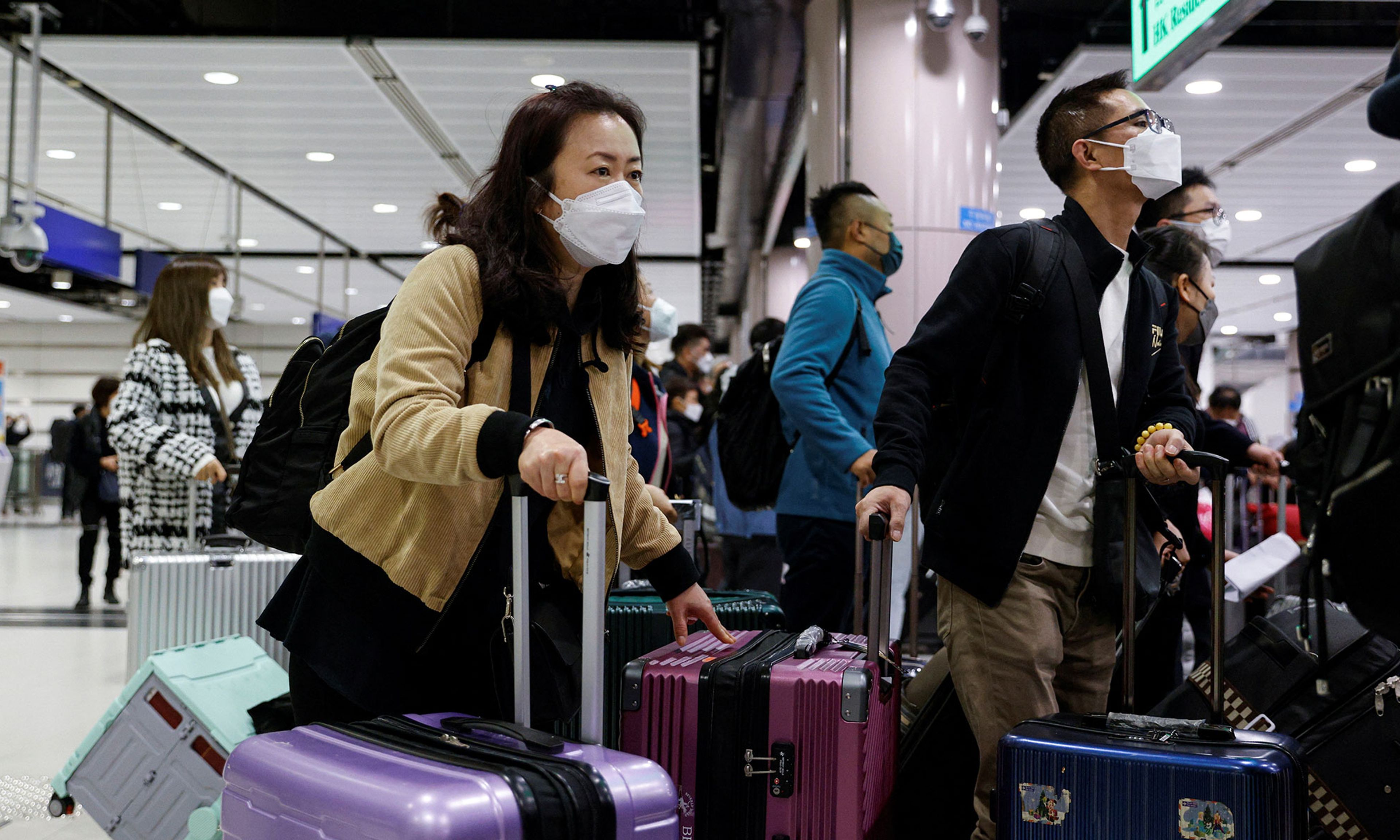
On Saturday, mainland China opened its borders with Hong Kong and ended its quarantine requirement for visitors after multiple years of Covid-19 travel restrictions.
Many people headed to Hong Kong’s Lok Ma Chau station on Sunday to cross over to mainland China, where they would greet loved ones and friends after a long travel pause during the pandemic, Reuters reported. The semi-autonomous region’s land and sea checkpoints with China were mostly not in operation for the last three years.
Saturday marked the beginning of “chun yun”, a period of travel in China with extremely high traffic load around the time of the Chinese New Year. Now that Covid-19 migration rules have been relaxed, twice as many people — about 2 billion — are expected to travel this year compared to last, a government spokesperson said said.
The one requirement remaining for Hong Kong residents inbound to China is to present a negative Covid-19 test taken within the last 48 hours. China also sees quotas for the number of people permitted to visit from Hong Kong, allowing people to make online bookings in advance.
Hong Kong hopes the reopening will kickstart a tourism revival for the city, although both sides are struggling with spiking Covid-19 cases currently, Reuters noted.
At a press briefing at Lok Ma Chau station Sunday, Hong Kong’s Chief Executive John Lee said Hong Kong and China would collaborate on increasing the number of access points connecting the two areas.
“The goal is to get back as quickly as possible to the pre-epidemic normal life,” Lee said. “We want to get cooperation between the two sides back on track.”
Last month, China reversed its most draconian zero-Covid policies after protests challenging the measures swept the nation. As part of a ten-point order issued by the Chinese National Health Commission, the regime eliminated the rule forcing citizens who contract the virus and exhibit mild or no symptoms to check into a state facility to quarantine.
Testing requirements for people traveling within China were also dropped and officials were ordered to discontinue frequent arbitrary lockdowns. Officials were instructed to “more scientifically and accurately” designate “risk zones” and expedite opening up high-risk zones after they have rebounded from high infection rates.
China started backtracking after angry street demonstrations overwhelmed major cities including Shanghai, Beijing, and Nanjing. The unrest was triggered after an apartment fire in Urumqi, the capital of the far western region of Xinjiang, killed ten people and injured nine late last month. Public outrage ensued, as it was suspected that quarantine policies either trapped the residents or delayed the arrival of emergency personnel. Protestors decried the zero-Covid strategy, with some demanding the dismantlement of the Xi government, chanting “Xi Jinping, step down” and “Communist party, step down.”






Comments