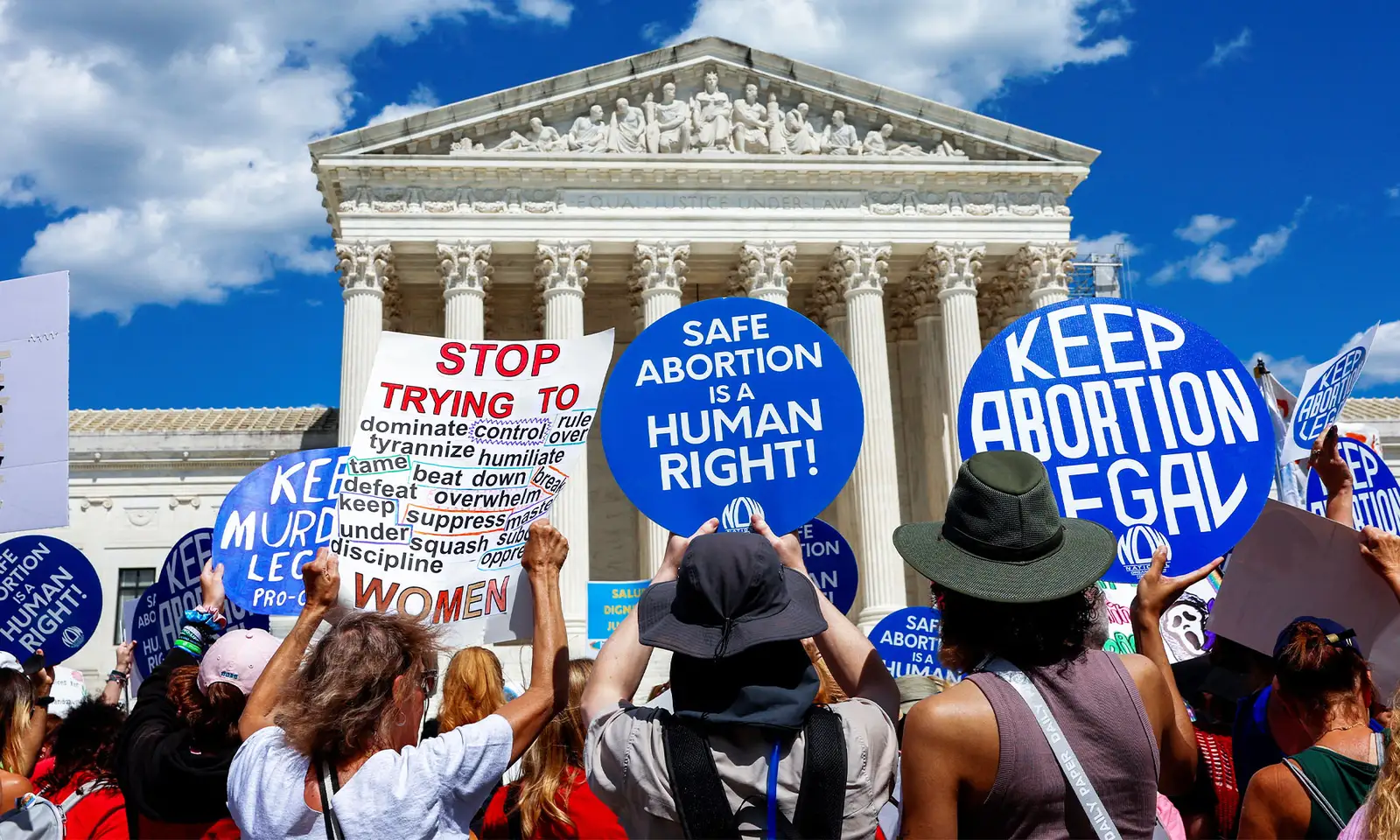
U.S. hospitals will continue to be able to perform emergency abortions, even in states with strict abortion bans, after the Supreme Court voted to dismiss Idaho’s challenge to a federal law regarding hospital care that some conservatives say is being intentionally twisted by the Biden administration.
In a 6-3 ruling on Thursday, the Court punted its decision in Moyle v. United States and Idaho v. United States back to the lower courts for further litigation. That means that for now, emergency-room doctors will still be able to perform abortions even in cases where the mother’s life isn’t threatened and in states where abortion is othewise not permitted.
The two cases pit Idaho’s near-total abortion ban against a federal law that requires hospitals in the state to perform emergency abortions even in cases where a woman’s life isn’t threatened but where she faces “grave harm,” including loss of fertility.
Idaho law allows abortions in cases of rape or incest or when the procedure is necessary to prevent the mother’s death. Doctors who violate the law could be punished with up to five years in prison.
What falls in the gap between Idaho’s law and the federal Emergency Medical Treatment and Active Labor Act “are cases in which continuing a pregnancy does not put a woman’s life in danger, but still places her at risk of grave health consequences, including loss of fertility,” Justice Elena Kagan wrote in a concurring opinion, adding that the “on-the-ground impact” of Idaho’s law was “immediate.”
“To ensure appropriate medical care, the State’s largest provider of emergency services had to airlift pregnant women out of Idaho roughly every other week, compared to once in all of the prior year,” Kagan wrote.
Justice Amy Coney Barrett, in a concurring opinion joined by Chief Justice John Roberts and Justice Brett Kavanaugh, supported sending the case back to the lower courts for further litigation, writing that “these cases are no longer appropriate for early resolution.”
But liberal Justice Ketanji Brown Jackson accused the court of shirking its duty, and warned that “storm clouds loom ahead.”
“There is simply no good reason not to resolve this conflict now,” she wrote, adding that by punting on the decision the court is “allowing chaos to reign wherever lower courts enable States to flagrantly undercut federal law.”
She also accused the three dissenting conservative justices, Clarence Thomas, Samuel Alito, and Neil Gorsuch, of suggesting that states “have free reign to nullify federal law.”
“So, to be clear: Today’s decision is not a victory for pregnant patients in Idaho. It is delay,” Jackson wrote. “While this Court dawdles and the country waits, pregnant people experiencing emergency medical conditions remain in a precarious position, as their doctors are kept in the dark about what the law requires.”
In his dissent, Alito suggested that President Joe Biden instructed members of his administration to find ways to limit the reach of the court’s Dobb’s decision, which reversed Roe v. Wade in 2022. He called the federal government’s theory that it can require states to perform emergency abortions when a mother’s life isn’t on the line “plainly unsound.” The federal law, he wrote, “unambiguously demands” that Medicare-funded hospitals protect the lives of both a pregnant woman and her baby.
“The text of EMTALA shows clearly that it does not require hospitals to perform abortions in violation of Idaho law,” Alito wrote. “To the contrary, EMTALA obligates Medicare-funded hospitals to treat, not abort, the ‘unborn child.’”
Thursday’s ruling came a day after a copy of the opinion was “inadvertently and briefly uploaded” online, a Supreme Court spokesperson said.
Idaho was one of the first states to ban abortion following the Dobb’s decision. It is one of six states that doesn’t allow exceptions if a mother undergoes a health risk that doesn’t threaten her life.
The state argued that EMTALA “does not require emergency rooms to become abortion enclaves in violation of state law.”






Comments
On “Supreme Court Allows Emergency Abortions to Continue in States with Bans”