
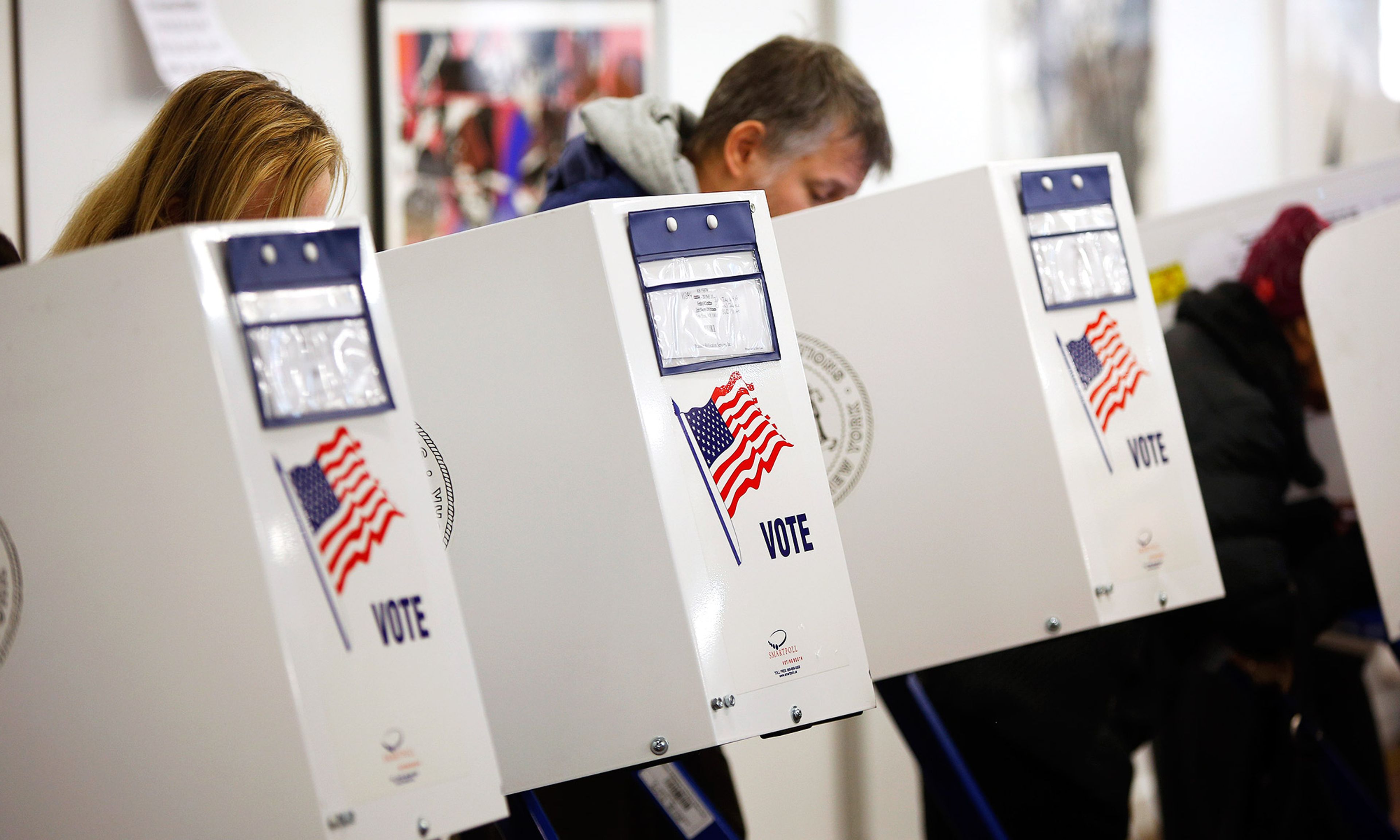
Making the click-through worthwhile: why we shouldn’t put much faith in those polls showing an extremely high percentage of the electorate is certain to vote in November; Beto O’Rourke’s most desperate line in his debate; a long-forgotten figure hints he’ll throw his hat in the ring in 2020; and some dramatic new survey numbers in Florida.
Lots of People Who Tell Pollsters That They’ll Vote . . . End Up Not Voting
Every year, we get told that we’ve never seen young people so fired up to vote.
Back in 2014, the Pew Research Center went back and looked to see if the people they polled actually went and voted. Unsurprisingly, a good chunk of respondents did not vote.
While changed minds contributed to some of the difference between the September poll result and the final outcome, this factor was less important than the turnout differential between Republicans and Democrats. Fully 73 percent of pre-election registered voters who supported a Republican candidate in the pre-election survey ultimately turned out to vote on Election Day, based on verified vote from the voter file. By comparison, only 61 percent of registered voters who supported a Democratic candidate were verified to have voted.
Wait, there’s more! They asked respondents to rate their likelihood of voting on a scale of zero to seven, with zero being the least likely to vote and seven being the most likely. Nearly half of all registered voter respondents characterized themselves as a seven. Out of that group . . . 83 percent voted. In other words, almost one in five people who told the pollster that they are absolutely, positively, definitely going to vote did not vote. What’s more, among the group that answered zero — which was only 4 percent of the whole sample — about one in ten actually went out and voted!
Some people lie to pollsters — or at least they do not keep their word, particularly when it comes to questions of whether they will vote. I suspect there’s a segment of the population that either never votes or votes infrequently but knows that they’re supposed to vote out of civic duty. This group of respondents doesn’t like admitting to some stranger on the phone that they don’t expect to be sufficiently motivated on the first Tuesday of November.
In 2014, 56 percent of respondents told the PRRI survey that they were certain to vote in the midterm elections. The actual turnout of registered voters that year was 36.4 percent, the lowest since 1942. This year, 55 percent of respondents told the same pollster that they were certain to vote.
What has Democrats worried — and ought to worry them! — is that the PRRI survey found just 35 percent of voters from age 18 to 29 saying they’re certain to vote, which is actually a little lower than four years ago. You know what percentage of this demographic turned out back in 2014? Under 20 percent.
It’s a similar story in the latest Washington Post poll, which touted the headline, “Voters say they are more likely to cast ballots in this year’s midterm elections,” and declared that 77 percent of respondents said that they were “absolutely certain to vote” or had already voted early.
Except . . . four years ago, the same survey found 65 percent saying they were “absolutely certain to vote” or had already voted early. And total turnout was only 36 percent!
I can hear the arguments already. “Jim, this time it’s different. Back then, young voters were complacent because of President Obama, and now President Trump has outraged young people. Just look at the Women’s March, Black Lives Matter, The March for Our Lives, younger Democratic candidates, Alexandra Ocasio Cortez, Taylor Swift’s endorsement of Phil Bredesen, and all the rest.”
And yes, that could happen. Over at FiveThirtyEight, Geoffrey Skelley makes a better-than-usual argument for expectations of higher youth turnout, pointing to the higher turnout among young voters in the Alabama special Senate election and Virginia’s statewide elections last year. (Of course, there’s the distinction between “higher turnout” and “high-enough turnout.” The youth vote in Alabama’s special election was about twice the state’s average and Democrat Doug Jones won by about two percentage points against Roy Moore. In Virginia, the youth turnout was 50 percent higher than four years earlier, and while that added up to a Democratic landslide in the governor’s race, it wasn’t quite enough to give Democrats a majority in the House of Delegates.)
Voter registration among young people is up in some places such as Connecticut. Texas now has slightly more registered voters between the ages of 18 and 29 than ages 65 and older.
But Robert Griffin, associate director of research at PRRI, told USA Today that he doesn’t expect to see a dramatic change from the 2014 turnout. In his autobiography Principles, Ray Dalio describes a phenomenon he calls “another one of those” — those moments where you suddenly recognize what’s happening from past experience and history. His point is that the more you study history, the more you recognize similar situations from the past and can apply useful lessons from that past.
Past history teaches us that when 77 percent of respondents tell pollsters that they are “absolutely certain to vote,” turnout is going to be significantly lower than 77 percent.
Beto O’Rourke: Hey, Look What Donald Trump Said about Cruz!
Texas Democratic Senate candidate Beto O’Rourke cited Donald Trump as a supporting witness in his debate with incumbent Ted Cruz last night.
“He’s dishonest,” O’Rourke said. “That’s why the president called him Lyin’ Ted and it’s why the nickname stuck because it’s true.”
This would be the president that O’Rourke wants to impeach, right? The president who O’Rourke called racist? Now he wants everyone to trust Trump’s opinion in his assessment of Cruz?
Julian Castro: Hey, Remember Me? I’m Gonna Run for President . . .
Speaking of overhyped Texas Democrats, Julian Castro — the former mayor of San Antonio, former secretary of the Department of Housing and former Democratic-party Flavor of the Month — tells Rolling Stone he’s likely to run for president in 2020.
On the subject of his presidential aspirations, he gave the clearest indication yet about his plans for 2020. “I’m likely to do it,” he tells Rolling Stone. “I’ll make a final decision after November, but I’m inclined to do it.”
It’s understandable if you don’t remember this guy, but from 2012 to about 2014, he was the “Next Big Thing” in Democratic politics. He’s the political equivalent of Carly Rae Jepsen’s “Call Me Maybe.” “Oh, that song! Man, I haven’t heard it in forever! Wow, back then, that song was everywhere.”
If you need a refresher on what Castro did as mayor — honestly, not all that much — look here. The limits of the power of the mayor of San Antonio are discussed here. If you want to remember how the gushing Castro profiles echoed today’s gushing O’Rourke profiles, look here.
But Castro’s interview with Rolling Stone had this exchange:
RS: Polls show right now a lack of energy among Hispanic voters. It could make a big difference in the midterms in states like Nevada and Texas. You’ve got a racist in the White House with Trump, and the pitch to Latino voters shouldn’t be that difficult. But it doesn’t seem to be landing.
Castro: The party needs to invest more resources more consistently in Latino voter registration and turnout. It’s not enough to just invest a few months before the big election. Whether it’s the Democracy Alliance [liberal donor network] or other individual big donors or organizations, they need to scale up efforts like the Texas Organizing Project, Voto Latino [of which Castro is a board member], and Jolt out of Austin. There needs to be a massive and sustained effort that’s well-funded and well-scaled to create a generation of Latino voters. And until that’s done, Latinos are not going to vote at the rate that they ought to vote at.
We’re constantly told that President Trump is anti-Latino xenophobia personified. If Latinos aren’t registering to vote in this circumstance, then one of two things is wrong. Either Latinos simply don’t care that the personification of anti-Latino xenophobia is now in the Oval Office, or more likely, they reject the characterization of him and don’t find him all that menacing. (Not choosing is a choice; choosing to not register to vote is an endorsement of the status quo.) In all likelihood, quite a few Latinos like some of Trump’s policies. Liberals are now lamenting, “last week’s NPR/PBS/Marist poll, 41 percent of Hispanics approved of Trump’s performance. Another recent poll put Trump’s approval among Latinos at 35 percent.” That’s not great, but that’s really good if you’re supposed to be el diablo.
ADDENDA: Man, is Florida going to be dramatic this year:
The race for Florida governor is essentially tied according to the first public poll conducted after Hurricane Michael devastated the Panhandle — and changed the course of state politics.
Twenty days before Election Day, Democrat Andrew Gillum is at 47 percent, while Republican Ron DeSantis is at 46. However, among those who say they have already voted, DeSantis is at 49 percent, while Gillum is at 45 percent.
A similar scenario is setting up for Florida’s U.S. Senate race: heading into the stretch in dead-heat fashion, according to the new survey by St. Pete Polls. Republican Gov. Rick Scott has a two-point lead over Democratic incumbent U.S. Sen. Bill Nelson.
The poll comes with a definitive asterisk as respondents in portions of the Panhandle, specifically the Panama City the media market, where Michael delivered his lethal blow, are under-sampled. A slight plurality of these voters typically support Republican candidates. end
Gillum led nine polls conducted in September.






Comments