
Never mind what actually happened in the world today; this morning, the president tweeted that the media is “the Enemy of the People” again, and so now everyone is apparently contractually obligated to spend at least one news cycle expressing their outrage about that, even though we’ve already done this several times this year. The media hates being called it. The president loves doing things they hate. Almost everyone shrugs as the term “enemy,” once more properly applied to ISIS and North Korea’s regime, becomes a synonym for “person I don’t like.” And the cycle continues, lather, rinse, repeat . . .
Making the click-through for this newsletter worthwhile: the true costs of the Florida governor’s race, Silicon Valley stops looking quite so appealing to the tech community, and two cases where Hollywood’s decision making is just baffling.
The Governor’s Race in Florida Just Got More Interesting . . . and Expensive
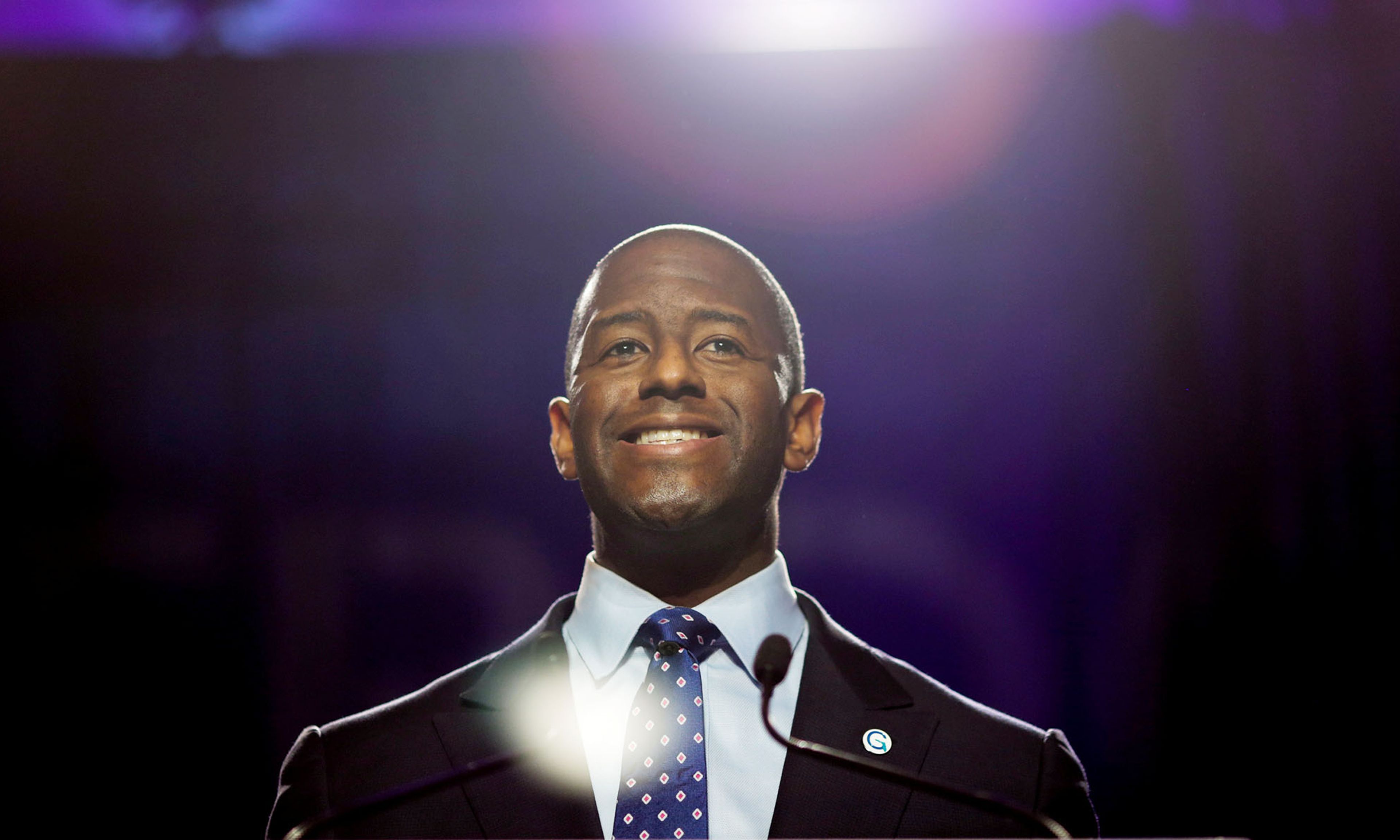
Democrats have high hopes for their new nominee for governor of Florida, Tallahassee mayor Andrew Gillum. The New York Times acknowledges that his long-shot win in a hard-fought primary might be the easy part, even after his GOP opponent, Congressman Ron DeSantis, used the term “monkey this up” in describing the consequences of electing Gillum.
[Gilllum] is an articulate spokesman for those far-left views, and he’s a charismatic candidate. I watched those Democrat debates, and none of that is my cup of tea, but he performed better than the other people there. So we’ve got to work hard to make sure that we continue Florida going in a good direction. Let’s build off the success we’ve had with Governor Scott. The last thing we need to do is to monkey this up by trying to embrace a socialist agenda with huge tax increases and bankrupting the state. That is not going to work.
Democrats charge that DeSantis’s use of the term “monkey” was a racial slur. Our Charles Cooke finds it an appallingly unfair and unsupported accusation.
The Times acknowledges that Gillum’s campaign needs a massive infusion of cash, quickly:
Gillum used the tussle to get airtime on Fox News himself, seeking to harness the publicity he received from his surprise win into the sort of major fund-raising that previously eluded him. He enlisted a handful of well-known Democrats, including Senators Bernie Sanders and Kamala Harris, to send out fund-raising emails on his behalf. By Wednesday night, he had raised more than $800,000 online since his victory.
Tom Steyer, the California-based donor who helped Mr. Gillum secure his primary victory, said he would consider spending more than the $5 million he had already allocated for the governor’s contest here.
That sounds like a lot, but Gillum will probably need a lot more.
As I said earlier this week, political race winners are rarely determined on spending alone, but Florida is a deceptively difficult state to run in, with at least ten major media markets: Pensacola, Panama City, Tallahassee, Jacksonville, Gainesville, Orlando, Tampa Bay, Palm Beach, Fort Myers, and Miami/Fort Lauderdale. In 2014, Rick Scott spent nearly $68 million on television ads and Charlie Crist spent more than $35 million, the highest totals in any state gubernatorial race. Gillum, the current mayor of Tallahassee, is unusual for a modern Democratic statewide candidate in that he isn’t from central or southern Florida. An advertising disadvantage can’t be easily overcome by more vigorous campaigning. People forget how big the state is; driving from Pensacola to Miami takes almost ten hours.
The Times notes that the “well-funded Republican Governor’s Association intends to spend upwards of $20 million overall in Florida, according to officials with the group, and have pre-booked $10 million worth of advertising that is to start in September.”
Silicon Valley Loses Some of Its Shine
The editors of The Economist notice that tech entrepreneurs are growing less convinced that living and working in Silicon Valley is worth the cost and aggravation.
Last year more Americans left the county of San Francisco than arrived. According to a recent survey, 46 percent of respondents say they plan to leave the Bay Area in the next few years, up from 34 percent in 2016. So many startups are branching out into new places that the trend has a name, “Off Silicon Valleying”. Peter Thiel, perhaps the Valley’s most high-profile venture capitalist, is among those upping sticks. Those who stay have broader horizons: in 2013 Silicon Valley investors put half their money into startups outside the Bay Area; now it is closer to two-thirds.
The article laments “rising anti-immigrant sentiment and tighter visa regimes of the sort introduced by President Donald Trump” but barely glances at the quality of local government. The Bay Area Rapid Transit system recently announced they need $150 million to $200 million to replace their fare gates, because it’s too easy to skip over the turnstiles. They have 600 total fare gates in the system. This means each new fare gate will cost between $250,000 and $333,333.33 each.
I Don’t Understand You, Hollywood: Part One
First, color me rather skeptical that a movie about the Joker, separate from Batman, will work.
Yes, Joaquin Phoenix is a good actor, but movies with a villain protagonist are difficult to enjoy unless everything works out just right. The Usual Suspects works because we belatedly realize the villain was sitting in front of us the whole time. The world around Patrick Bateman in American Psycho bristles with shallow, materialistic, selfish social climbers, so he seems like some sort of retribution for their sins. Neither of those ideas can really work as a concept for the movie about the Joker, as the audience knows he’s the villain going into the movie and the character . . . really isn’t supposed to be sympathetic.
The Joker is the comic-book character who needs to be explored and reinterpreted the least, after the performances of Jack Nicholson, Heath Ledger, Mark Hamill’s voice-over work in the animated versions, and (sigh) Jared Leto. (One of the few things that the Suicide Squad movie got right was the idea that everyone in the DC universe’s criminal underworld, even the ones with superpowers, feared “the clown.”) As a character, the Joker is supposed to combine the mystery of the Zodiac killer, John Wayne Gacy’s faux-jovial persona, Charles Manson’s ability to inspire followers, and Son of Sam’s ability to manipulate the media and terrorize the public.
But they’ve decided to go forward with the story of the Joker as some frustrated comedian, and for a few days Alec Baldwin was supposed to play Thomas Wayne, Bruce Wayne’s father, although “this being a movie project that will veer off-center from the traditional Batman canon, sources say the script paints Thomas Wayne as a cheesy and tanned businessman who is more in the mold of a 1980s Donald Trump.” (Baldwin said yesterday he wouldn’t be able to be in the film because of scheduling issues.)
Reimagining Bruce Wayne’s father as a showboating tycoon isn’t merely “veering off-center from traditional Batman canon”; that’s veering off the road like Toonces the Cat. The entire core of the Batman story is his desire to avenge the murder of his parents — and that his parents were kind and loving, the last people in the world who deserved to be gunned down during a mugging gone wrong. Making Thomas Wayne unsympathetic undermines . . . well, everything.
Maybe the final product will be a masterpiece, but the little details we’re hearing suggest a weirdly morally inverted story, one where the character that we know has to become an insane mass killer will be portrayed somewhat sympathetically, and the slain father won’t.
I Don’t Understand You, Hollywood: Part Two
Christian Toto reminds us that Sasha Baron Cohen’s new television series on Showtime has finished its first season . . . and it never aired the segment that was taped with Sarah Palin.
Seems like an odd choice, doesn’t it? The network insisted Cohen “did not present himself as a disabled veteran” and that he “never presented himself as a veteran of the U.S. military to former Alaska Governor Sarah Palin during the booking process or during the filming of her interview, and contrary to her claims he did not appear in a wheelchair.” And whatever the segment showed, it almost certainly would have been good for ratings.
The tape must either confirm or refute Palin’s accusation. And yet they chose to never show it. If the tape always contradicted Palin’s account, why not release it, even separately from the show, on YouTube? And if it verified Palin’s account, why did the network put out the adamant denial?
ADDENDUM: I’m scheduled to appear on HLN this afternoon, discussing race and the midterms, and am scheduled to join my friend Cam Edwards on NRATV at 2 p.m.






Comments