
On the menu today: A major setback for the Russians in their ongoing full-scale invasion of Ukraine; a Trump administration official orders an Atlanta museum to cover itself in a giant Russian flag; and Secretary of Homeland Security Markwayne Mullin defends his decision to fly in a private jet on Saturday to the LSU-Texas college football game while airports were still recovering from Friday’s nationwide full ground stop. Read on.
A Bridge Too Far
In March 2024, I was in the Ukrainian capital of Kyiv with my traveling buddies, having dinner with a Ukrainian military official, and while we all agreed that fierce Ukrainian resistance had turned the war into a stalemate, the question turned to how the hell Ukraine would ever be able to win this war. The discussion was on background, so I couldn’t quote him, but his thoughts ended up in the March 19 edition of this newsletter:
The Crimean Bridge is about as important as a transportation artery can get, although apparently the Russians have started using ferries to move ammunition and weapons to Crimea. Ferries are slower than trains and trucks; once you’ve crossed the water, you need to unload the cargo and load it onto trains or trucks to get it to its destination. But the Russians have good reason to fear that a giant cargo truck or train full of ammunition or explosives would make an extremely tempting target for the Ukrainians’ drones.
Intermittently during the war, the Ukrainians have managed to damage the bridge and temporarily halt traffic, but the Russians have always managed to repair and reopen it. The bridge was closed for half an hour Sunday morning.
Last month, the commander of Ukraine’s Navy, Vice Admiral Oleksiy Neizhpapa, predicted that the Crimean Bridge would be destroyed by the end of this year. . . .
Get enough long-range missiles in the hands of the Ukrainians, and they can take enough shots to destroy the bridge. Destroy the bridge, and the Russian forces in the south lose their supply lines. If Russian forces in the south lose their supply lines, many will likely surrender.
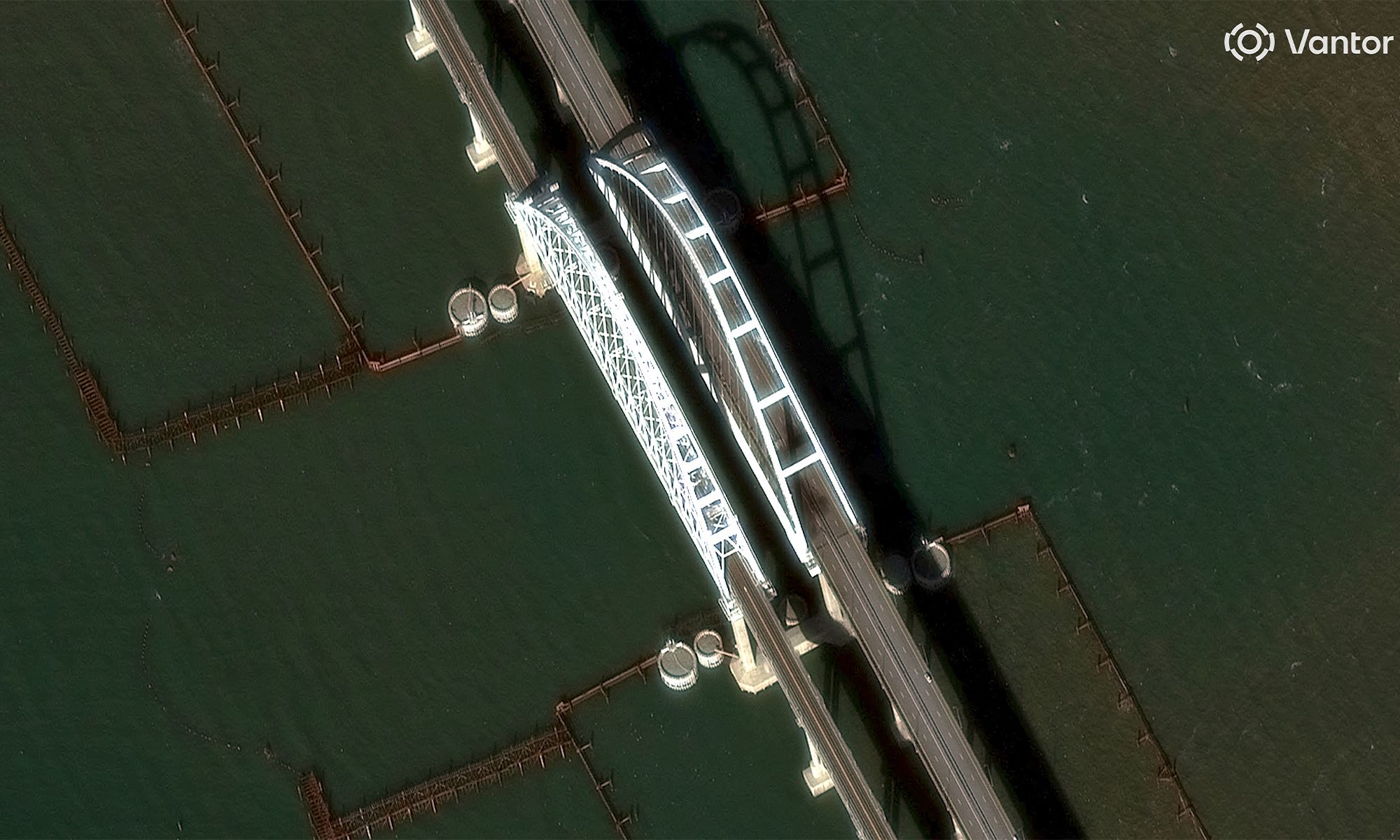
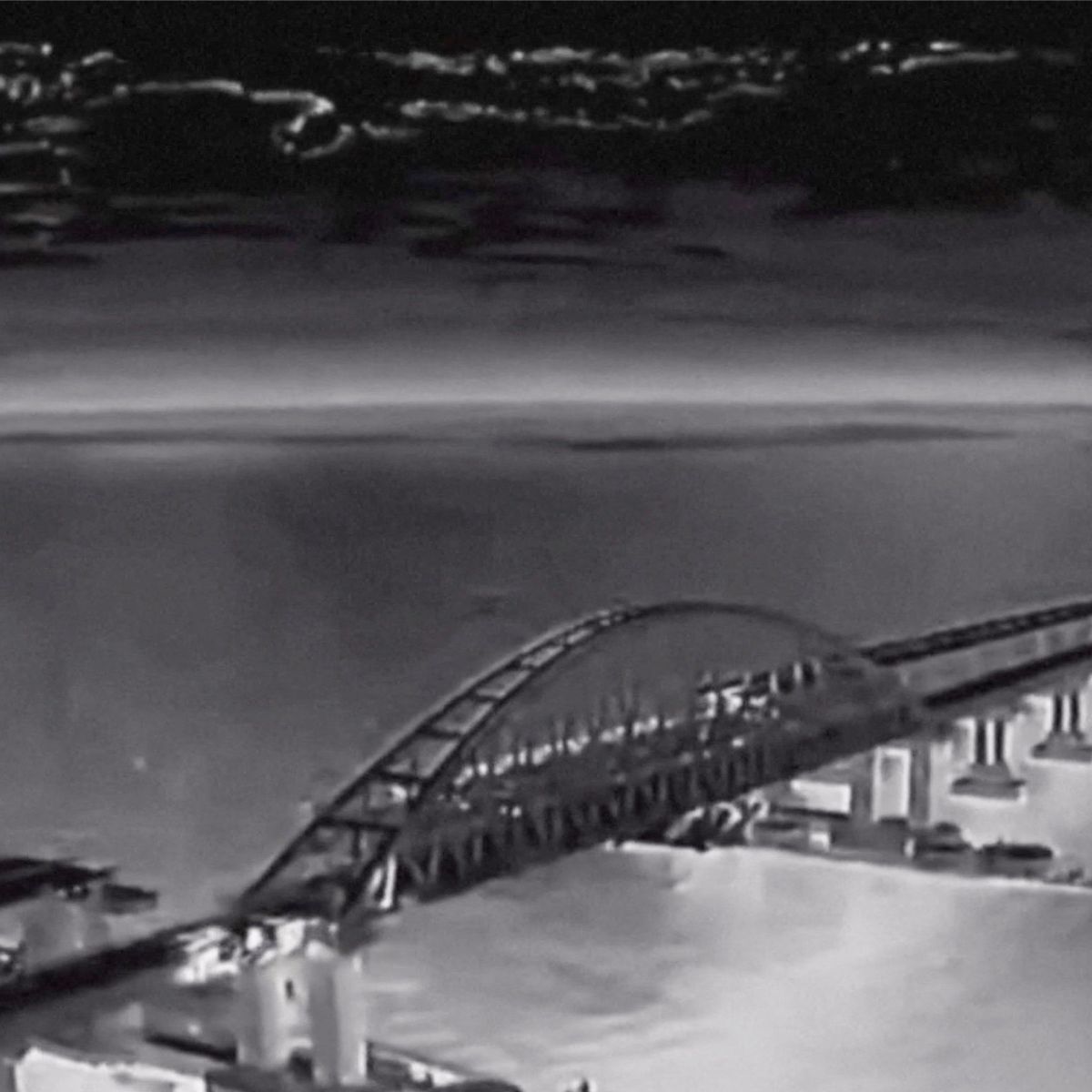
It took longer than Neizhpapa predicted, and instead of long-range missiles, the Ukrainians used the FP-5 Flamingo drone, which carries a large and powerful warhead. But the Crimean Bridge, also known as the Kerch Bridge, is largely out of commission, and likely to stay that way for a long while: “Images of the aftermath suggest that a 227-meter road arch span had fallen into the Kerch Strait, which connects the Sea of Azov with the Black Sea. The bridge’s railway arch span also sustained damage. . . . Until the bridge is repaired, traffic from Russia to Crimea will have to travel via a land corridor in Ukraine that Russia currently occupies — a route that is, however, vulnerable to Ukrainian drones.”
The New York Times notes, “It also threatens to create a maritime bottleneck. The damage to the bridge littered the sea with twisted metal and debris that could block any ships that Russia might want to sail through the strait.”
The Institute for the Study of War: “The Ukrainian strike against the Kerch Bridge showcases Russia’s inability to defend strategic objects that are critical both for the Russian economy and military logistics. Several Russian milbloggers expressed their frustration at the success of the Ukrainian strike and called on Russian forces to escalate their strikes against Ukraine and strike Ukraine’s decision-making centers, targeting political leadership. One milblogger reported that Ukrainian forces managed to land three hits on the bridge and stated that these hits were too much for a strategic object protected at a high level.” (Another Russian milblogger contended that ten Flamingo missiles hit the bridge.)
Phillips O’Brien, a professor of strategic studies at the University of Saint Andrews, writes: “The attack means that Ukraine is now pulling out the stops as it were (a big snub to Donald Trump), it could mean that Ukrainian systems have improved technologically in vital areas such as accuracy and explosive power, and it very well indicates that a stepped up campaign to isolate Crimea is finally going to happen after a number of false starts.”
As of this writing, the railway arch span is damaged, but the Russians said rail service across the bridge was restored by Tuesday on a single track. We can expect that railway span to be relentlessly targeted until it falls, too. And then Ukrainian drones will have one long and largely unprotected route to continue targeting, exacerbating the already considerable difficulties in keeping the Russian southern front supplied:
Russia is now effectively left with a single overland supply route to the peninsula: the R-280 federal highway, also known as “Novorossiya,” which stretches more than 630 kilometers through the temporarily occupied cities of Mariupol and Melitopol.
But this road is neither straightforward nor safe: Ukrainian drones frequently locate military trucks traveling along it, and few people are willing to drive vehicles carrying weapons there. The highway itself is also under constant attack, with Ukrainian drones and missiles repeatedly striking bridges and other logistics hubs along the route.
In July, Ukrainian defense officials said that the lack of vehicles and risk of drone attacks were forcing Russian infantry to walk 18 miles to combat positions at the front.
Dmitry Peskov, the press secretary of the Kremlin, issued a statement saying, “The sequence and timeframe for the restoration work will be determined. There is no doubt that the bridge will be restored and will be even better than before.”
Sure, sure, but in the coming months, those Russian debris crews and construction engineers should ask for combat pay, because it’s not like this is going to be the last time a Flamingo drone targets that bridge, or anybody working on it. Ukraine is producing 90 Flamingo drones per month.
The Ukrainian estimate of Russian casualties — which is in line with estimates by experts outside the country — is that the Russians lost 54,400 men in October from combined injuries and deaths. That number is likely to be even higher in November; so far this month the Russians have lost 38,870 men injured and killed. They’re on pace for about 60,000 to 70,000 wounded or dead this month.
Russia’s Defense Ministry says it has recruited 89 percent of its annual goal for soldiers for the war, but did not give specific figures. We know it’s a lot; in July, the Center for Strategic and International Studies put Russia’s recruitment rate at roughly 27,000 recruits per month. The newer waves of Russian recruits are older, often have health issues, and struggle with alcoholism. There are also many reports of coercion.
Increasingly, Russia’s recruits are not Russian; Ukraine’s Coordination Headquarters for the Treatment of Prisoners of War states that in the first nine months of 2026, Russia recruited more foreigners than in all of 2025, and Russia is recruiting about 1,800 foreigners each month. They have identified 45,959 foreigners who signed contracts with the Russian Armed Forces, citizens of 151 countries and representatives of unrecognized territories.
Amnesty International contends Russia practices “coercive and deceptive recruitment of African nationals into Russia’s military forces to fight against Ukraine.” The Indonesian police recently publicly complained that “Indonesians recruited to fight for Russia were bound by contracts requiring them to serve until the war in Ukraine ends or until they die in combat.” Yemenis describe being recruited by the Russians with promises that they’ll only be on the third line and then being sent to the front line — and getting only a fraction of the pay they were promised.
As dire as the outlook for Russia’s war ambitions is, this only partially mitigates the relentless assault of Shahed drones and ballistic missiles on Ukrainian cities and the targeting of power plants and Ukraine’s bridges. It is going to be a long, cold winter all over Ukraine. The Russian strategy is apparently to immiserate the Ukrainian people so horrifically that they run to the negotiating table, eager to exchange land for promises of peace. But as The Wall Street Journal reported November 12, “The campaign is threatening to leave Ukrainian cities with little electricity, heating or running water ahead of winter. Surveys suggest it isn’t making Ukrainian society any more willing to capitulate, despite the growing hardships.”
Why Did a Giant Russian Flag Get Draped over an Atlanta Museum?
I’m not losing any sleep over the recent death of Russia’s ambassador to the U.S., Alexander Darchiev, at age 66. But if the U.S. State Department had wanted to issue a pro forma “rest in peace” statement of condolences, fine.
What I don’t understand is why a giant Russian flag was displayed over the Millennium Gate Museum in Atlanta. The Millennium Gate Museum is one of those triumphal arches that the president wants to build on the Potomac, “designed to serve as a perpetual monument to Georgia’s rich history and its future potential.” It has jack squat to do with Russia, or U.S.–Russian diplomatic relations.
The Russian embassy boasted that the flag’s display was “at the initiative of President of the U.S. Commission of Fine Arts Rodney Mims Cook-Jr.” and that “Ambassador Darchiev and Rodney Mims Cook-Jr. met numerous times, paying special attention to the restoration of cultural and humanitarian ties, as well as popularization of the common pages of the history of Russia and the U.S..” Well, that’s nice. But we traditionally mark someone’s death by lowering our own flag to half-mast, not by putting another country’s flag atop our own buildings. There’s great symbolism to having somebody else come along and put some other country’s flag over your building.
Putting a giant flag of another country — a country deemed by U.S. law enforcement as a major threat to American interests — doesn’t seem very “America First,” now, does it? Nor does putting Chinese flags atop the White House.
ADDENDUM: Department of Homeland Security Secretary Markwayne Mullin, in an interview with CNBC:
Q: Mr. Secretary, there’s a tempest in a teapot. So, 24 hours after the skies werereopened, you took a government plane to the LSU-Texas [football] game. . . . You are required to . . . take government planes, right? And you paid for it. So, the big kerfuffle is that . . . Americans were grounded and you were flying around on a private jet to go to a football game.
Mullin: Well, we’re — I’m required to be in . . . communication 24/7, seven days a week, 365 days a year. Uh this isn’t abusiness that you’re able to have any privacy. We would have never went if the airlines, if the airways weren’t completely open. They’d been completely open for 21 hours. . . . I would have never taken airspace if the airspace wasn’t open.
Later in the interview, Mullin added, “When I take any type of government travel for personal use, I have to pay personally for that. And I’m not allowed to take tickets for anybody. I have to pay fair market value for all that stuff.”
The ground stop was lifted at 8:15 p.m. Friday evening, but the wave of cancelations, delays, and other problems at the nation’s airports were still going on through the weekend. When you’re the Secretary of DHS, sometimes you’re going to have to cancel your plans, and this was an entirely avoidable controversy and a self-inflicted wound.




Comments