
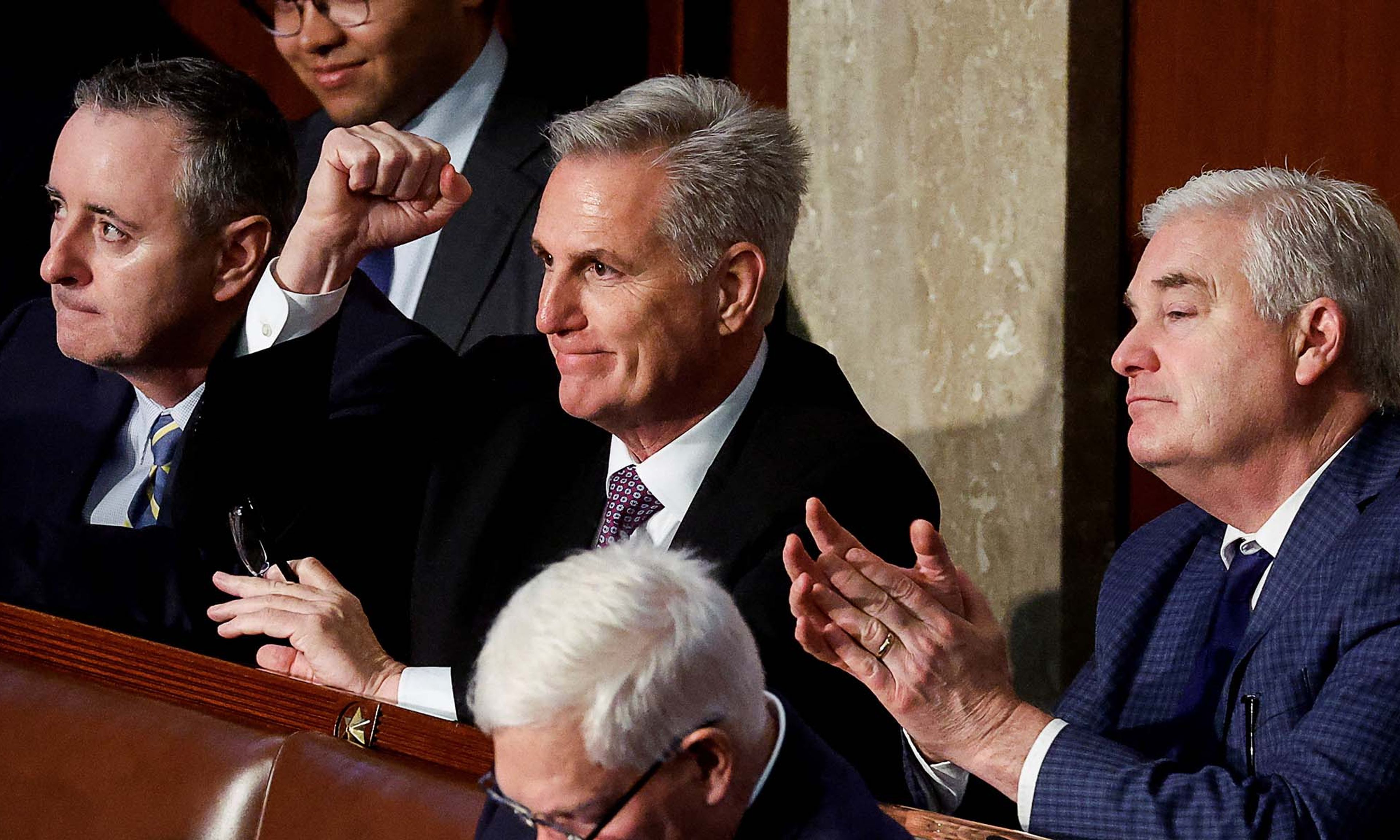
On the menu today: The saga of House Republican infighting about the next speaker drags on, and neither Kevin McCarthy nor his opponents are emerging stronger from this fight. The House GOP can’t move on to any policy issues or address anything the Biden administration is doing until the question of who runs the House gets resolved — and yet no one seems to be in any hurry to end this, or be willing to make any bold moves to shake up the stalemate.
The Speaker Fight Drags On
It’s understandable if lots of Americans watch the House GOP infighting over who should be speaker of the House and shrug, scoffing at the notion that this is a “crisis.” You can almost envision some hyperbolic cable-news congressional correspondent breathlessly declaring that, “The ongoing fight over the next Speaker is the most shocking and hotly contested battle to hit Capitol Hill in the first week of January since . . . okay, wait, I guess it really hasn’t been that long.”
After six votes of voting for speaker in which no figure reached the necessary majority, it seems Kevin McCarthy’s strategy is to keep holding votes until the 20 or so members adamantly opposed to him becoming speaker just give up. It appears that the strategy of the 20 or so members adamantly opposed to him is to just keep voting against him until he just gives up.
“Just wait until the other side quits” is not a particularly effective approach to a conflict.
I understand the argument that this ongoing battle is demonstrating why McCarthy is a poor choice for speaker. He’s had a sense of the diminished size of the Republican House majority since Election Night. He’s known that he has 188 members backing him, and 31 opposed, since mid November. McCarthy has had almost two months to hash out a deal with the members opposed to him. Apparently, he hasn’t gotten very far.
The fact that McCarthy can’t get 218 Republicans to vote for him to be speaker does not suggest he’ll be a whiz at getting 218 Republicans to unite behind any proposal or legislation.
One of the political axioms I have long trusted is, “You can’t beat something with nothing.” And yet, because there is no declared rival to McCarthy who wants the job . . . right now, nothing is beating McCarthy.
The editors of National Review weigh in this morning and observe that the opposition to McCarthy comes in two distinct forms:
The dissidents have an array of motives and an (ever-shifting) list of demands, but they can be roughly thrown into at least two broad categories. One, exemplified by Chip Roy of Texas, genuinely wants a more open process on the House floor and is horrified by the level of spending in Washington and how so much of it happens with rushed, practically unread, enormous “must pass” bills. These concerns are real, and it’s right to address them, although — again — a narrow House majority by itself is unlikely to be able to make major changes.
Then, there are the arsonists like Matt Gaetz who enjoy the thrill and notoriety of burning something down. They are contemptible and unappeasable, and all you need to know is that even Marjorie Taylor Greene is done with them.
As Charlie Cooke observed, one of the more intriguing developments of this fight was former president Donald Trump’s weighing in with a clear endorsement of McCarthy . . . and not flipping a single vote. In fact, Gaetz seemed to mock Trump when he tweeted out, “Supporting McCarthy is the worst Human Resources decision President Trump has ever made. Sad!” When Boebert declared that Trump should call McCarthy and tell him to quit, Charlie noted, “In other words, the new power dynamic is such that Trump doesn’t tell figures such as Boebert what to do; figures such as Boebert tell Trump what to do.”
You won’t often see Vanity Fair’s Molly Jong-Fast quoted in this newsletter, but I think it’s worth chewing over her assertion that the rebellion against McCarthy is “peak Trumpism,” even though Trump is on McCarthy’s side. The fact that the 20 anti-McCarthy House Republicans, who almost all come from the safest of safe GOP districts, reject Trump’s arguments does feel a bit like Dr. Frankenstein’s monster rising from the table and lurching around and smashing lab equipment, no longer listening to instructions or orders.
Jong-Fast writes:
Republicans created a cult of personality around Trump. And now that Trump is off the main stage, the cult no longer has a personality. It’s just a cult with lots of zealotry but no actual tenets or beliefs. And even if McCarthy does eventually prevail, the chaos gripping the House GOP is just a symptom of a larger problem. The Republican Party isn’t really a governing party anymore. It’s an incubator for right-wing celebrities. . . .
By 2020, Trump had lost control of the monster he created. The base decided to reward social media stunts with small-dollar donations. Fox News and the right-wing internet ecosystem created a world of mini Trumps, little congressional bomb-throwers like Boebert, Marjorie Taylor Greene, and Matt Gaetz. More motivated by fame than governing, these members seem to want what Real Housewives want: to build their brands. These congressional Kardashians don’t have a governing principle beyond obstruction and attention, of which they’ve all been getting amid this week’s party meltdown.
“An incubator for right-wing celebrities” is not an accurate description of the entire Republican Party. There are 48 Republican senators, 28 Republican governors, and roughly 4,000 Republican state legislators. No offense intended to lesser-known workhorses such as John Barrasso and Joni Ernst and James Lankford, but they’re not where they are because they’re so adept at cultivating controversy and gaining attention. As I wrote last year when a liberal New York Times columnist scoffed that Republicans only nominate celebrity candidates, “Lots of people in the left-of-center mainstream media fume about shallow, uninformed celebrity candidates and how these fame addicts aren’t truly committed to doing the work of being a legislator, and then give all their attention and airtime to shallow, uninformed celebrity candidates.” There are other kinds of Republicans out there, but very few people in the mainstream media are interested in them, compared to the circus clowns.
But it does feel fair to contend that a significant chunk of the Republican Party isn’t interested in governing anymore, and that chunk is now large enough to disrupt the work of everyone else.
This fight would feel more worthwhile if it offered two distinct options, and if it stemmed from a clear issue or policy dispute, or two dramatically different leadership styles.
If McCarthy were a genuinely odious and petty leader who tried to rule his caucus like a tyrant, the rebellion would be easier to understand. But clearly, about 200 of his colleagues have figured out how to have a productive working relationship with him.
As I noted on The Editors a few days ago, I would be fine with McCarthy as speaker. He’s got his flaws, but he’s a known quantity, he’s laid out a clear conservative agenda that is broadly popular with the caucus, and he’s put in the work.
I also would be fine with Steve Scalise, who currently wants to be House majority leader. In fact, the GOP would likely benefit from having Scalise in place as speaker every time House Democrats insist that their opponents’ heated rhetoric is going to lead to ideologically motivated violence. Mmm, yes, Democrats, go lecture Steve Scalise about the likely dangerous political consequences of political figures demonizing their political rivals.
But McCarthy and Scalise have been buddies and working partners in GOP House leadership for a long time. Their differences on policy or political philosophy are few and far between. I don’t understand the position of adamantly opposing McCarthy as speaker, only to turn around and accept McCarthy’s right-hand man instead.
Yesterday in the Post, I laid out how over the past generation, the worlds of entertainment and politics have merged, to the harm of both. (As usual, the comments section denounced me with the fury of a thousand suns going supernova.) Last night, Boebert was a guest on Fox News Channel host Sean Hannity’s program, and off-the-cuff said she might nominate Trump to be the next speaker of the House. Hannity’s patience appeared exhausted. “Is this a game show? Like we’re gonna pick [Representative] Jim Jordan [R., Ohio] one day, Trump the other day?”
To Boebert . . . yes, this is a game show — “angertainment,” as her Democratic opponent in last year’s midterm elections called it.
Earlier this week, the boss wrote in Politico that we are witnessing opposition for its own sake:
The fact is that an anti-authority spirit pervades a portion of the party, and the authority it opposes is that of its own side.
Kevin McCarthy is not a visionary or an inspirational leader and has been around Washington a long time, but his fundamental offense for his enemies is seeking to be speaker. By the usual calculus, the absence of an obvious alternative to McCarthy would militate against opposing him. But, given the attitude of many of the rebels, this makes it an even purer exercise — an act of defiance unburdened by a substantive agenda or a different candidate.
ADDENDUM: In case you missed it yesterday, the FBI made arrests after investigating the attacks on those power substations around Seattle, Ron DeSantis’s inaugural address will easily convert to a presidential-campaign stump speech, and White House press secretary Karine Jean-Pierre admits that sometimes the Biden team leaks private conversations with congressional leaders. The year 2023 is off to a heck of a start.






Comments