
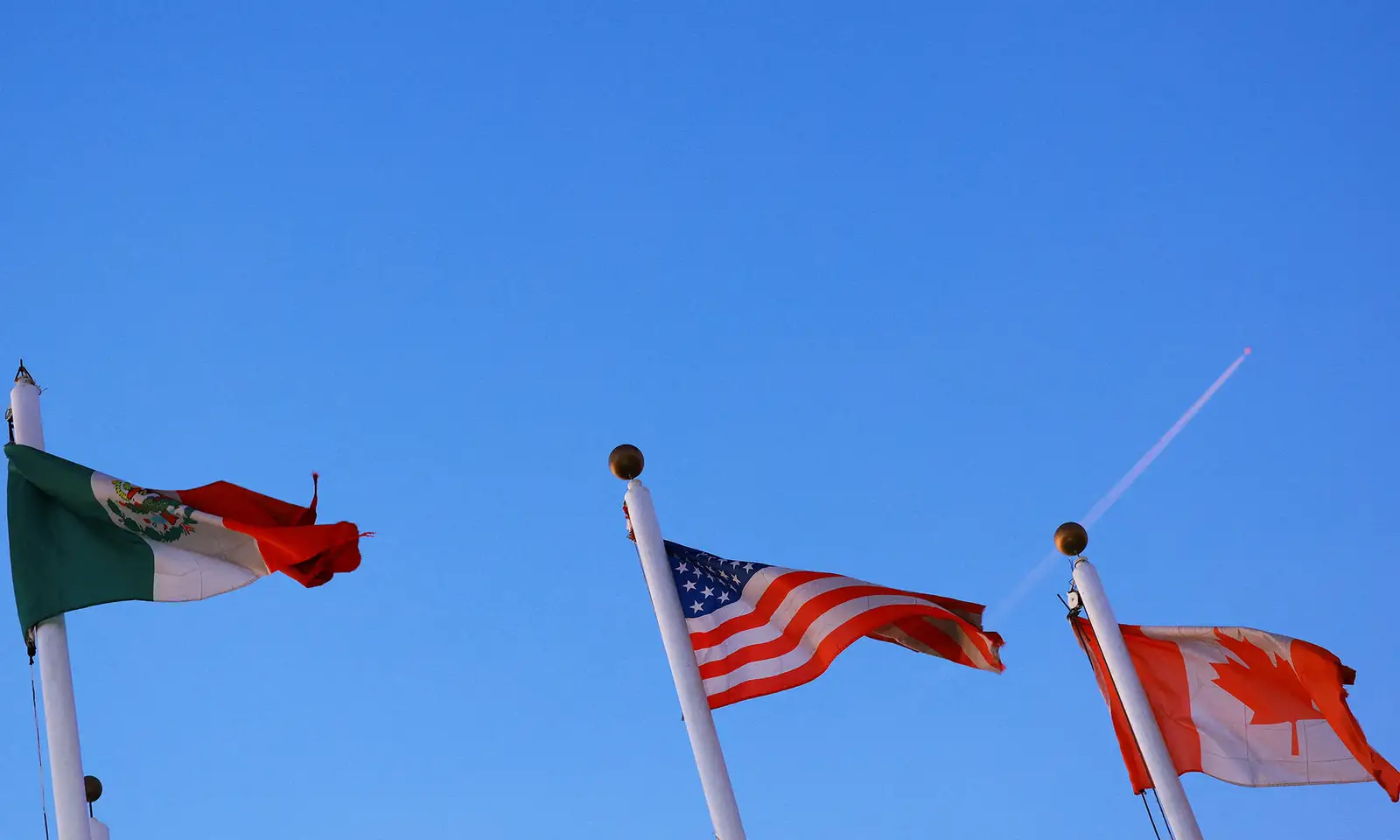
On the menu today. The great North American Trade War of 2025 gets postponed for at least a month; laying out all the things USAID does besides the nonsense programs you’ve probably heard about; Vox belatedly notices an axis of anti-Western powers cooperating more frequently; and how ’80s rock bands influence our understanding of Central America.
A Trade War Pause
President Trump, last night, postponing the implementation of 25 percent tariffs on Canada:
I have determined that the Government of Canada has taken immediate steps designed to alleviate the illegal migration and illicit drug crisis through cooperative actions. Further time is needed, however, to assess whether these steps constitute sufficient action to alleviate the crisis and resolve the unusual and extraordinary threat beyond our northern border.
Canada will implement their $1.3 Billion Border plan, and as per Prime Minister Trudeau, will be, “reinforcing the Border with new choppers, technology and personnel, enhanced coordination with our American partners, and increased resources to stop the flow of fentanyl. Nearly 10,000 frontline personnel are, and will be, working on protecting the Border. In addition, Canada is making new commitments to appoint a Fentanyl Czar, we will list cartels as terrorists, ensure 24/7 eyes on the Border, launch a Canada-U.S. Joint Strike Force to combat organized crime, fentanyl and money laundering. I have also signed a new intelligence directive on organized crime and fentanyl, and we will be backing it with $200 million.
Canada’s $1.3 billion border plan was announced December 17. You can read it here.
But the plan announced in December didn’t mention a “Fentanyl Czar.” Prime Minister Justin Trudeau said via X last night, “We will list cartels as terrorists, ensure 24/7 eyes on the border, launch a Canada-U.S. Joint Strike Force to combat organized crime, fentanyl and money laundering. I have also signed a new intelligence directive on organized crime and fentanyl and we will be backing it with $200 million.” So, Trump can point to those moves as “wins” from his tariff brinksmanship.
Of course, the U.S. business community might prefer to have a stable and predictable sense of what their supply-chain costs are going to be beyond the next month.
The president made the same determination with Mexico in the same wording. On Truth Social, Trump said:
Just spoke with President Claudia Sheinbaum of Mexico. It was a very friendly conversation wherein she agreed to immediately supply 10,000 Mexican Soldiers on the Border separating Mexico and the United States. These soldiers will be specifically designated to stop the flow of fentanyl, and illegal migrants into our Country. We further agreed to immediately pause the anticipated tariffs for a one-month period during which we will have negotiations headed by Secretary of State Marco Rubio, Secretary of Treasury Scott Bessent, and Secretary of Commerce Howard Lutnick, and high-level Representatives of Mexico. I look forward to participating in those negotiations, with President Sheinbaum, as we attempt to achieve a ‘deal’ between our two Countries.
The Mexican president pledging to commit 10,000 troops to the U.S. border is apparently a sufficient concession to get the Trump administration’s tariffs delayed by a month.
But wait, in 2019, Mexico deployed collectively nearly 20,000 troops to its northern and southern borders:
Alongside 6,500 members of the security forces sent to Mexico’s southern border area with Guatemala, where many migrants enter, a larger contingent was in the north, he said.
“In the northern part of the country we have a total deployment of 14,000, almost 15,000 units between the National Guard and the Army,” [Secretary of Defense] Luis Cresencio Sandoval told a regular news conference.
And then in April 2021, in an agreement with the Biden administration, the Mexican government agreed to station 10,000 troops at its southern border with Guatemala to stop caravans of migrants who intended to come to the U.S.:
Mexico has informed the United States that it will maintain 10,000 troops at its own southern border, aiming to double the number of migrants that it stops from traveling north, Ms. Psaki said. Guatemala has added 1,500 troops to its border with Honduras and has set up a series of a dozen checkpoints along the route that many migrants take as they head to the United States.
She also said that Honduras recently “surged” 7,000 police and troops to disperse a contingent of migrants that had gathered to make the trip north seeking refuge.
It’s hard to say that the presence of those troops had much of an effect on illegal immigration patterns; U.S. Customs and Border Protection encounters at the U.S.-Mexican border jumped in March 2021 and remained high for years.
If the point of this (so far, short-lived) trade war was to impede the smuggling of fentanyl, I will want to know what those 10,000 Mexican troops will be doing. Consistently, about 86 to 90 percent of all fentanyl that the government seizes is found at official ports of entry, not illegal crossing routes. (Unsurprisingly, a car, truck, van, or boat can carry more fentanyl than a person walking across the desert.) Will these troops be searching vehicles approaching the Mexican side of ports of entry? That would lead to slowdowns, but maybe that will be bearable.
But what will it take to get the administration to keep its word on USMCA, the trade agreement with Canada and Mexico that Trump’s first-term team negotiated and that he signed into law?
What USAID Actually Does
Did the Biden-era U.S. Agency for International Development fund a lot of nonsensical programs? Absolutely.
U.S. taxpayers shouldn’t be footing the bill for a version of Sesame Street in Iraq. USAID didn’t need to invite 14 travel writers to Kazakhstan to promote tourism in that country. We shouldn’t be giving a dime to any entity that is working with the Taliban-run Afghan government, and the same goes for any organization working with the Houthis and Hamas.
And then there’s spending in a greyer area.
If you’re bothered by the number of illegal immigrants from Honduras crossing our southern border, you might want to have USAID funding programs that “promote sustainable reintegration of these migrants into their communities, helping to reduce repeat migration,” and training and job placement in Honduras for those returned illegal immigrants. The more people put down roots down there, the less likely they are to attempt to come up here. If these migrants are heading north because of violence in their home countries, maybe it makes sense for USAID to partner with local organizations to run police training programs and anti-corruption efforts. Maybe you’d like to have USAID collaborating with the ecumenical Christian humanitarian aid group World Vision on working with at-risk youth to keep them out of gangs and on better paths in life.
Maybe you don’t think USAID needed to spend $183 million over five years for “dioxin remediation at Bien Hoa Airbase Area, the primary Agent Orange storage and handling site during the U.S.-Vietnam War and the largest remaining dioxin hotspot in Vietnam.” (Then again, it was our government that brought that stuff there.)
Maybe you don’t like the idea of a couple million dollars per year going to the American Committee For Shaare Zedek Hospital In Jerusalem in Israel. “USAID/ASHA has undertaken a number of projects within Shaare Zedek, including rebuilding and expanding the ER, providing mammography equipment in the new Diagnostic Breast Health Center, and sponsoring an angiography system, new operating tables, an anesthesia system and, most recently, a Da Vinci Robotic Surgical System.”
The West African country of Mali was devasted by internal wars, but maybe you think USAID shouldn’t provide $5 million to help rebuild schools.
Maybe you think the U.S. shouldn’t spend money on programs designed to fight child marriage. Or sex trafficking. Or combatting human trafficking overseas. Or programs fighting slavery and forced labor.
But if you’re going to cut or preserve a program, cut it or preserve it on the merits. Don’t fool yourself into thinking you’re reducing the deficit or controlling the debt in any significant way. The U.S. federal government spent $8.6 trillion in fiscal 2024; there are about 31.6 million seconds in a year. That comes out to $272,151.89 per second.
In fiscal 2024, the U.S. Agency for International Development spent $406 million on grants for programs aiming to fight tuberculosis, $795 million to fight malaria, $935 million for children’s health, $159 million in nutrition programs, and $700 million in “health security efforts” which track Ebola, Zika, H1N1 influenza, COVID-19, and antibiotic resistance.
(I’m getting these budget numbers from the Kaiser Family Foundation because the U.S. USAID website is down, part of Elon Musk’s “feeding USAID into the wood chipper.” Nothing says “government accountability” like taking down government agency websites. In other news, the last presidential remarks to be transcribed and posted on the White House website are from January 25.)
Shutting down USAID would throw a lot of metaphorical babies out with the bathwater.
It also would be nice if high-level Trump administration officials could get on the same page about what they intend to do. Musk, the head of the Department of Government Efficiency, declared with his characteristic hyperbole, “USAID is evil.” Meanwhile, Secretary of State Marco Rubio had a different message:
Speaking to reporters in El Salvador, Mr. Rubio said that many of U.S.A.I.D.’s programs were worthwhile and would continue under the umbrella of the State Department, promising to delegate the day-to-day operations to Pete Marocco, the department’s director of foreign assistance.
So, USAID is evil, but many of its programs are worthwhile. Clear as mud!
If Vox Uses the Term ‘Axis’ for America’s Enemies, It Must Be Okay
Our Noah Rothman observes that Vox — remember their original slogan, “The smartest thinkers, the toughest questions, occasional hallucinations about a bridge connecting the Gaza Strip and West Bank” — has finally noticed that America’s enemies are working in cooperation. Vox writes:
It’s clear that America’s principal global adversaries are increasingly cooperating, and policymakers and experts are increasingly treating these four countries in particular — China, Russia, Iran, and North Korea — as a cohesive unit. They’ve been called the “axis of upheaval,” the “quartet of chaos,” or simply the “CRINKs
I still prefer “Axis of A**holes,” but I’ll settle for “the Axis of the Devils.” And let’s not forget all the junior appendages of the axis, such as Maduro’s regime in Venezuela, the Taliban in Afghanistan, and terrorist groups such as Hamas and Hezbollah.
ADDENDUM: The funniest observation from a listener to the Three Martini Lunch podcast in a while: “My biggest takeaway from today’s episode: How you pronounce “Panama” depends on whether or not you listened to Van Halen.”




Comments
On “The North American Trade War Gets Postponed, for Now”