
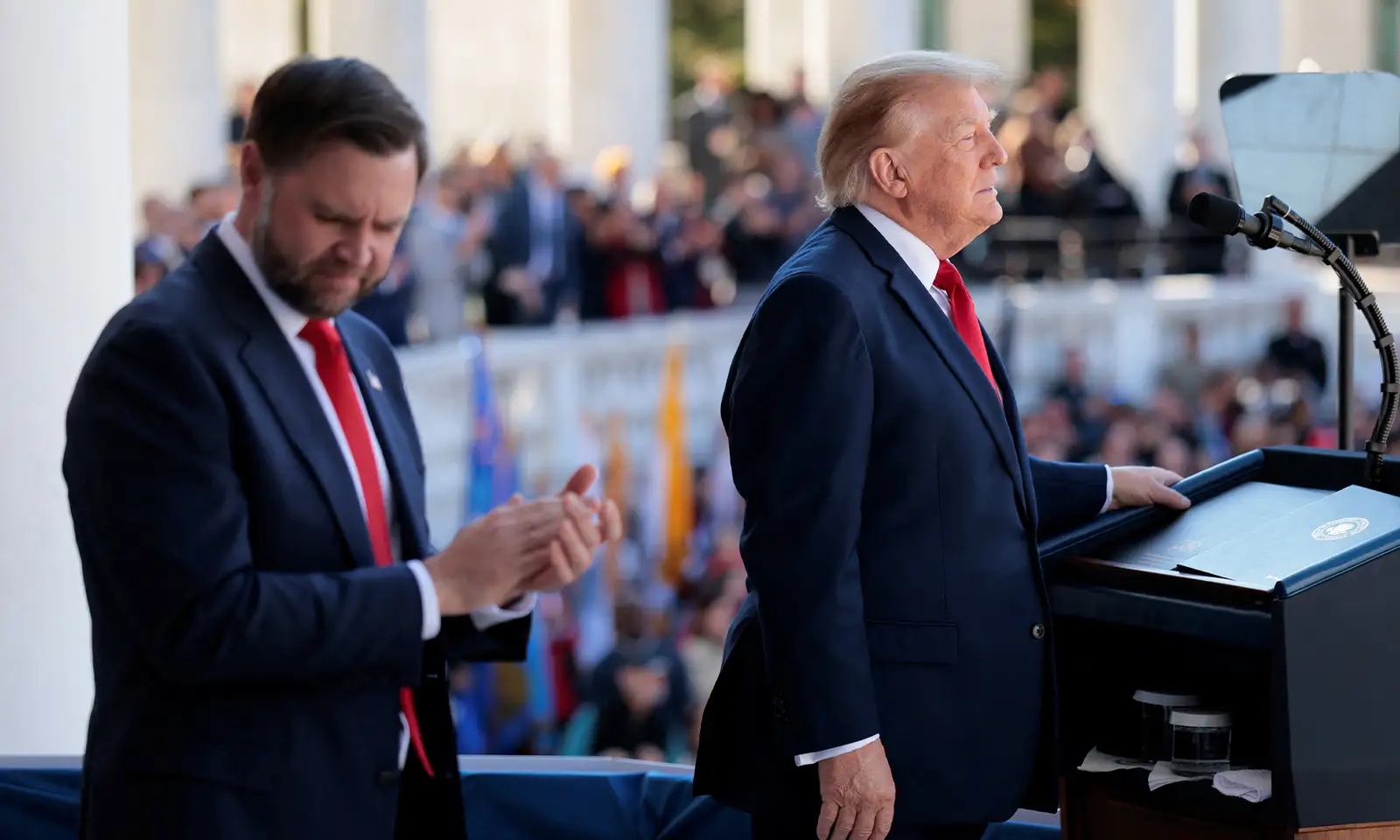
On the menu today: Vice President JD Vance uses the launch of the video game Grand Theft Auto 6 to argue “the Golden Age is now.” I suppose if you were a Democratic congressional candidate this past year, it feels that way, yes. The border is much more secure, although the administration faces a tough deadline for its ambitious wall construction plans; most of the economic data are mixed — not a recession, but wages are falling behind the inflation rate; and once again, President Trump sets out to prove that he’s Vladimir Putin’s best friend. Read on.
Trump and Vance Are Still Arguing America Is Enjoying a Golden Age
In the most recent issue of the print magazine, as part of our review of the 2026 midterms, I argued President Trump took on reality . . . and reality won. He kept telling Americans that inflation had been defeated, the Strait of Hormuz was open, and gasoline would soon be below $3 per gallon. That, more than anything, explains how the midterms turned into such a debacle for Republicans:
Over the past year, the gap between Trump’s rosy picture and Americans’ day-to-day lives grew too wide. Trump kept insisting that things had gotten better and that even happier days were just around the corner. Americans looked in their wallets and bank accounts, at their grocery bills and at the number on the gas pump, and disagreed. After a while, they concluded that Trump didn’t know what the heck he was talking about or that he was just another used-car salesman willing to promise anything.
On Election Day 2026, Trump’s war against reality suffered its most devastating defeat.
I mention all this because it appears the administration hasn’t learned a darn thing from losing nine U.S. Senate seats, 46 U.S. House seats as of this writing (Democrats lead in three more races that have not been officially called), six gubernatorial offices, and control of twelve state legislative chambers.
At 6:05 p.m. last night, the Office of the Vice President put out a post on X using images of Donald Trump and JD Vance in the style of the Grand Theft Auto game series, declaring, “The Golden Age is now.”
I mean, I suppose if you’re a Democrat, it may feel like a golden age kicked in on Election Day.
I’ll start with the administration’s strongest argument. One of the images in Vance’s post is that of Border Patrol agents walking past the border wall.
Now, indisputably, the change at the U.S. southern border since Trump’s second term began is like night and day. In October, the U.S. Border Patrol encountered just 11,443 individuals attempting to cross from Mexico into the United States. A year earlier, in October 2025, that figure was about the same: 11,703. In October 2024, the final months of the Biden administration, it was 106,316. The year before that, October 2023, it was 240,927.
But when it comes to border wall construction . . . it’s not quite the same sterling success story. The border between the U.S. and Mexico runs 1,954 miles. Before January 20, 2025, the U.S. had 644 miles of existing primary wall that met U.S. Border Patrol operational requirements and 75 miles of secondary wall. While it may have always been unrealistic to have a wall running the length of the entire border, that left 1,310 miles with no barriers.
Nearly two years into President Trump’s second term, the construction efforts of U.S. Customs and Border Protection and the Department of Defense have indisputably made progress. About 100 miles of new wall have been built, 48.5 miles of replacement wall have been installed, 82 miles of water barriers are in place, and 133 miles of secondary border wall have been built. Assuming the water barriers and border walls don’t overlap, that adds up to 230 more miles covered. (Secondary barriers do not count as new miles covered.) But . . . we’re still left with 1,080 miles without barriers.
Nearly six years into Trump’s presidency, 55 percent of the U.S.-Mexico border has no manmade barriers.
The administration plans to build 1,418 miles of “primary smart wall,” with “approximately 536 miles of the U.S.-Mexico border without barrier will be covered by detection technology “due to unfavorable terrain or remoteness of location.”
In August, a CBP spokesman declared, “Border wall construction is planned for completion in 2028.” Considering how it has taken two years to build 100 miles of new wall, it is a tall order to complete 386 miles in the next two years.
Turning to the economy, over the past year, the nominal average weekly wage grew 3.6 percent . . . while the inflation rate was 3.7 percent. Until May 2026, the administration could at least boast that year-over-year wage growth was in the 3.3 percent to 4.3 percent range, while the inflation rate bounced between 2.3 and 3 percent — not great, but at least keeping the head above water. But in the last few months, even that minor success story has evaporated.
From a year ago, gas is nearly 37 percent more expensive, computer software is 25.9 percent more expensive, and postage and delivery service prices are up almost 16 percent. Ground beef is 5 percent more expensive. Eggs are almost 27 percent cheaper, though!
Similarly, the stock markets are still having a good year overall, and some degree of deflation of the artificial intelligence bubble was just about inevitable. But the S&P 500 peaked at 7,819 on October 6, and yesterday it closed at 7,175. It is still up about 10 percent, a pretty good year, but for a while it was looking like a great one.
And there are some ominous rattles in the economy. The average mortgage rate on a 30-year mortgage is 7.28 percent. Credit card debt is at an all-time high. A low-hire, low-fire economy — which has been in place for three years — feels alright if you have a job but is deeply frustrating if you’re looking for one.
The tariffs were supposed to generate an explosion of new manufacturing jobs. In January 2025, the U.S. had 12,693,000 manufacturing jobs. In October 2026, the U.S. had 12,681,000 manufacturing jobs, a slight decline.
The Tax Foundation calculates that tariffs will increase taxes by an average of $820 per U.S. household. That is a major tax increase, despite the president’s insistence that other countries are paying them.
The administration will point to the national average price of gas declining from $4.60 in late September to $3.94 per gallon last week (Energy Information Administration numbers here). But it’s November, traditionally a time of lower demand. At this time a year ago, it was $3.19. Two years ago, it was $3.16. Three years ago, it was $3.41.
If you want to change the perception of something, you must change the reality of something. You cannot convince people that they’re doing better than they actually are. This administration can churn out memes about the “golden age” as much as it wants, but it’s not going to change people’s perceptions about the administration or the economy until the economic reality on the ground actually changes.
The U.S. Is Now on Russia’s Side, Part 2,345
From the Daily Telegraph, over in London:
Donald Trump told European leaders to withhold funding from Ukraine in an angry phone call after his summit with Vladimir Putin.
The U.S. president dialed into a meeting of the coalition of the willing in Berlin from Air Force One and launched what was described as a “tirade” against NATO allies.
Sources said Mr. Trump had told European supporters of Ukraine to stop talking about sending emergency financial aid and focus instead on his controversial peace plan.
Two insiders described the U.S. president’s remarks as “a tirade”, saying he criticized plans by the EU and Ukraine’s other international supporters to help cover the country’s €70bn (£62bn) financing gap for 2027.
(Interruption from Jim: In U.S. dollars, Ukraine’s projected deficit for 2027 is $81 billion. That might sound bad, but at the current pace, the U.S. government runs up $81 billion in new debt every twelve days.)
Mr. Trump’s call was made via the phone of Jared Kushner, the U.S. special envoy who attended the coalition of the willing summit in Berlin along with Steve Witkoff, another US peace envoy.
The US president was travelling back from China, where he held an unprecedented trilateral summit with Putin and Xi Jinping, the Chinese leader, that was called “Yalta 2.0”, referring to the post-World War Two meeting between Winston Churchill, Franklin D Roosevelt and Joseph Stalin.
Mr. Trump also held a private one-on-one summit with Putin, who appeared buoyed by the talks. Putin said the meeting had gone “even better than expected”, and the Kremlin said his mood was “excellent.”
Dan Foster, a regular contributor to The Editors podcast, is correct. This administration no longer merely wants Europe to take a larger share of the responsibility for its own defense against Russia; this administration wants Europe to stop helping Ukraine, period. The president believes ending all international aid to Ukraine will lead to peace, based upon Vladimir Putin’s promises. If it does lead to peace at all — an extremely dubious assertion — it will end with a peace that is on Putin’s terms.
Back in March 2025, this newsletter declared, “The U.S. government has effectively switched sides in the war.” I was told that was hyperbolic and premature.
In just the past few weeks, we’ve seen President Trump issue waivers to the Lindsey Graham Act sanctions on Russia and its trading partners, purchase Russian oil that no company based in the U.S. wants to take, review the lifting of additional sanctions on Russia’s sovereign wealth fund, call Putin “his friend,” and invite Putin to the G-20 summit. Oh, and a Trump appointee ordered that a giant Russian flag be draped over an Atlanta landmark.
ADDENDUM: Speaking of Grand Theft Auto 6, over in the Corner, Noah Rothman argues that violent video games do not beget violent acts, and the notion these games are shaping young minds ignores some dramatic demographic changes: “The Entertainment Software Association’s 2026 Essential Facts report found that the average American video game player is 37 years old.”
Meanwhile, Kathryn Jean Lopez argues, “My position on the matter remains the same as it ever was: Bill Bennett, Tipper Gore, and Joe Lieberman were right. . . . Immiseration degrades the desire for flourishing until such a thing — anything better — seems quite impossible. The more lifelike, the more dehumanizing it seems.”
I come down somewhere in the middle. Years back, I recall Tom Nichols getting really mad that video games had become a spectator sport. It’s not how I’d choose to spend my free time, but everybody relaxes and blows off steam in their own way, and there’s not much point in getting mad at how someone else chooses to unwind. (You’re unlikely to persuade anyone by yelling at them about it, anyway.) I’m sure some people find it ridiculous to watch football, or superhero movies, or to celebrate the Christmas season with Die Hard. Whoever you are, you choose to do something that somebody else finds ridiculous.
With that said . . . whatever time you spend playing video games, you could do something else and actually have something you’ve accomplished.



Comments
On “The Problems with the Trump Administration’s ‘Golden Age’ Claim”