
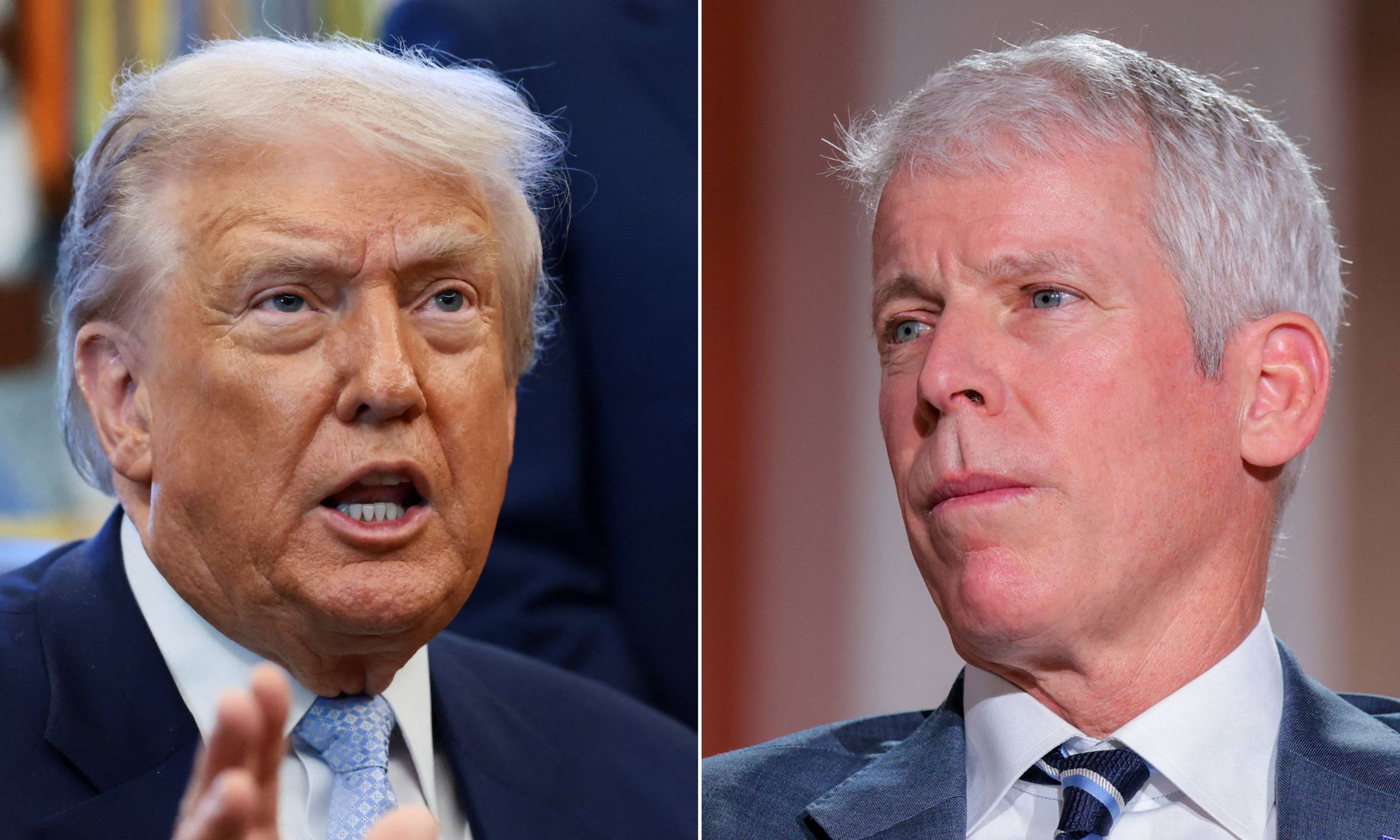
On the menu today: If you live in Virginia, today’s the day to go out and vote against the ludicrous gerrymandering proposal from the Democrats. But beyond my home state, the president is insisting that his secretary of energy is “totally wrong” in his assessment of gas prices in the coming year, while the U.S. Defense Intelligence Agency has concluded, “Iran retains thousands of missiles and one-way attack UAVs that can threaten U.S. and partner forces throughout the region, despite degradations to its capabilities from both attrition and expenditure.” Thousands? Read on.
Gas Prices, the Iran War, and the Republican Midterm Gloom
Secretary of the Treasury Scott Bessent, holding a press conference at the White House, Wednesday, April 15:
Q: When are we really going to get $3 a gallon gas?
Scott Bessent: Well, I think that’s going to be up to how the negotiations go. President Trump said this morning that he thinks we’re nearing the end. The U.S. kept their side on the cease-fire. We’ve stopped firing. The Straits of Hormuz have not been completely reopened. So, we will see. And I’m optimistic, uh, that during the summer, we will see gas with a three in front of it sooner rather than later.
Q: So, not by summer, like Memorial Day, but maybe by Labor Day?
Bessent: Uh, again, I’m optimistic that sometime between June 20th and September 20th, that we can have $3 gas again. And as I said this morning too, we are going to be watching the gas stations because they — they raise prices very quickly when the stated — when the crude oil prices went up, we hope they’ll bring them down just as quickly as crude oil prices have come down, which they’ve come down substantially just in the past ten days.
Secretary of Energy Chris Wright, appearing on CNN’s State of the Union, Sunday morning:
Jake Tapper: So, when you were on the show March 8, I asked you when gas prices would go under $3 a gallon for regular unleaded. You said — quote — “In the worst-case, this is a weeks, this is not a months thing.” That was six weeks ago, so we’re still within the weeks realm, but we’re two weeks away from the months thing. When do you think it’s realistic for Americans to expect the gas will go back to under $3 a gallon?
Chris Wright: I don’t know. That could happen later this year. That might not happen until next year. But prices have likely peaked, and they will start going down. Certainly, with a resolution of this conflict, you will see prices go down. Prices across the board on energy prices will go down.
Tapper: But it might not be under $3 a gallon until 2027?
Wright: Under $3 a gallon is pretty tremendous in an inflation-adjusted terms [sic]. We had that in the Trump administration, but we hadn’t seen that in inflation-adjusted terms for quite a long time. We will get back there, for sure.
But by Monday, President Trump was insisting that Wright was “totally wrong” on his assessment:
President Trump told The Hill on Monday that he disagreed with Energy Secretary Chris Wright’s assessment that gas prices may not drop below $3 per gallon until next year.
“No, I think he’s wrong on that. Totally wrong,” Trump said in a phone interview when asked about his Energy chief’s comments.
When asked by The Hill when he believes gas prices will drop, Trump said “as soon as this ends,” referring to the Iran war.
Back on April 7, the U.S. Energy Information Administration issued its short-term energy outlook report and concluded, “We forecast retail gasoline prices to peak at a monthly average of close to $4.30 per gallon (gal) in April and average more than $3.70/gal this year.”
According to the EIA, as of April 13 (the most recent date as of this morning), the average price for all grades and all formulations nationwide is $4.12. According to AAA, the average price for a gallon of gasoline is $4.02. (That’s actually slightly down from a week ago, when it was $4.11.) A year ago, the average price on AAA was $3.15.
And remember, we’re getting into summer driving season: “Gas demand increases a few percentage points each month beginning in February and peaks in August. Total fuel demand is 10 percent to 15 percent greater in August than in February.”
The average American drives about 13,500 miles per year. Different calculations will give you different figures, but if gas prices remain around $4 for the rest of the year, Americans can expect to spend anywhere from $500 to $574 to $740 more than last year on filling up their tank.
Unless you’re in preschool, you’ve lived through this before. In June 2022, EIA’s average price for a gallon of gas nationwide surpassed $5 per gallon. (By November, EIA’s average price was $3.79, and Democrats didn’t have such a bad midterm election cycle, although they did narrowly lose their majority in the House of Representatives.)
When gas prices go up, the cost of moving freight goes up, and the cost is passed along to consumers. UPS, FedEx, Amazon, and other retailers will start adding fuel surcharges, along with rideshare services like Uber.
This is a formula for even more economic frustration and discontent between now and the midterm elections. And by one measure, consumer economic confidence is at its all-time low:
Consumer confidence plunged to a record low in April as fears mounted over rising energy prices and the broader impact of the Iran war, according to a University of Michigan survey Friday.
The university’s headline index of consumer sentiment tumbled to 47.6, down 10.7 percent from the March survey to its lowest on record. Current conditions and expectations indexes also saw double-digit monthly declines.
The drop in sentiment coincided with a sharp spike in inflation expectations, with respondents seeing prices up 4.8 percent in a year from now, a full percentage point rise from the March reading to its highest since August 2025. . . .
Survey comments “show that many consumers blame the Iran conflict for unfavorable changes to the economy,” said the survey’s director, Joanne Hsu.
In case you’re wondering, the University of Michigan has been measuring consumer confidence since 1946.
The administration and congressional Republicans — and for that matter, Republicans running for non-federal offices like governors and state legislative offices, too — need a clear message on the war, and a clear message on the economy. And that message cannot be, “Oh, everything will get better, just wait and see.”
As I noted in the Corner yesterday, the president has been saying that the war against Iran is “won,” “close to over,” or a “total and complete victory” for about four weeks now.
Back on March 23, Trump said, “Our powerful military campaign to end the threats posed by the Iranian regime continued in full force over the past few days. They have been literally obliterated. . . . The missiles are trickling in now at very low levels because they don’t have too many missiles left.”
Yesterday afternoon on Truth Social, Trump wrote, “I’m winning a War, BY A LOT, things are going very well.” (At the risk of being considered one of those conservatives who are allegedly obsessed with pronouns, I found the president’s choice of first-person singular revealing.)
On April 16, Lieutenant General James H. Adams III, the director of the Pentagon’s Defense Intelligence Agency, testified before the House Armed Services Committee’s Subcommittee on Intelligence and Special Operations:
Iran retains thousands of missiles and one-way attack UAVs that can threaten U.S. and partner forces throughout the region, despite degradations to its capabilities from both attrition and expenditure. In addition, Iran poses a persistent threat to freedom of navigation throughout the Persian Gulf, Strait of Hormuz, and Gulf of Oman, including retaliatory seizures of commercial ships and the threat of mining the Strait of Hormuz. Since the beginning of Operation EPIC FURY, Iran has effectively closed the Strait of Hormuz by conducting and threatening attacks on commercial ships. Iran’s ground and air forces have outdated equipment and limited training and sustained damage during coalition strikes; they almost certainly cannot defeat a technologically superior adversary. Iran likely will further asymmetric warfare advancements to augment its conventional capabilities as it remains in conflict with the United States and Israel. [Emphasis added.]
This isn’t the assessment of the mainstream media — you know, the one that Secretary of Defense Pete Hegseth compares to the Pharisees and declares to be “incredibly unpatriotic.” This is the assessment of the U.S. Defense Intelligence Agency, whose primary mission is to “provide military intelligence to warfighters, defense policymakers and force planners in the Department of Defense and Intelligence Community.” In other words, getting the best and most accurate assessment of enemy capabilities is their job. If the DIA believes and publicly declares that Iran still has “thousands of missiles and one-way attack UAVs that can threaten U.S. and partner forces throughout the region,” then it’s a safe bet that the Iranians have them. The regime may well have started the war with 10,000 or more, and no doubt the U.S. has destroyed many of their stockpiles. But attacks on ships in the Persian Gulf continue.
The president boasted Friday, “Iran has agreed to never close the Strait of Hormuz again. It will no longer be used as a weapon against the World!” Only the most spectacularly naïve or deluded figure would ignore the entire history of the regime in Tehran and accept a promise from the mullahs at face value.
The president boasts of the “obliteration” of the Iranian regime and that “they don’t have too many missiles left,” but the DIA assesses otherwise. The president says gas prices will come down soon; his Energy Secretary and the EIA project otherwise.
Very little of what the president says off the cuff or posts on Truth Social lines up with reality, and the American people have noticed. This is why his approval rating is at a new low for his second term, two-thirds of respondents disapprove of his handling of inflation and the Iran conflict, and only 36 percent of Americans approve of the strikes against Iran. A new Reuters poll finds 71 percent of Americans do not consider Trump “even tempered,” and 51 percent say Trump’s mental sharpness has “gotten worse.” Forty percent say Trump’s mental sharpness has “stayed the same,” and somehow 6 percent have talked themselves into believing it has “gotten better.”
ADDENDA: You can watch the National Review Institute’s regional seminar on limited government, featuring my interview with former Governor Jeb Bush, here.
. . . The January 30 edition of this newsletter looked at Trump’s cabinet and pointed to five figures as particular underperformers or liabilities: then–Secretary of Homeland Security Kristi Noem, then–Attorney General Pam Bondi, Director of National Intelligence Tulsi Gabbard, Labor Secretary Lori Chavez-DeRemer, and Health and Human Services Secretary Robert F. Kennedy Jr.; with Chavez-DeRemer’s departure yesterday, it’s three down, two to go. If only someone could have warned the president about Chavez-DeRemer!
. . . Nick Fuentes may be a hateful little toad, but he’s raking in the cash . . .
. . . Finally, over in that other Washington publication, President Trump declared that English is the official language of the United States . . . and then gutted and eliminated the U.S. Department of Education office that specializes in teaching English to immigrant kids — both legal and illegal — in public schools.






Comments