Dear WJ Reader and Imbiber,
Before we belly up to the bar, I thought I’d give a plug to my pal Scott Rasmussen, who is back in the polling saddle. His latest presidential-race tracking numbers were released on Valentine’s Day, and show President Trump with a 50 percent “total approval” of likely voters. Scott adds a little comparative gimmick: At the same presidential point in time in 2011, Barrack Obama had a 48 approval rating.
Now bartender . . .
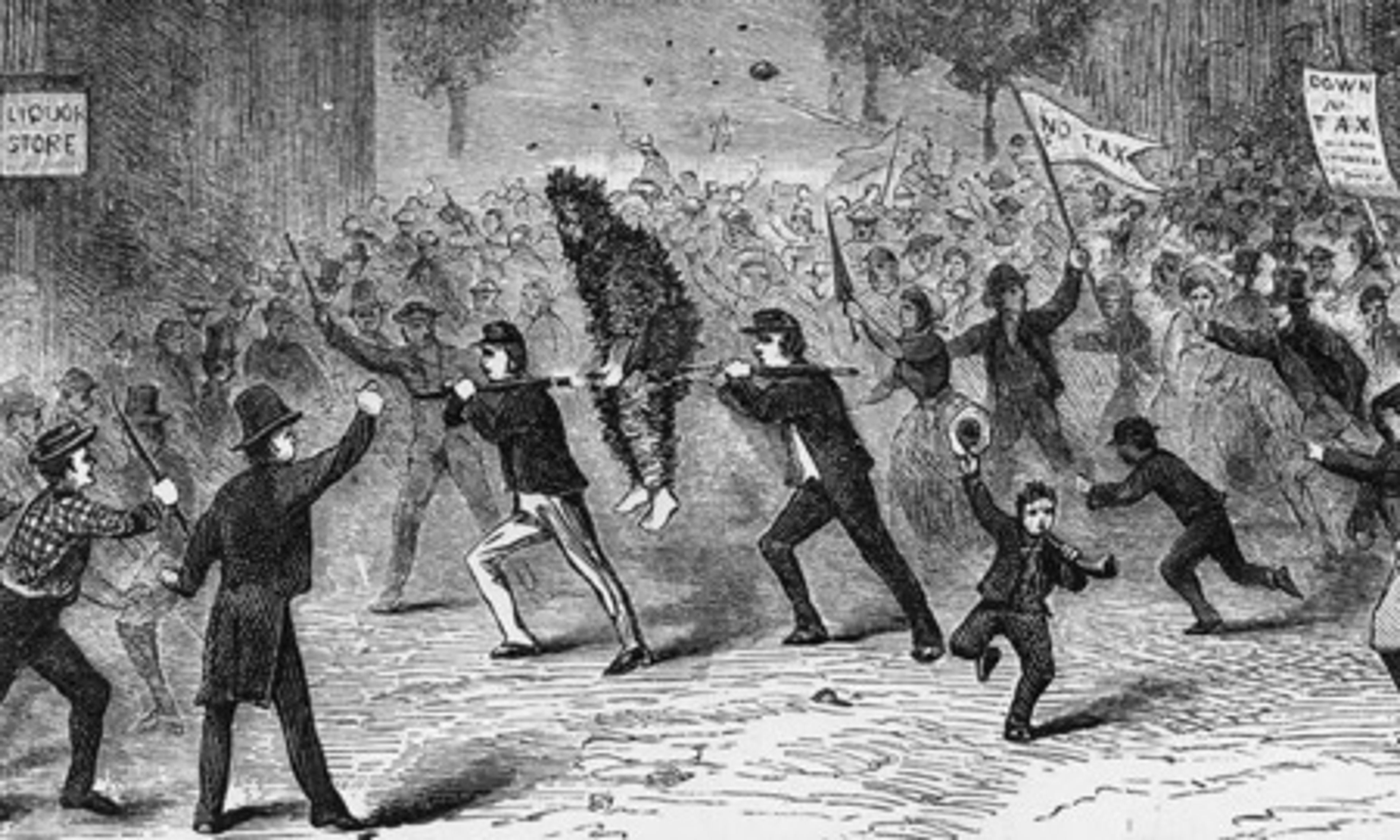
So much of the history of this Nation, conceived in Liberty and pickled in moonshine and marinated in lager, is dedicated to the proposition that the bartender buys back the fourth drink. How America, land of the Whiskey Rebellion (pictured above — looks like some ancient revenuer getting a little tar-and-feathers treatment from the locals), endured a decade or thereabouts of Prohibition remains a mystery, because so much of our national being — never mind revenues! — has been emeshed (e-mashed!) in the fruit of the vine; the sudsy byproduct of yeast, hops, barley, malt, and water; the juniper-smelling liquid distilled in the tenement bathtub; and the tooth-melting White Lightning dripping from coiled stills deep within the woods primeval.
Admittedly, our War of Independence began over another liquid libation, tea, but that aside, other than baseball and Old Glory, ’Murica is about booze in its many breeds and variations.
On the GDP front, bottles with labels that admit to a “proof” comprise many big and growing businesses, or booznesses (rimshot!), whose product is exported hither and yon. And now for the grim news: The alcohol industry and the many many jobs it provides to many many a household is at risk from the tariffs imposed by the Trump administration and the ensuing retaliation from other nations. The unintended consequences of trade warfare on this particular industry is increasing pain, sharp enough to make your head spin (like after that fourth Harvey Wallbanger which followed your third Tom Collins). See below for a link to a must-read story about this overall to-do. Play this while you read it.
Now before we get to the WJ meat and potatoes I hope you chow down on this President’s Day Weekend, here is . . . a commercial.
“Didn’t I Meet You on a Summer Cruise?”
The great director Roger DeBris asked that of Accountant Bloom, and though the answer was “no,” the fact remains that someday you might ask the same of the people you will have met, during the week of August 24-31, on Holland America Lines’ beautiful MS Zaandam, home to the National Review 2019 Canada/New England Conservative Cruise. Here are the essentials:
- It’s affordable (prices start at only $2,499 a person).
- The itinerary is terrific — Montreal, Quebec City, Halifax, Bar Harbor, Sydney, Charlottetown. The growing speaker line-up — Rich Lowry, Charlie Cooke, Kevin Williamson, Jay Nordlinger, John O’Sullivan, and Maddy Kearns — includes former U.S. Attorney General Jeff Sessions, author Peter Schweizer, conservative legal expert Cleta Mitchell, Acton Institute founder Fr. Robert Sirico, AEI scholar Christina Hoff Sommers, and City Journal editor Brian Anderson. It will make for excellent discussions of the day’s primo topics.
- The NR exclusives — seven scintillating seminar sessions, two fun-filled “Night Owl” sessions; three revelrous pool-side cocktail receptions; one late-night “smoker” featuring superior cigars (and complimentary cognac); and intimate dining on at least two evenings (and likely three) with a guest speaker or editor — will greatly enhance an already superior voyage.
You’ll want to go. You will go. Get complete information (and a per-person discount of $200 if you sign up this month) at www.nrcruise.com.
Editorials
1. Jew-Hate is alive and well and living in the seat occupied by the representative of Minnesota’s Fifth Congressional District, Ilhan Omar. We’re having none of her filth. From our editorial:
The old proverb about race in the United States held that in the North they embraced African Americans as a group but rejected them individually, whereas in the South they might embrace African Americans on an individual basis but hated them as a group. American progressives who insist that they are not anti-Semites but only anti-Israel take something like the southern view: They hate Jews as a national entity, not on a case-by-case basis. If that is the best they can say about themselves, that isn’t very much.
But it certainly is not the worst they can say about themselves. The Left and the Democratic party tolerate anti-Semitism openly expressed, period: From the Reverend Al Sharpton and his Jewish “bloodsuckers” in Crown Heights to the footsie-playing with Farrakhan to Representative Omar’s trafficking in the worst of 1920s anti-Semitic mythology, anti-Semitism is now a regular part of politics among Democrats, from the far-left radicals who see in Israel an extension of American imperialism to those who appeal to the anti-Semitism that is all too common among African Americans and Muslim Americans, the latter of whom are an important new Democratic constituency. This is the reality that informed Representative Omar’s libel.
2. Well, the paltry Wall funding is a lousy deal. From our editorial:
If this is a disappointing state of affairs, it’s a product of poor choices, by Trump and congressional Republicans, on one of the president’s top political priorities. It was malpractice not to get more funding for a border barrier out of Congress when it was held by Republicans (though the Democrats might have filibustered any deal they didn’t like). It was bizarre that the White House didn’t formally request more funding last year, before Trump drastically increased his demand to $5.7 billion near the end of process. Finally, it was foolhardy to lurch into a shutdown without a viable strategy for getting out of it.
At least the current deal doesn’t reflect Nancy Pelosi’s vow not to approve a dollar for a border barrier, and Democrats backed off their demand in the negotiations for a hard cap on ICE detentions.
3. The (nominally) most Catholic state in the nation, Rhode Island, is making plans to duplicate New York’s infanticide depravity. We urge legislators there to defeat this literally inhumane proposal. From our editorial:
The bill is already cosponsored by more than half the members of the Rhode Island house. Democratic governor Gina Raimondo, a self-professed moderate, has vowed to sign it, writing of the bill, “I believe that no one should get in the middle of a decision between a woman and her doctor and that no woman should have to [choose] between health care and making ends meet.”
The bill’s supporters say it would merely codify Roe v. Wade, spin included in the bill text. Too few voters realize that the Supreme Court’s precedents effectively create a right to late-term abortion. But as expansive as the Court’s rulings have been, the bill goes further. The Court has allowed states to ban partial-birth abortion and to declare that life begins at conception; the bill removes both of these provisions from state law. The Court allows states to refrain from subsidizing abortion, too, but the bill can be read to require state funding for elective abortions.
4. Omar Strikes Again: The ignorant Lefty clashes with President Trump’s nominee for Venezuela special envoy, Elliott Abrams. From our editorial on the House freshman:
In short, Elliott Abrams is one of the wisest, most experienced foreign-policy heads in this country. He is also a steadfast advocate of freedom, democracy, and human rights, or American values, if you like.
Yesterday he appeared on Capitol Hill and encountered Ilhan Omar. She is a freshman House member — a Democrat from Minnesota — who has had a lively first month. We editorialized about her and anti-Semitism on Monday (here).
She called Mr. Abrams “Mr. Adams.” (Congratulations, Elliott, you’re a Gentile!) She got a lot else wrong too. She swiped at Abrams for the Iran-Contra affair — and refused to let him defend himself. She went on to accuse him of being complicit in the rape, murder, and mayhem of Central America — El Salvador, in particular.
To see this performance on C-SPAN, go here.
A great many hailed this performance, certainly on the old anti-Reagan left. It was as though the Christic Institute and CISPES had come back to life. Social media rang out with the old charges, the old smears, the old libels. Not all of Abrams’s enemies are on the left, of course. David Duke, of Klan fame, or infamy, chimed in with “Rep. Omar clashes with Zionist war criminal.”
You Can Stop Smacking Your Lips, Because Here Are 16 Delicious and High-Calorie NRO Articles, Fresh from the Oven
1. More kudos to President Trump for naming David Malpass to head the World Bank, this time from David Bahnsen. From his article:
If there is to be a World Bank at all, its core mission must be rediscovered. Facilitating a dependence on interest rates below market levels is not a sustainable mission, is distortive to economic stability, and creates malinvestment that is revealed as such at the most inopportune times. Using the bank’s vast financial resources to drive a turn towards “strong growth principles” (Malpass’s words) is not to reject the World Bank’s mission, but rather promotes the greatest of solutions for the world’s poorest countries. His agenda centers around accountability — finding ways to measure success so that the dollars provided from the bank can be optimized and constantly in pursuit of their most effective allocation. Malpass sees transparency as fundamental to accountability and has promised to enforce requirements that borrowing nations reveal the terms of their debt agreements. It strikes me that someone demanding this basic step from those the bank lends money to probably cares about the viability of the lender more than those cheerleaders of the institution who fail to demand such do.
Those genuinely supportive of the mission of the World Bank should praise the substance of David Malpass’s criticisms. China received nearly $2 billion in loans from the World Bank in 2018 alone and yet is the world’s second-largest economy, with unfettered access to capital markets. The argument Malpass makes is irrefutable: When World Bank resources are used to help powerful countries that do not need them, the mission of the bank is called into question.
2. Corporate welfare is for losers . . . which would mean taxpayers. Russell Latino looks at some recent deals that have gone very awry. From his article:
Across the country, cities and states spend billions every year trying to either entice new companies to set up shop or persuade existing ones to stay put. They do the same with professional-sports teams.’
Yet even with a mountain of academic evidence showing that such corporate-welfare schemes have little to no overall positive economic impact, the politicians — Republicans, Democrats, and independents alike — continue falling for every outlandish promise of more jobs and an economic boost for their communities.
In most cases, businesses’ location decisions are based on things like the availability of a qualified work force, general business climate, and quality of life. Even in cases where a business receives corporate welfare, the incentives make a difference at most one quarter of the time.
More often, corporate welfare is icing on the cake for a decision that was already baked in. In 2016, Northrop Grumman raked in millions from Maryland taxpayers. Lawmakers expressed concern that the company — which was already located in the state — might be lured away by subsidies from other states.
3. Funny (not) that the original “New Deal” sought to bring electricity to the overlooked countryside, while the Green New Deal flips that: It’s nothing less than an assault on electrical power for rural America. Robert Bryce looks at how the plan would cost Old MacDonald billions. From his article:
For New Deal politicians such as Representative Sam Rayburn (D., Texas), Senator George Norris (R., Neb.), and Senator Burton Wheeler (D., Mont.), the need for cheap electricity in rural America could no longer be ignored. Rayburn grew up on his family’s 40-acre cotton farm near the north Texas town of Bonham. First elected to the House of Representatives in 1912 at the age of 30, Rayburn never forgot where he came from or how hard life was for farmers. Without electricity, Rayburn said, rural farmers and ranchers were merely “unwilling servants of the washtub and water pump.” As he famously said: “I want my people out of the mud and I want my people out of the dark.”
Rayburn, who would go on to be the longest-serving speaker of the House in U.S. history, was the co-sponsor of both the Public Utility Holding Company Act and the Rural Electrification Act. Those New Deal laws yielded quick results. By 1950, nine out of ten farms in America were connected to the electric grid, a reversal of the situation that existed just 20 years earlier. Between 1940 and 1970, the amount of electricity produced by rural cooperatives jumped more than 200-fold. Over that same time period, the cost of residential electricity in the U.S. fell dramatically, going from 3.8 cents per kilowatt-hour in 1940 to 2.1 cents in 1970.
4. Más on the GND: David French sees it as a con job. The target? The Democrats’ base. From his take:
Look back at the list of presidential-candidate endorsers of this plan, all experienced politicians, all with years of experience working through the American legislative process. Now look back at the promises above. If you believe for one second that any material provision of the Green New Deal will become policy, you’re being conned.
A competent media could and should prove as much in mere moments. A competent media could and should ask Kamala Harris at every campaign stop for her precise plan to “guarantee a job with a family-sustaining wage” to every person in the U.S. A competent media could and should rush to press Elizabeth Warren about her precise plan to completely overhaul American power generation in a mere ten-year span without crushing the economy.
5. Dan McLaughlin says it matters if presidential wannabe – and alleged mean boss – Amy Klobuchar treats her minions like crapola. From his analysis:
In the specific case of Senator Klobuchar’s mistreatment of subordinates, Democrats will be hard pressed to claim that this is a new avenue of criticism. John Bolton, now the national security adviser, was filibustered by Senate Democrats when President Bush nominated him as U.N. ambassador in 2005, in large part on the basis of claims that he was abusive to subordinates (see this contemporary report by Jay Carney, later Obama’s press secretary, for a taste). And of course, reports of Donald Trump’s emotional outbursts and demeaning treatment of the people who work for him have been a daily staple of Trump criticism for the past three and a half years and are expected to be part of the Democrats’ case against Trump in 2020. Tina Nguyen at Vanity Fair draws the parallel explicitly: “Terrified Aides Say Amy Klobuchar Is Just Like Trump.” Clearly, this line of attack is good for the gander.
Indeed, more trivial claims of mistreatment have led to much more extensive press coverage. Mitt Romney was almost universally regarded by his subordinates as a model boss, but a story about Romney driving to a vacation spot with his dog on the roof of his car led to a colossal, years-long media feeding frenzy. Seamus the dog was mentioned more than 80 times just by the New York Times columnist Gail Collins, in near-nightly jokes from David Letterman, and in jibes from the Santorum and Obama campaigns. Seamus was the topic of international media coverage, televised questions for the nominee from Diane Sawyer and Chris Wallace, a New Yorker cover, a “Dogs Against Romney” protest group, a Snopes fact check, even a song by Devo. The Atlantic’s David Graham wrote of “America’s Enduring Seamus Obsession,” and the Boston Globe’s Neil Swidley, who originated the story, ruminated on “What our fascination with Mitt Romney’s dog Seamus says about our culture.”
Ultimately, there are two main reasons why Klobuchar’s treatment of subordinates is particularly newsworthy: because it calls into question her executive temperament, and because it conflicts with the public image she tries to project.
6. What the Northam / Fairfax lunacy in Virginia is teaching us about the new mores of the American Progressive Left. Professor Victor Davis Hanson is at the lectern. From his essay:
Get used to far more of this.
America is a multiethnic, multiracial society in which victimization leads to career dividends, attention, and psychological rewards. Yet intersectionality hinges on the various indecipherable strata of identity politics — especially when no one knows which DNA strand or ancestral narratives trump others. Add the 1960s left-wing legacies of promiscuity, sexual discovery, and let-it-all-hang-out, get-with-it, -all-is-groovy New Ageism, now mixed with 21st-century Victorian progressive prudery — and the result is a weird new hipster profile in sackcloth, as randy and as gross as Woodstock and yet as condemnatory as the Anti-Sex League of Orwell’s 1984.
The rules of sexual congress are being radically redefined among the elite as requiring veritable contractual agreements along every step of each encounter. When it comes to destroying careers, there is no statute of limitations, and no need for due process, cross-examination, or factual evidence.
Once a society establishes a system of rewards and punishments that favor accusation and force-multiply it through enhancements of race and gender, then fairness and truth become secondary considerations. Much less valued are notions of human frailty and atonement. Truth becomes a narrative of a particular class of victim, to be adjudicated in mob-like and often electronic arenas, without much attention to testimony, evidence, or witnesses.
7. Rich Lowry lambasts the New York abortion/infanticide law. From the end of his new column:
It is telling that pro-abortion advocates resort to euphemism even in this season of extremism. The New York law is called the Reproductive Health Act, an audacious abuse of language; the law is hostile to reproduction and dismissive of the health of unborn children. Two New York legislators wrote a defense of the law that constantly referred to “abortion care,” as if the addition of “care” softens the reality of what they are supporting.
The wordplay is cute, but the fact is that they deliberately denied the most innocent and vulnerable any explicit protection from heinous violence. This isn’t pro-choice. It isn’t humane. And it doesn’t have anything to do with medicine. In New York, pro-abortion advocates have shown us what they really are, and no one should ever forget.
8. John Yoo and James Phillips make the case for a restoration of the separation of powers. From their essay:
Thomas Jefferson believed “the leading principle of our Constitution is the independence of the Legislature, executive and judiciary of each other.” The Constitution allows only very specific ways for one branch to intrude into the affairs of another. It explicitly grants the president a limited veto, subject to override by two-thirds of both houses of Congress. The Constitution creates limited exceptions to the president’s exercise of the treaty and appointment powers by requiring Senate advice and consent — otherwise, the executive would enjoy both powers alone.
Progressives have long criticized this “formalist” approach to the separation of powers for restricting their ability to create new forms of government to handle problems unanticipated by the Founders. They usually have in mind agencies such as the Federal Reserve Bank, which seeks to shield interest rates from political manipulation by making its board independent, or the Federal Bureau of Investigation, which grants its director a ten-year term. But it has also led to hundreds of alphabet agencies, ranging from the Federal Communications Commission to the National Labor Relations Board to the Consumer Financial Protection Bureau, which regulate large swaths of the economy and society without having to obey the president or observe the Constitution’s limit on legislation to laws that survive both houses and receive presidential signature.
Unfortunately, even the Supreme Court of conservative Chief Justice William Rehnquist gave its blessing to this perversion of the Constitution’s original scheme. In Morrison v. Olson (1988), the Court upheld the original independent-prosecutor law, which prevents the president from removing the counsel except for cause. Even though all of the justices agreed that prosecution remained fundamentally an executive power, Chief Justice Rehnquist wrote for a 7-1 majority that this did not necessarily compel presidential control. According to the Court, Congress could shield the independent counsel from direct removal with a “for-cause” provision, which limited the president’s traditional discretion to fire any executive official for any reason. Acting through the attorney general, the president could still supervise the independent counsel to ensure he or she did not violate the law or DOJ policy. “We simply do not see how the President’s need to control the exercise of [the counsel’s] discretion is so central to the functioning of the Executive Branch as to require as a matter of constitutional law that the counsel be terminable at will by the President.” Outweighing any intrusion into presidential power was Congress’s need to advance an important public purpose: to solve the conflict of interest inherent when federal law enforcement investigated those at the upper rungs of government. The following year, in Mistretta v. United States (1989), the Rehnquist Court upheld an even more misbegotten creature, the U.S. Sentencing Commission, which claimed the power to set sentencing factors for every federal criminal trial in the nation.
9. One place where efforts to reduce political polarization should be directed is the college classroom. Which is exactly where such stuff ain’t happening, writes Ilana Redstone Akresh. From her essay:
Our universities are failing students by teaching them that there’s only one right way to understand our most vexing inequalities and social problems. This undoubtedly disproportionately affects students focusing their studies in the social sciences, but the near universality of cross-disciplinary general-education requirements (such that many students, regardless of their area of study, are required to take courses in the social sciences) suggests that almost no student is immune.
In sociology, for instance, we teach students about a wide range of social disparities. This entails conversations about the causes of those differences. Yet we do students an enormous disservice teaching them only about the possible structural causes of those disparities — aspects we can blame on the “system” or on “institutions.” Students learn, for example, that the gender pay gap is due to systemic labor-market discrimination against women and a devaluation of women’s work. These are likely contributing factors. But when pressed on the topic, most students can’t name a single additional factor that might contribute to the wage difference (such as variation between the sexes in job preferences or priorities).
I have had a chance to see this firsthand in an undergraduate course I am currently teaching at the University of Illinois at Urbana-Champaign. Aptly, the course is called Social Problems. It is an intro-level course in the sociology department and serves as a gateway to the major. On the first day of class, I told students that I would be teaching from multiple political angles — i.e., from a “heterodox” perspective — an approach that would necessarily include conservative viewpoints that are likely heard less often in their other classes.
We’re now almost four weeks into the semester and it’s clear that these bright, engaged students are not being exposed to the range of perspectives that they will need in their lives after college. I expect that, in this regard, they resemble students at many other institutions across the country. They are led to believe that our most difficult problems have simple causes and that those causes are rooted in structural bias that the right policies will fix. In addition, they are taught that this is the only right way to view these challenges.
10. California’s ginormously costly Train to Nowhere boondoggle, now largely abandoned, is the Green New Deal in a choo-choo setting, says Kevin Williamson of this and other outrages that find their root in the need to have “plans.” From his article:
Progressives love trains. They hate cars. There’s a reason for that.
The fundamental progressive idea is central planning. In the progressive imagination, society is a puzzle to be solved, a grand Rubik’s Cube that can be adjusted and readjusted and experimented with until — perfection! The progressive looks at society the same way a child looks at a model railroad set or an ant farm — which is to say, from a point of view that is effectively godlike. Human beings, their families, their desires, their pleasures, their dreams, their businesses, their associations, their communities — all of these are only chessmen to be moved around in pursuit of utopia.
A car can go basically anywhere its driver wants. A train can go only where the central planners have preordained. It is for this reason that trains have long been at the center of the progressive vision. And not only the progressive vision: Such modern utopians as Ayn Rand find in the railroad the model of the kind of society they desire: a society that is designed, that proceeds according to plan. Whose plan? Preferably one of their own, of course, but they’ll get on board for almost any old plan if the alternative is no plan at all.
There is another vision of society: that it is organic, that many of its best and more effective institutions are spontaneous orders, that all sorts of magnificent and enriching things are the result of systems that have no one in charge of them at all. That isn’t a manifesto for anarchism, but for what conservatives call “well-ordered liberty.” What is that? Aren’t ordered and liberty mutually exclusive? As conservatives understand things, the purpose of government is to govern: enforcing contracts and protecting property, rights, and liberty, which provides the security that is necessary for spontaneous orders to thrive.
11. Booze Boos Boo-Boo: President Trump’s tariffs have give America’s alcohol industry the DTs. C. Jaerrett Dieterle and Clark Packard roll out the barrels of facts. From their analysis:
President Trump’s tariff policies are the most prominent example of this disconnect. The administration’s aluminum tariffs, meant to protect the domestic aluminum industry, have had a disproportionate negative impact on beer manufacturers. Because aluminum is used in beer cans, the tariffs are driving up production costs for brewers. According to analysis by the Beer Institute, aluminum tariffs are costing breweries nearly $350 million a year and putting around 20,000 beer-related jobs at risk.
The damage to the alcohol industry from tariffs extends to other drinks as well. In response to U.S. tariffs, Canada, Mexico, China, and the European Union have all slapped retaliatory tariffs on American whiskey. Several distilleries have already forecast higher prices as a result, which could dampen consumer demand and stymie the job-producing potential of the spirits industry. Meanwhile, small craft distillers looking to expand into Europe have seen their market access dry up.
Lost in all this is the fact that the American drinks industry has some of the best job-growth potential in the country. According to data from the Bureau of Labor Statistics, breweries, wineries, and distilleries created the second-most manufacturing jobs of any industry in 2017. These numbers don’t even include support industries that are tied to drinks, such as barrel manufacturers or bottle producers. With new breweries and distilleries opening every day, the growth seems primed to continue — if policymakers will let it
12. Esquire had the temerity to run a cover story about a white 17-year-old low-ambitioned boy. Pretender-outrage ensued. Michael Brendan Dougherty checks out the knicker-twisteds. From his piece:
Esquire magazine launched a series of reported essays this morning with an article titled “The Life of an American Boy at 17.” It featured a tall, handsome, but not particularly dynamic white kid from Wisconsin who thinks he’s likely to end up working at a “water plant.” Thousands of people who don’t subscribe to Esquire, or normally read Esquire, or fit in with Esquire’s target demographic are furious about the choice of subject. Or at least they are pretending to be. Our future water-plant worker is just too unbearably privileged for the leading minds of New York media. He shouldn’t be represented this way. For reasons that aren’t altogether clear.
The outrage that this article exists in is recursive in quality. It begins with a presumption that this particular subject, a tall white teenager who vaguely supports the president, should not be “centered” — or given attention at all, that he has earned too much attention. Again, these aren’t Esquire subscribers or regular readers. The question occurs: “Aren’t you in control of your attention? Couldn’t you just ignore this article?” Apparently not. And because there is outrage that he got attention, the controversy itself becomes the cause of further controversy. The people claiming they don’t want to “center” Esquire’s cover subject draw him into the center of a hurricane.
13. Real “health care” — not the Cuomo version — saves lives instead of killing them. Alexandra DeSanctis explains how the “Groningen Protocol” has come to America. From her article:
Unborn children like the Simpsons’ daughter are rarely so lucky. Until now, technology hadn’t yet developed enough to offer parents a possible cure in utero. Instead, the medical community began to advocate terminating the lives of these fetuses. According to a 1999 study, 64 percent of fetuses diagnosed with spina bifida were aborted worldwide during that decade.
Some countries take this even further. In 2017, CBS News published a feature piece examining how Iceland is “leading the world in eradicating Down syndrome births,” as if the country had managed to develop a cure for the chromosomal disorder. Instead, the country has used a combination of prenatal testing and “therapeutic” abortion to systematically exterminate children prenatally diagnosed with Down syndrome. At last count, only one or two infants with the condition are born in Iceland each year — the lucky survivors.
In the Netherlands, meanwhile, the so-called Groningen Protocol allows for neonatal euthanasia of “severely ill” newborns. Killing such children is permitted up to the age of one in “the presence of hopeless and unbearable suffering.”
14. Jonathon Tobin recommends not accepting Congresswoman Omar’s “phony alibis for hate.” From his column:
In her apology statement, Omar also said that she continued to be concerned about “the problematic role of lobbyists in our politics, whether it be AIPAC, the NRA or the fossil fuel industry.”
If lobbying per se were the issue, Omar wouldn’t have confined her examples to lobbies whose views she opposes but might also have mentioned Planned Parenthood or the Council on American–Islamic Affairs, a group linked to supporters of Hamas terrorists, which also contributed to her congressional campaign. And, tellingly, not long after she issued her apology, she retweeted with praise a Twitter thread by a supporter who engaged in a vitriolic attack on supporters of the “Israel lobby” that repeated the same themes about Jews using money to seek power.
Omar’s focus on “the Benjamins” and the supposedly malign influence of lobbies also ignores the truth about AIPAC.
For all its mythic status, AIPAC’s power in terms of the money connected to its supporters and their influence is actually dwarfed by that of Planned Parenthood or a commercial lobby such as those that support the pharmaceutical industry. The broad bipartisan pro-Israel consensus in Congress is not the result of campaign contributions or clever lobbying tactics. It is a result of Israel’s popularity, which is reflected in opinion polls and stretches far beyond the influence of the Jewish community or political donors.
15. You’ll like this: Jennifer Braceras takes on the newest charge of “sexism” — wondering if female candidate X is likeable, or like Hillary, not likeable. From the beginning of her article:
Pantsuit nation is already crying foul. Fresh off the “Hillary lost because of sexism” tour, many purveyors of female victimhood are gearing up for a do-over.
With at least five women running for president (Senators Kirsten Gillibrand, Kamala Harris, Amy Klobuchar, and Elizabeth Warren have all announced their candidacies, as has Representative Tulsi Gabbard), the 2020 election cycle promises to be historic.
But rather than celebrate the rise of female politicians, many on the left are already excusing defeat by blaming sexism.
The latest culprit? “Likability” — that intangible constellation of personality traits that help candidates connect with voters on a personal level.
16. There’s an important SCOTUS establishment-clause case approaching concerning atheist attempts to remove the “Peace Cross” — the Bladensburg Veterans Memorial, which honors 49 Maryland men killed in action in World War One. Alexandra McPhee has the story:
Next week, the U.S. Supreme Court will hear oral argument from advocates for and against the preservation of a World War I–era veterans memorial, the Peace Cross, in Bladensburg, Md. The crux of the case, American Legion v. American Humanist Association, is the question whether a two-county commission offends the establishment clause of the U.S. Constitution by maintaining the cross-shaped memorial.
Advocates of letting the memorial stand at an intersection along National Defense Highway urge that its shape should not dictate its removal because it is chiefly a monument in honor of Prince George’s County’s war dead. They also stress that the commission accepted ownership of the memorial owing to traffic-safety concerns more than 30 years after private parties constructed it. At Family Research Council, we agree with the 84 percent of Americans who, according to one survey, say that the memorial should stand. Our nation has long accommodated and even facilitated religion in the public square. We argue that an unapologetic recognition of the religious nature of public monuments such as the Peace Cross is perfectly consistent with the establishment clause.
Weekend Jolt Is Brought to You by Victor Davis Hanson’s Forthcoming Book, The Case for Trump.
Yours Truly was in the midst of drafting a Corner post about the new VDH book, out March 5, when Rush Limbaugh did my work by spending a big chunk of his program on Thursday doing the same. This is cribbing on steroids:
RUSH: I have to tell you, folks, Victor Davis Hanson, I interviewed him for The Limbaugh Letter on Tuesday. The man is brilliant. He is one of the most gifted writers. He loves President Trump. He has a new book called The Case for Trump.
Now, I come across books now and then, and I heartily recommend those I really like. But I’m just flat-out telling you to get this one. If you believe in Donald Trump, if you believe in the whole “Make America Great Again” agenda, if you want to read some of the most intelligent defense of Trump, the most intelligent defense and explanation of Trump’s agenda.
If you want to have a compendium in front of you of every effort that has been mounted to get rid of Donald Trump and what impact it has had, if you want to have a book that’s filled with well-intentioned advice for the country as it relates to this effort to get Trump, if you want to read a book that is devoted to the Trump agenda and to Trump being reelected and why, if you want to have a book that will explain to you what would have happened to this country if Donald Trump had not been elected, if you want to have a book that has all of this written in easy-to-understand, easy-to-follow, simple language — you read this book.
Rats! This Stuff Should Have Been in Previous WJs!!
What was I thinking? What was I drinking? (Answer: Black Sambuca; strictly medicinal.) Our old paysan Neal Freeman weighed in with the second and third installments in his five-part series on the WASP. As in the White Anglo-Saxon Protestant . . . that type once believed to populate and rule the US of A.
1. In Part Two, Neal looked at the faith aspect of the WASP, and sought to remind that nope, all roads do not lead to Rome. Here’s how his essay begins:
I have been wandering in the desert for so long that I’m not sure where a search for faith should begin. The possibilities seem dauntingly numerous. Should it begin with the wise men of letters — with those famously persuasive witnesses named Belloc and Chesterton and Lewis and such like? Should it begin with the brand-name leaders of institutional religion, in either their homespun or elaborately costumed iterations? Should it begin with the sacred texts of Scripture that have stood the millennial test of time? Should it begin by just looking around, with a window-shopping tour of the houses of worship currently on offer? Or, as long as I’m up and around anyway, should it begin by engaging seriously if not literally with the pamphleteers prospecting at my front door?
My undisciplined answer in recent months has been, as students of the reserved New England personality could have predicted, all of the above. I started by spreading the word round my personal and professional circles that, as I now intended to commence an inquiry of faith, spiritual guidance would be welcome and tales of inspiration would be especially well received. The response has been immediate, torrential, and quite beyond my capacity to absorb. Friends and associates have been crowding in, pressing tracts into my hands, inviting me on “journeys” in bewildering variety, warning me against false prophets (who, it appears, are swarming in ominous numbers), pointing me in the direction of epiphanic possibility. One well-intentioned neighbor insisted that I join him on a tour of the Holy Land where I could “walk in the steps of Christ.” (Whoa. Now I’m intimidated. I’m not ready to walk in the steps of Joel Osteen.) Over these past few months I have been the recipient of copious amounts of instruction, uplift, and prayerful concern, and for all of those good intentions, I have advanced not a single step closer to God.
2. And then Neal switches focus a bit to look at prayer, his new . . . hobby? practice? prompted in part most recently by votives lit for the Angry White Male, Mr. Kavanaugh. From the reflection:
As you can see, I’m new at this business. Praying, that is. With my devotional habits unformed, and the guide rails still in the packing crate, I have been wildly promiscuous, spraying off prayers in all directions and on too many quotidian occasions. When I pause to think about it, of course, I understand that it is not in His nature to fire up a 24/7 Help Line for the resolution of my passing whims, be they political, social, animal, or vegetable. (This praying has always been a tricky business. George Carlin, who was the last of our truly incorrect comedians, was once asked if he prayed. A famously lapsed Catholic, Carlin replied, “Sure, but not to God. I pray to Joe Pesci. He seemed like a guy who could get things done.”)
My problem is that I don’t pause to think about it. I now leap to prayer as a first resort. I’m the boy who can’t wait to take his bike for a spin on birthday morning. Plainly, I need some structure to this new life of prayer, some rigor that, it would seem, does not come pre-assembled from the packing crate. The last thing I want is for Him to check Caller ID, mutter “Oh, him again” and then make Himself unavailable.
3. And then this week comes and brings with it Part Four, in which Brother Freeman discovers the Decline and Fall of the Protestant Sermon. From his essay:
It was toward the middle of the Sixties when I first noticed that my church had promulgated its own foreign policy. In matters of war and peace, as also in matters of wealth and poverty, Episcopalians rolled out a series of pronouncements — in sermons, so-called — that were both rhetorically perfervid and objectively anti-American. From the exquisitely carved pulpits of what had once been houses of worship, those of us still trapped in the pews were informed that in Latin America, in Europe, in Africa, and most egregiously of all in Southeast Asia, America’s policy was, in a mendacious usage of an old and honorable word, wrong.
Why was America wrong? Well, take your pick, responded our triangulating pastors. America was wrong because we were disproportionately prosperous or, in the alternative, because we were historically tainted. In the WASPiest of the WASP churches, there was even the suggestion, at first cloaked and furtive, that America was wrong because we were white.
These pronouncements were not based in Scripture. They were not even based in thought. They reflected, rather, a fatal attraction to the editorial page of the New York Times, which for two generations had served as Holy Writ for the secular Left. (Just curious. Can anybody out there tell me when Times editorial writers stopped providing supporting argument for their daily asseveration? My own attention has flagged.)
Recommended Viewing
The great Brian Lamb conducts one of his terrific C-Span Q&A interviews with my old NRO colleague, Helen Andrews, who discusses shame storming. She is so damn smart. Watch it here.
Podcastapalooza
1. On the new episode of The Editors, Rich, Charlie, MBD, and Luke discuss Trump’s new wall agreement, the uproar around the Green New Deal, and presidential wannabe office meanie Amy Klobuchar. Listen here.
2. At Radio Free California, Will and David want to know if they can call ‘time of death’ on the state’s insane high-speed-rail boondoggle. It’s must-listen stuff, heard here.
3. Caracas fracas: On the new episode of The Remnant with Jonah Goldberg, as our host of hosts interviews AEI big brain Roger Noriega about Maduro’s chances, and Venezuela’s future. Hear here.
4. Never a dull moment: On The McCarthy Report, Andy and Rich discuss John Dowd’s scorn for the Mueller probe, Andrew McCabe’s new book, and recent developments in the Manafort case. Catch it here.
5. You’ll flank me for this: Carl von Clausewitz’s On War is the subject of The Great Books’ new episode, in which host John J. Miller talks about the classic book for wannabe generals with Macalester College’s Andrew Latham. Ten hut! Fix earphones! Listen!.
6. On the “Failure to Launch” edition of Mad Dogs and Englishmen, Charlie and Kevin discuss a trifecta of flops today, covering the Green New Deal, California’s high-speed train, and Amazon’s departure from an NYC headquarters. T-Minus Zero: Blast-off on your earbuds here.
7. The great Robert W. Poole has a new book out, titled A Think Tank for Liberty, and he joins JJM on The Bookmonger to discuss it. Catch the discussion here.
8. Over at Ordered Liberty, David and Alexandra discuss Ilhan Omar’s anti-Semitic tweets, the rape accusations against Justin Fairfax, and the kerplopping Green New Deal. Listen up here.
The Six
1. Hasta luego? Maduro’s turmoils are very real, but it doesn’t mean Venezuela is out of the tyrannical woods. The Wall Street Journal’s Mary Anastasia O’Grady explains. From her column:
Nicolás Maduro’s decision to block humanitarian aid to the starving Venezuelan people is no surprise. It’s already well-established that the dictator and his Cubans backers are tyrants.
What really matters politically is the effect of new U.S. Treasury rules mandating that payments for Venezuelan oil go to an escrow account for the government of interim President Juan Guaidó. As the Journal’s Kejal Vyas and Bradley Olson reported Feb. 4, the restrictions “are making it difficult for the Maduro regime to secure payment for the oil.”
A severe cash-flow disruption increases the odds that Mr. Maduro will have to move out of the presidential palace. Even so, democracy advocates had best not get ahead of themselves. Many risks would remain even if Mr. Maduro retires.
2. Stick a fork in the humanities, writes Gilbert Seawall for The American Conservative. It’s been self-inflicted. From his essay:
Lacking self-awareness, many liberal arts professors blame “soulless” business schools and STEM programs for their woes. Capitalist greed and technocracy are at fault, they insist. In fact, motivated, highly industrious students, who come from modest circumstances and are often foreign-born, are exactly what colleges and universities seek out. Their outlook toward higher education tends toward the contractual and transactional. Coming as likely as not from distressed circumstances, they want to monetize what they have learned. Family expectations that graduates will do something to advance their finances and status often drive the education project. Such students are not mere careerists and grinds. They want to avoid economic hardship that they have known firsthand, unknown to cosseted children of privilege. Forgoing shared assumptions of reality, and making ambiguity and uncertainty their studies’ core, the liberal arts might seem pointless in the minds of increasingly practical students.
The sciences are able to devalue moral judgment and empathy more easily than the humanities. That is not a good thing, as faculties drained of benevolence might be monsters, but there are right answers in science, at least most of the time. The sciences can protect their integrity through built-in empiricism, proofs, and replication. The humanities do not enjoy such innate protection. For students who want a baccalaureate credential, but who don’t want to work too hard, the humanities and social sciences offer fail-free courses of study that the hard sciences do not.
Not all able students think crafting a philosophy of life is an unaffordable luxury. As University of Toronto psychologist Jordan Peterson’s popularity demonstrates, many youth remain starved for models of thought and action. These include those forcibly dispossessed of once hallowed traditions, possibly ridiculed if Christian, tainted by ancestry, cast as unduly privileged. But perennial wisdom that flows from Athens and Jerusalem is not where the action is, according to most humanities faculties, unless it’s there to be flogged and ridiculed, or re-purposed to serve contemporary polemics. The weaponized humanities offer students little except angst and ressentiment, which is what a few seek — but not many —and probably not the most discerning, well-adjusted, or personable among them.
3. Douglas Murray, writing for Gatestone Institute, looks at how British officials find secretive Holocaust commemorations to be . . . winning. Damn this is disconcerting. From the beginning of his essay:
Remember the Holocaust exhibition in London that couldn’t be staged last month — the exhibition at Golders Green about Muslims who helped to save Jews from the Nazis in Albania during the Second World War? The small exhibition appeared clearly intended for two reasons. First to try to build trust between a new local mosque and the large Jewish community in Golders Green, and second, to remind Muslims in Britain that hostility towards Jews is an ancient and modern evil. The intentions behind the exhibition seemed good.
Not everyone, however, in Britain’s Muslim communities approved. The radical Islamist website “5Pillars” said that there was a problem about the exhibit. They said that it had originated from Yad Vashem, a memorial and research institute. Of course, Yad Vashem just so happens to be in Israel — and any contact with the state of Israel is absolutely verboten to many Islamists, such as those at “5 Pillars” (who of course would deny many accusations of anti-Semitism). So, “5 Pillars” denounced the Muslims and others who were supportive of the Holocaust exhibition being shown in Golders Green. They said that Muslims and non-Muslims who thought the Holocaust exhibition should go ahead were “Zionists.” Then, in a demonstration of the sway that such Islamist groups seem to have in their own communities, the exhibition was promptly cancelled.
4. In Quillette, Richard Hanania provides the evidence to buttress the conservative claim that Twitter treats them more harshly than it does liberals. From his piece:
Are prominent Trump supporters more likely to break neutrally applied social media terms of service agreements than other voters? Perhaps. But are they four or more times as likely? That doesn’t seem credible.
Indeed, it is not difficult to find cases of liberals engaging in speech that appears to cross the line while not being punished for their transgressions. This includes the case of Sarah Jeong. After she was hired as an editorial writer for The New York Times, it was discovered that over the years she had posted dozens of messages expressing hatred and contempt of whites. When conservative activist Candace Owens copied some of Jeong’s tweets and replaced the word “white” with “Jewish,” she was suspended from the platform. Perhaps realizing how hypocritical this looked after they had not taken any action against Jeong, Twitter allowed Owens back on, but only after she deleted the offending tweets.
5. In First Things, Daniel McCarthy lays out a “New Conservative Agenda.” Here’s how the must-read essay ends:
The idea that economic nationalism is not compatible with free-market economics is absurd. The history of America from the founding to the New Deal belies the idea that nationalist economics is bad for business or growth. Its virtue is that it is good for labor and political stability as well. From growth, a contented middle class, and moderate political culture flow a strong country and stronger families and citizens. In the early decades of the twenty-first century, when nations and supranational institutions are in turmoil, those benefits are of existential significance.
The ideal of Jefferson’s agrarian America (as distinct from its too often plantation-based reality) was a nation of virtuous yeomanry — small, independent farmers capable of providing for their families themselves. Abraham Lincoln’s vision was of a country in which working men, not only farmers, could improve their standards of life. In the twentieth century, the American dream became a thing to which every salaryman could aspire: a good job; enough money to buy a house, start a family, and retire; and the chance to watch one’s children rise to a higher station. In the twenty-first century, that dream has given way to delirium — feverish uncertainty about whether in midlife one will have to become an Amazon deliveryman or a Walmart greeter, and anxiety about whether one’s children will be tech-company winners or endlessly indebted gig workers.
6. Writing for The Algemeiner, Cory Booker’s old Oxford BFF, Rabbi Shmuley Boteach, lays out his very personal dismay over the presidential wannabe’s sell-out of Israel. From the story:
My closest friend since his years as a Rhodes Scholar in Oxford, where he served as president of my organization The Oxford L’Chaim Society, Cory was once considered the greatest ally the Jewish community might ever have in elected office. Having spent countless hours studying Torah texts with me, Cory was able to dazzle Jewish audiences with his insights on the Parsha, often quoting passages that we practiced together in Hebrew.
Upon his rise into the Senate, however, Cory’s support for Israel has cratered. He notoriously voted for the Iran nuclear deal, which presented a clear-cut existential threat to Israel and did so even as his senior Democratic senator from New Jersey, the heroic Bob Menendez, led the charge against it. When it was brought before the Senate subcommittee on Foreign Affairs, Cory betrayed his moral convictions when he voted against the Taylor Force Act, a law that merely forbade the Palestinian Authority from using American taxpayer funds to finance the families of terrorists. Even as his pro-Israel support evaporated, however, some expected presidential-candidate Cory to adopt a more sympathetic approach to the Jewish State. Perhaps in his efforts to represent the entirety of Democratic America he might finally commit to the Democratic Party’s stated approach — and his own countless promises — to be a stalwart friend of Israel.
This past Thursday — less than a week into his race — Cory removed all doubt as to just how firmly he would pander to anti-Israel extremists whose support he believes he needs to secure his party’s nomination. Cory voted against a critical federal anti-BDS bill, itself designed simply to protect Israel from being brought, economically, to its knees. Known as the Strengthening America’s Security in the Middle East Act (S.1), the act provides legal cover to state governments that seek to stymie the BDS movement. The law passed 77-23, earning yeas from every Republican except one, and with a substantial 25 Democratic senators supporting the bill.
Lights. Cameras. Pundits!
1. Kyle Smith gets pinned by Fighting with My Family. From the review:
Maybe you can, but I surely cannot, resist a film whose production entities include Britain’s Film4 (12 Years a Slave, Secrets & Lies, Trainspotting, etc.) and WWE Studios (sweaty oiled men pretending to pummel each other for entertainment and profit). Fighting with My Family puts a British sense of humor inside a chassis of American gusto. It’s as if Hugh Grant became a NASCAR driver.
The title, taken from a 2012 documentary about a real English family, is more literal than figurative: Saraya “Paige” Bevis (Florence Pugh) grew up in a working-class clan of pro wrestlers in Norwich, England. As a little kid, she is seen complaining to Mum and Dad that her big brother is choking her. Dad (an ursine Nick Frost) tells the boy he’s not doing it right; mum (Lena Headey) challenges the girl: “What are you going to do about it?” Then mum and dad eagerly watch the action.
As the kids grow into adults, the family stars in cheesy pro-wrestling exhibitions in small-town England. Written and directed by Stephen Merchant, the co-creator with Ricky Gervais of The Office and previously the co-director of the 2010 movie Cemetery Junction, Fighting with My Family is best in these very funny early scenes, which have some of the oddball spirit and freshness of The Full Monty along with the same appreciation for the scruffy, glamour-challenged corners of England. Merchant himself appears briefly as a shocked upper-middle-class dad whose daughter becomes pregnant by Zak (Jack Lowden), Saraya’s brother. He and his staid, tweedy wife try to maintain their composure at the table with the wrestling ruffians and their loutish dad, who confesses he once did eight years in prison. What for? “Violence, mostly.”
2. Armond White disses Pixar and finds the art of cartooning reclaimed in Ruben Brandt, Collector. From the review:
Ever since Pixar revamped Disney animation from drawing to digital, its 3-D artifice has also set the dominant style for baby-sitting fare. With few exceptions — such as The Iron Giant, Monster House, Coraline, The Adventures of Tintin, Winnie the Pooh, Paranorman, The Secret of Kells, Kubo and the Two Strings, The Lego Movie, and My Life as a Zucchini — most animated features seek the simple shiny-new-thing response.
But Milorad Krstic, a Slovenian filmmaker working in Hungary, uses modern animation technique and inspiration to restore the form’s connection to the tradition of hand-created fine-art in Ruben Brandt, Collector. Krstic converts the Eastern European style of poster-art animation to museum culture. The title figure is a psychotherapist (voiced by Iván Kamarás) experiencing high-art vertigo; he suffers from nightmares about art-canon masterpieces from Velázquez, Manet, and Botticelli to Van Gogh, Warhol, and Hopper. This obsession intrigues his patients, including kleptomaniac Mimi (voiced by Gabriella Hámori), who ironically advises, “Possess your problem.” This leads to a series of thefts in international museums, including the Louvre, the Uffizi, the Tate, and MoMA.
3. Armond finds the gay-politics complication Sorry Angel to be a near-masterpiece. From his review’s get-go:
The agenda statement in this week’s New York Times op-ed “How Green Book Gives Short Shrift to a Gay Life” condemns that banal film, continuing the paper’s program to outline and influence the way people think about social issues — in this case, the on-screen depiction of gays. Green Book becomes another of those middle-brow films like Call Me by Your Name and Moonlight through which the mainstream media dictate a civil standard while ignoring more complicated and difficult films such as Sorry Angel, a politically challenging near-masterpiece that challenges gay political correctness.
Set in 1993, still the AIDS era, Sorry Angel opposes the Times’ presumption that gay men must be seen simplistically, as victims of conservative social policy and cruel fate. Director-writer Christophe Honoré dramatizes many complexities in the uneasy romance between middle-aged writer Jacques (Pierre Deladonchamps) and his young-adult paramour Arthur (Vincente Lacoste).
Baseballery
My heart broke to see Rich Lowry opine encouragement for adopting the designated hitter in the National League. As I wipe tears off the keyboard, I must admit that there is a thrill amongst some Baseball Ancients to discover those beautiful cases where pitchers . . .hit.
Such as . . .
On July 15, 1966, the two best teams in the American League — the Baltimore Orioles and the Detroit Tigers — were locked in an extra-inning struggle at Tiger Stadium. Detroit had recently acquired pitcher Earl Wilson from the Red Sox, for whom he had clubbed eleven home runs in the previous two seasons (in fact, Wilson hit what would prove to be the game-winning home run off Bo Belinksy in his June 26, 1962 no-hitter of the Los Angeles Angels). The Birds’ ace reliever Stu Miller had already been on the mound for four innings when, in the bottom of the 13th, with two on and two out, Tigers manager Bob Swift had Wilson pinch-hit for Tigers reliever Bill Monboquette. He got the win thanks to Wilson, who clobbered a three-run walk-off homer.
A Dios
Pray for the people in Venezuela, and that their long torment under the Chavez-Maduro Reign of Starvation and Terror ends.
God’s profound blessings on you and yours,
Jack Fowler
Who can be deluged with defenses of the designated hitter at [email protected].





Comments