Dear Weekend Jolters,
Sunday being January 6, the Twelfth Day of Christmas, Christians — at least those who still practice — will religiously mark it as the Feast of the Epiphany, when the Three Wise Men arrived in Bethlehem with their gifts of gold, frankincense, and myrrh for the Son of God.
The Magi and their symbolism and meaning can still pack a theological and cultural punch, and for over a century have found a welcome home in Hollywood, where scriptwriters have traded turbans for 10-gallons and sandals for spurs and robes for chaps and camels for mustangs. And royalty for banditry. But still — goodness exudes.
In 1916, Harry Carey starred in The Three Godfathers, the story (based on Peter Kyne’s popular 1913 novel) of a trio of outlaws who come across a dying woman and her baby in the desert. Just three years later, with John Ford directing, and Carey again starring, the story was remade as Marked Men (it’s a lost film), and then Hollywood tried again, with a 1929 version (directed by William Wyler and titled Hell’s Heroes) and then a 1936 version (titled Three Godfathers, and starring Chester Morris of “Boston Blackie” fame — his fellow padrini were Lewis Stone, aka Judge Hardy, and the great Walter Brennan).
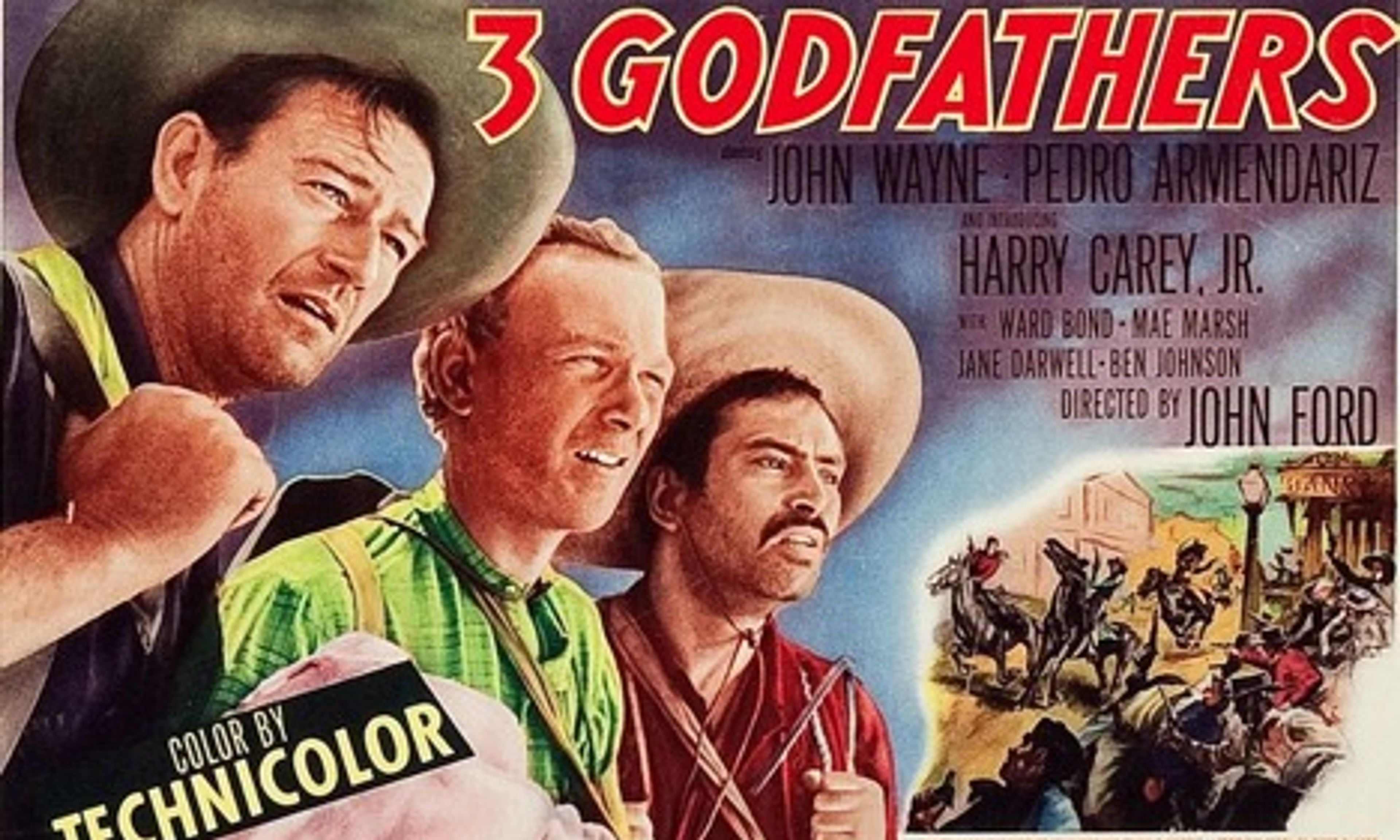
And then Ford tried again, in 1948, with the slightly altered title 3 Godfathers, starring John Wayne and Harry Carey Jr. (son of . . . and also there was the sombrero’d Pedro Armendáriz). It’s a terrific film, warts and melodrama and all. A tad of overacting, but so what. Too bad, Turner Classic Movies won’t be showing it tomorrow. It would be darned fitting if film aired. But whenever you get the chance to see it, do, and remember from whence it comes — from the East, and bearing gifts.
BONUS: Check out NRO’s Epiphany Day Celebrations slide show.
An Onslaught of Brilliant NRO Pieces that Will Instigate a Slew of Intellectual Epiphanies
1. Wesley Smith calls out gene-splicing biotech researchers in Red China, where “ethics” seem to be non-existent. From his Corner post:
There is great peril here. The bioethicist William Hurlbut worries that we could be entering an era of “outsourcing ethics,” by which he means Western universities and companies circumventing our laws by conducting research in countries with loose standards. At least to a small degree, ethics outsourcing has already started.
Such research anarchy (if you will) is dangerous. CRISPR gene editing and other fast advancing biotechnologies — such as the creation of artificial life forms — are among humankind’s most portentous and powerful inventions. It is not overstatement to state that they rival the splitting of the atom in potential benefit and peril.
2. California, Here I Go. Victor Davis Hanson laments about the Golden State’s tarnish. From his piece:
To fathom California’s near medieval asymmetry, ask how a state with such high taxes can offer such poor services. The top California income-tax rate is 13.3 percent (the nation’s highest). The state’s average sales tax is (conservatively) about 8.5 percent (ninth in the nation). California’s bewildering combined array of gasoline taxes are about 55 cents per gallon and rising (second-highest in the nation).
In exchange, California public-school test scores rank between 44th and 46th in the nation. Its roads and infrastructure are rated in various surveys between 42nd and 45th. Driving from the state’s interior to the coast on roads mostly unchanged from 45 years ago takes about twice the time as in the past — if carefully planned at particular times and days of the week.
One no longer just drives on any two-hour or longer journey in California. Instead, he navigates, with the planning, apprehension, and wariness of a 16th-century galleon captain sailing to the New World.
What is going on?
3. In Part VII of their 10-part series on Constitutional restoration, John Yoo and James C. Phillips find there is a too-broad interpretation of the First Amendment. From their essay:
The First Amendment declares that “Congress shall make no law . . . abridging the freedom of speech, or of the press; or of the right of the people peaceably to assemble, and to petition the Government for a redress of grievances.” This text protects four distinct rights: speech, press, assembly, and petition. Yet the Court has allowed free-speech imperialism to expand so far as to swallow up these other First Amendment rights.
Take the assembly clause. There are few cases where the Supreme Court has protected a right to assembly. Instead, the Court has replaced it with a judicially invented “freedom of association” that it somehow discovered in the constitutional language of “freedom of speech.” This is not only wrong as a matter of interpretive principle, but John Inazu has persuasively shown that the right of assembly was both broader and more concrete than the Court’s creation of a free-speech right of “association.”
For example, the Court’s freedom of association limits constitutional protection through adjectives: “expressive” or “intimate.” But there are no qualifiers in front of the Constitution’s prohibition on “abridging . . . the right of the people peaceably to assemble.” All types of assembly are protected, as long as they are peaceable. In fact, the Congress that passed the First Amendment rejected an attempt to add the limiting language “and consult for the common good” to the freedom of assembly.
4. My old Pal Tom Glessner believes Americans on either side of the abortion divide can and should come together via support of local pro-life pregnancy centers. From his article:
Can Americans come together and support the value of human life at all stages even while political battles continue to rage around abortion? I believe we can.
Such unity can be achieved through the support of all Americans for the inspirational work of pro-life pregnancy centers, regardless of political thoughts about the legality of abortion. These small, faith-based ministries of compassion exist in every community across the nation. They provide vital resources to mothers contemplating abortion and empower them to choose life. Medical services include ultrasound confirmation of pregnancy and testing for sexually transmitted infections; material assistance includes baby clothes, diapers, prenatal vitamins, adoption referrals, and maternal housing.
A recent report from the Charlotte Lozier Pregnancy Center provides compelling evidence that the work of pregnancy centers is critical. America’s pregnancy centers provided 2 million people with free services in 2017, saving taxpayers an estimated $161 million. Two-thirds of the centers are medical facilities staffed with licensed medical professionals providing free services, including ultrasounds worth $114 million.
If the right to choose means anything, multiple options must be available. By providing the support and resources that make choosing life possible for the abortion-vulnerable, America’s pregnancy centers provide a real choice — an alternative to abortion.
5. Big Jim Geraghty shares 20 things you may not have known about that Vermont Socialist, Bernie Sanders. Here’s number three from Jim’s rundown:
His first campaign for public office started because he simply showed up and volunteered. In 1971, Vermont Republican senator Winston Prouty died, setting up a special election. A young Bernie Sanders chose to attend the meeting of the newly formed Liberty Union party, which he described in his memoir as “a small peace-oriented third party.” (The party called for “nonviolent revolutionary socialism” and compared the draft to slavery.)
In Sanders’s account, he became the candidate for Senate because at the meeting the party needed a candidate; he raised his hand and volunteered. He won 2 percent statewide. In the subsequent decade, Sanders twice ran as the Liberty Union party’s candidate for Senate and twice for governor, never winning more than 6 percent of the vote. During this time, he declared on the campaign trail that the Central Intelligence Agency was “a dangerous institution that has got to go,” and that “right-wing lunatics use it to prop up fascist dictatorships.”
By the time Sanders was elected to Congress, the Liberty Union party saw him as a sellout, calling him “Bernie the Bomber,” charging “Bernie became an imperialist to get elected in 1990” and declaring, “Bernie’s selling out says clearly to working people and those unable to find work that even leftists become mainstream politicians, when and if they win office.” The group also observed that, at the time, Sanders had “no person of color on his staff.”
6. David French argues for why a U.S military presence in Afghanistan and Syria remains central to American security. From his analysis:
Let’s analyze our challenge as clearly and concisely as we can.
First, there exists a jihadist enemy of our nation and civilization that doesn’t just seek to harm our national interests, it actively seeks to kill as many Americans as possible, as publicly as possible — with the goal of so thoroughly destabilizing and demoralizing our nation that we make room for the emergence of a new jihadist power.
Second, this enemy exists not because of immediate and recent American actions (though it can certainly use some of those actions to recruit new followers) but because of an ancient, potent systematic theology. Never forget that one of the grievances Osama bin Laden listed as justifying his attack on America was the Christian Spanish reconquest of Muslim Spain. That event occurred almost 300 years before the American founding.
Third, while it is difficult to predict any given terrorist attack, this much we can say — when terrorists obtain safe havens, they become dramatically more dangerous. The creation of a safe haven escalates the threat and renders serious attacks a near-inevitability.
Fourth, for reasons too obvious to outline, terrorist safe havens are always in nations and locations that are either hostile to the United States or in a state of fractured chaos. Terrorist cells may operate in places like France, but a true safe haven cannot thrive in functioning, strong allied territory.
Finally — and this is critically important — the national obligation of self-defense is permanent. No functioning government that abdicates its duty to protect its citizens from hostile attack can remain legitimate. Preferably self-defense is maintained by deterrence. But when deterrence fails, a failure to engage the enemy doesn’t bring peace, it enables the enemy to kill your people.
7. How can it be that Malthusians retain a shred of credibility? Gale Pooley and Marian Tupy explain the new Cato Institute study which shows how population growth tracks with a growing abundance of resources. From their article:
Population growth and abundance seem to be connected. Adam Smith observed that division of labor, or separation of the work process into distinct tasks, leads to faster growth. Simon took Smith’s ideas a step further. He noted that in addition to more labor, a growing population produces more ideas. More ideas lead to more innovations, and more innovations improve productivity. Finally, higher productivity translates to better standards of living.
Considering that world population will likely peak at 9.8 billion people at around 2080 and fall to 9.5 billion by 2100 — in the medium fertility scenario calculated by demographer Wolfgang Lutz and his colleagues at the International Institute of Applied Systems Analysis — our descendants may yet find that the Earth is short on the most important resource: people.
8. Professor Eric Ort takes to The Atlantic to claim the Constitution’s clear-as-blazes requirement for two senators per state is . . . malleable. So Charlie Cooke takes to The Corner to claim Ort is a nincompoop. From his post:
We’ll get to the argument Orts makes in a moment. But, before we do, we might take note of his framing, which does not help his case either in the general or in the specific realms. “Our Constitution is more malleable than many imagine” is the sort of thing that people plop in to their overture when they’re teeing themselves up to argue that our Constitution should, in fact, be ignored. It is a euphemism, rather than a framework, and it should be recognized as such. Ort’s more specific example, meanwhile, is completely, embarrassingly backward. The argument made against the Affordable Care Act’s constitutionality was not that the Constitution’s meaning is malleable, but that it is extremely rigid. One may disagree with that argument, as four members of the Supreme Court clearly did (John Roberts ultimately cast a vote to uphold the law, but joined a majority of five in declaring the mandate illegal on Commerce Clause grounds). And yet it is the height of disingenuousness to portray those who blew open the commerce clause as the guardians of tradition and those who wished to keep it narrow as audacious Jacobins. It is certainly true that America has played host to some commerce-clause revolutionaries over the last nine decades, but they did not sound like Justices Clarence Thomas, Antonin Scalia, Anthony Kennedy, John Roberts, and Samuel Alito. They sounded like Professor Orts.
9. Mitt Romney begins 2019 with a Washington Post op-ed that is a kick in the Trumpian shins, to which Ben Shapiro responds: That’s counterproductive, Senator-elect. From his new column:
The essay, in truth, reads like the opener of a presidential campaign. It’s a stock speech replete with broad recommendations on policy (more strength in foreign policy, a call to “repair our fiscal foundation”) and ersatz optimism (“I remain optimistic about our future . . . noble instincts live in the hearts of Americans”). Romney states that Americans “will eschew the politics of anger and fear if they are summoned to the responsibility by leaders in homes, in churches, in schools, in businesses, in government.” Presumably, Romney considers himself such a possible leader.
If not, the entire op-ed raises the question: What do you want us to do about it, senator? By declaring Trump unfit for his office, Romney immediately forces a choice: Should he back Trump in 2020, or challenge him? Should Republicans be pushed to choose between an incumbent president and a person of more character and consistent conservative conviction — and would a primary effort actually effectuate that choice?
10. More Mitt: Teddy Kupfer checks out the post-column chatter and wonders about the claims by some that the incoming Utah Senator is taking the baton from the departing Arizona solon, Mr. Flake. He’s not buying it. From his post:
This could generate an interesting dynamic where Romney works constructively with the administration on occasion while continuing to speak out against his character flaws and his scattershot approach to maintaining alliances. I’d bet that Romney will stick to his promise to criticize Trump when Trump says things that he deems “divisive, racist, sexist, anti-immigrant, dishonest or destructive to democratic institutions,” which means we’ll hear from him with some regularity. But he isn’t Jeff Flake, which means he might wind up being relevant for more than just his criticism of the president. Like Flake, Romney doesn’t represent the future of the GOP. Unlike Flake, he could play a constructive role in shaping it.
11. Even More Mitt: VDH thinks Romney’s op-ed displayed “naïve incoherence.” From his Corner post:
But that said, I fear that much of Romney’s invective is utterly incoherent. The departures of many top-cabinet officials in some cases were regrettable, in some understandable, but most were likely because Trump ran on an agenda neither traditionally Republican nor Democratic. Trump was the first president without either political or military experience. So there always was also going to be difficulty (and paradoxes) in matching his outsider policies with experienced insider administrators. We should, however, remember that the tenures of Department of Defense secretaries (four in the respective Obama and Truman administrations) and White House chiefs of staff (four respectively for Reagan and Clinton, five for Obama) are historically not always particularly long.
Romney is, euphemistically, accurate in stating that he opposed Trump (“Donald Trump was not my choice for the Republican presidential nomination”). And he explains, admirably so, that he hoped that “his [Trump’s] campaign would refrain from resentment and name-calling. It did not.” And Romney was further disappointed that “on balance, his [Trump’s] conduct over the past two years, particularly his actions this last month, is evidence that the president has not risen to the mantle of the office.”
But, ironically, all such long-standing repulsion at Trump’s behavior (even if it did crest in December as Romney alleges) raises the question, again, why would Romney have accepted Trump’s endorsement for his senate run in 2018, especially given the fact that he probably did not need it to be elected in Utah?
12. The Louis C.K. controversy (see more below) has Kyle Smith hitting back at the asshat comic’s critics. From his piece:
But what C.K. said isn’t hacky. A hack does a bit on how the Starbucks menu is too confusing or how women gain weight after marriage. And anyway, a hacky routine isn’t worth mentioning, much less getting upset about. “Parts of a comedy routine performed in an obscure club two weeks ago bombed” is not news. To mock the Parkland kids in even so mild a way as to suggest they have no expertise on gun control is to venture into a high-voltage area. It’s the opposite of “hacky.” It is in fact “edgy.” The edge in question is the frontier where “things that can be said” meets “things that cannot be said.” It’s where “funny” meets “offensive.” It’s where the audience will laugh while thinking, “I can’t believe he said that.” It’s where most of the top comics have wanted to live ever since Lenny Bruce inspired outrage for “mocking Jackie Kennedy.” (Actually the bit in question suggested Mrs. Kennedy was guilty merely of being human, of trying to flee the limousine where her husband had been shot, rather than bravely seeking help. This was an edgy thing to say in 1964 but hit home because it was likely true.)
C.K.’s comments on youth weren’t hacky and trite either, because their premise wasn’t a kids-these-days cliché but something close to the opposite. He was pointing out that (first time in recorded history!) kids these days aren’t adventurous enough, aren’t frivolous enough, aren’t freewheeling enough. Somehow every kid these days wants to clamp down on others, aspires to be a cultural vice principal or a language Niedermeyer. That’s funny.
13. Michael Brendan Dougherty sees the EU doing a crash-and-burn. A spectacular one. From his piece:
In the face of the Yellow Vest protests, French president Emmanuel Macron abandoned his campaign pledge to stand firm behind his reform agenda. He rescinded tax increases and promised more spending outlays, expanding his budget deficit beyond the European Union’s threshold of 3 percent of GDP. The EU’s budget commissioner, Günther Oettinger, said the EU would make an exception and accept the rule-breaking French budget.
No such exception is made for the new Italian government, which seeks approval for a budget that has a 2.4 percent deficit. The EU wants to clamp down on Italy’s debt, which at 130 percent of GDP is more than twice the EU’s limit of 60 percent. (France exceeds the limit as well, however, with a debt roughly equal to its GDP.) And in the eyes of the EU, Italy’s government is an enemy, made up of “populists” and occasional critics of the EU. No allowances are made for them, even though Italy has gone through political upheaval similar to or greater than France’s.
All this should be a reminder that there is nothing much to envy about European Union membership. If you’re a relatively wealthy Western European nation, it is a source of instability. Brexit is treated as a “shambles,” but to an outsider it looks orderly and civilized compared with what is happening in the European Union itself. The immediate political effect of the Leave vote was to strengthen the U.K.’s most long-lived mainstream parties: Tory and Labour. Meanwhile, on the Continent, the traditional political parties in European Union member states continue to shrivel and die. The Yellow Vest protests have moved on from French cities to Brussels. So-called populists parties continue to make gains.
14. Kat Timpf has become America’s expert at cataloguing political-correct lunacy. So you’ll want to read her rundown on 2018’s top 10 most ridiculous PC moments.
15. John O’Sullivan compares Brexit and the government shutdown. He sees comparisons between Donald Trump and Theresa May in their (poor) handling of respective struggles. From the end of his analysis:
May’s mistake was a simple one: She assumed her opponent had no real weapon when he turned out to be well-armed. She has probably lost as a result. Trump’s mistake is a lesser one: He picked a fight without first ensuring that his weapons were better than his opponent’s. He probably cannot win, but all is not lost. Trump can probably hold the Democrats to a draw this time, and thereafter learn from Margaret Thatcher, who when she found herself advised by ministers to fight a miners’ strike she was likely to lose in 1981, quietly surrendered and set about establishing the conditions in which she would fight again. That moment occurred four years later when the miners again challenged the government and conclusively lost a strike that lasted more than a year. That battle established her political dominance for a generation. Trump today is very far from doing that.
As Margaret Thatcher would never have put it: You don’t take knife to a gunfight, and you don’t take a knife to a knife fight either; you take a gun to a knife fight and even then you frisk everyone else on arrival.
16. Jonah lays into The Donald’s character. At American Greatness, Roger Kimball states why he has no problem with it (the President’s character) and therefore why Jonah is wrong. To which Jonah rebuts: There’s a lot of obscuring here. From his Corner post:
As I have said and written countless times, I believe the transactional defense of Donald Trump is intellectually defensible. I may have severe disagreements about the cost-benefit analyses some bring to it (the long-term damage to the GOP and/or to conservatism may be worth a couple of Supreme Court Justices, but let’s not pretend we’re not paying a price). I also think many of his accomplishments would have been achieved by other GOP presidents and that people exaggerate Trump’s role in many of the victories that have occurred over the last two years. But I can’t object to the logic of someone who says, “Yeah, I know Trump is crude and a boor, but I like what he’s getting done.”
But that is not what Roger is doing here. He is saying that a man who bedded a porn star while his (third) wife was home with their newborn child now fits the — or at least a — definition of good character because he delivers tax cuts. A man, who by his own admission, “whines until he wins” and boasts of how he screwed over business partners, a man who lies more egregiously and incessantly than Bill Clinton and used his family charity in Clintonian ways, has a good character because he’s “working to end Obamacare, and fighting to keep our borders secure.” Is that really what conservatives should be telling presidents? That so long as you fulfill your promises to the base of the party, not only will we abstain from meaningful criticism, but we will in fact redefine good character to fit the president? I have deep admiration for Roger, but if I knew what the original Greek for “bologna” is, I would use it here.
For starters: This argument simply isn’t true. Take Trump’s position on judges, one of the triumphs virtually everyone on the right concedes. When Trump was campaigning, he displayed no meaningful knowledge of the Constitution nor any meaningful desire to correct his ignorance. When asked about who he’d appoint to the Supreme Court, he talked about his sister. It was then explained to Trump that he couldn’t win without promising to appoint justices picked not by him, but by institutions Trump-skeptical conservatives trusted: the Federalist Society and the Heritage Foundation. How does Trump’s agreement to do this make him a man of good character, as Roger suggests? I just can’t see it. And if one were to make similar arguments about Bill Clinton or any Democrat, I’m fairly certain Roger wouldn’t have any patience with the suggestion either.
17. At Bench Memos, Carrie Severino scores the attacks on the Knights of Columbus and judicial nominees who are affiliated with the K of C by Democratic senators Kamala Harris and Mazie Hirono and a bunch more. Read it here.
JONAH BONUS: “Dogs are a safe harbor.” Mr. Goldberg explains his canine love. From his piece:
Dogs — and animals generally — are among the few things that bridge the partisan divide. Tragedies are a partisan affair. If someone dies in a hurricane or shooting, there’s a mad rush to score political points. Last week, a lovely young woman, Bre Payton, died from a sudden illness, and a bunch of ghouls mocked or celebrated her demise because she was a conservative.
Even babies can be controversial, since babies can touch various nerves, from abortion politics to the apparent scourge of “misgendering” newborns.
But dogs are largely immune to political ugliness. The angriest complaints I get about my dog tweets — from people on both the left and the right — are that I’m wasting apparently scarce resources on dogs when I could be expressing my anger about whatever outrage the complainers demand I be outraged about.
Lights. Cameras. Punditry.
1. Rich Lowry goes to see Peter Jackson’s limited release-documentary They Shall Not Grow Old, and says Jackson deserves a medal more so than an Oscar. From his column:
Yet what is most striking about They Shall Not Grow Old is how many grins there are. The vets, who were just kids at the time, say that they joked constantly. Really, what else were they going to do, except try to make the best of it? One vet compares the times of relative quiet to an outdoors trip among friends with just enough danger to make it interesting. That Jackson recovers this neglected part of their story is a key part of his contribution.
Not that there is any stinting on the horrors. The descriptions of battle are unadorned and hauntingly specific — the mind-numbing artillery barrages, the fearful waiting before going over the top, the walking (yes, walking) across no man’s land, the battle plans gone terribly awry, the shattered bodies all around, hand-to-hand combat with the Germans.
Still, amid the carnage, the humanity of the soldiers is undimmed. When they capture Germans, they tend to get along. German prisoners spontaneously take up stretcher duty, carrying the British wounded to make themselves useful. The underlying attitude is that they are all boys, thrown into this maelstrom by forces beyond their control.
2. Aquaman is all wet, says Armond White. From the beginning of his review:
A he-man who swims, slithering through the ocean deep, then comes ashore to demonstrate his amphibious strength and superhero powers, the new live-action Aquaman is perfectly embodied by Jason Momoa. Zack Snyder first introduced Momoa during a teasing digression of Batman v. Superman: Dawn of Justice in a sequence that promised other D.C. Comics characters would share a heroic-erotic mode. They would answer the millennium’s politically depressed view of bravery, principle, and history with an atavistic ideal. (Sndyer must have heard Walter Hill’s commendation from Bullet to the Head that Momoa was “a man among men.”)
But now that the Aquaman movie is finally here — and is a record-breaking box-office hit — Snyder’s aesthetic drive has been castrated. The Aquaman movie proceeds like a Marvel movie — an expanded generational narrative, starting with Aquaman’s parents (Temereu Morrison as his Pacific Islander father and Nicole Kidman as Atlanna, his ocean-empress mother) and the birth of their demigod offspring named Arthur. (“Product of a love that never should have been.”) This intro is Marvel-mundane, despite featuring a sped-up fantasy fight scene. The digital effects — overkill excitation — immediately ruin Snyder’s almost tactile corporeal vision for emphasis on action and frantic stimulation that video-game and VR enthusiasts have come to prefer over cinema. Marvelized reviewers don’t even appreciate the difference.
3. On Aquaman, David French heartily disagrees with Armond, et al: “I’m no populist, but this time the people are right, and my colleagues are wrong, wrong, and wrong. From his article:
There was a moment when I was watching (and thoroughly enjoying) Aquaman that it hit me. This is the Con Air of superhero movies. Don’t go to the film expecting the darkness of previous DC films. Nolan’s Batman series and Snyder’s Man of Steel are in the rear-view mirror. There will be time for think pieces on what this means for the great contest between DC and Marvel, but for now let’s just glory in the insanity. The Con Air formula lives.
Does Aquaman have an amazing cast showcasing action stars and Serious Actors? In addition to Jason Mamoa and Amber Heard, the movie features Nicole Kidman, Willem Defoe, Dolph Lundgren, and Julie Andrews (as a Kraken-like monster, no less.)
Is there a ludicrous premise? Yep. Imagine that the world’s oceans are inhabited my multiple advanced civilizations and enormous sea creatures, and they’ve been entirely undetected by the surface. Then they go to war, and still nobody really knows what’s happening.
4. More from Armond, who finds The Mule to be “refreshing” and an “exceptional pleasure.” From the review:
Director Eastwood’s restraint feels like middle-of-the-road conservatism; when applied to the film’s contemporary ethnic expansion — and featuring reactions of the country’s white, formerly dominant social group — it achieves new rich classical Americana. Stone encounters dykes on bikes and a black family stranded on a highway and refurbishes a burnt-out VFW hall. In one other extraordinary incident, he witnesses a Mexican motorist encountering an officious highway patrolman.
This scene shows that Eastwood is perhaps the only Hollywood filmmaker willing to admit the self-conscious wariness on both sides of that typical American opposition. The confrontation is funny, rather than tragic, because Eastwood and screenwriter Sam Dolnick understand that before stereotypical American social tragedy occurs, there is always American knowingness — particularly in the comic drama of civilian–authority opposition. The Mexican driver is fully aware of the situation’s grave potential (“This is the most dangerous five minutes of my life — being pulled over by law enforcement”), as is the white cop who stops him.
It’s neither satire nor sour or cynical. Eastwood imparts the complications of modern American social experience. This moment surpasses Green Book, The Hate U Give, and all the other movies spawned from the last America-hating spasms of the Obama era that connected social authority with racism, depicting non-whites as fateful victims. Eastwood’s non-jaundiced complexity is refreshing.
5. Ross Douthat has Big Screen / Little Screen visions dancing in his head as he reviews Widows. Here’s how it kicks off:
Widows, the new not-just-a-heist movie from the camera of Steve McQueen (it’s his first film since 12 Years a Slave), began life as a miniseries more than 30 years ago. It was an English six-parter, to be precise, and I’m torn about whether it should have remained one. There is something intensely welcome about watching such a rich and sprawling narrative on the big screen, in an era when so much storytelling ambition is migrating to television. At the same time, the movie feels like a would-be Dickensian story from which some crucial parts were cut. It’s solid entertainment, but its ambitions can’t be met within its running time, when even an hour more might have made it great.
6. Just a spoonful of sugar helps the socialism go down . . . Armond White says Mary Poppin Returns is something no one really asked for, so why in the heck did she come back? From his review:
Also unmistakable is the nasty political undercurrent that prevents this reboot from being escapist fun. Take the new politically instructive songs in Mary Poppins Returns. Sure, they’re the usual Marc Shaiman pastiche — cliché Broadway compositions (from the composer of the lame musical Hairspray) that lack the memorable delight of Richard and Robert Sherman’s songs for the original Mary Poppins in 1964.
Incapable of a charming tongue twister, or relatable lyrics about medicine in sugary spoonfuls, Shaiman assimilates the #Resistance mood that has overtaken Broadway and Hollywood. Though pretending to be innocuous family entertainment, the knock-off tunes have a faintly repressive, pedantic note, especially in Shaiman’s balloon-song finale “Nowhere to Go but Up.” To careful listeners, it sounds like showbiz Stalinism: “The past is the past / It lives on as history / Let the past take a bow / Forever is now.” Why should a family-movie ditty recall the essence of Soviet erasure of history?
7. Kyle has found ten — conservative! — flicks from 2018 that he claims “hit home.” From the line-up, here are Numbers Three and Two, in that order:
THREE: Little Pink House (for rent via video-on-demand, also on Hoopla and Kanopy). If high-school students were required to see this film in classrooms, libertarianism would become as popular as Barack Obama. Catherine Keener creates a screen version of Susette Kelo, the New London, Conn., citizen who didn’t want to relinquish her lovingly painted house to the grasping hands of a government that had decided a property developer should get to bulldoze it. As Antonin Scalia memorably put it when Kelo’s case reached the Supreme Court, the government’s absurd position was that “you can take from A to give to B if B pays more taxes.” It would be hard to name a better cinematic illustration of the importance of property rights.
TWO: Halloween (for rent via video-on-demand). Judy Greer’s character expertly and hilariously trolls the Left when she says her mom, Laurie Strode (Jamie Lee Curtis), is wrong to arm herself and prepare for the worst because, “The world is not a dark and evil place. It’s full of love and understanding!” The importance of armed individual self-defense, the fallen nature of man, the incompetence of state authorities, the necessity of capital punishment for evildoers, and even the vapidity of liberal true-crime podcasters all get ingeniously dramatized as Michael Myers goes on yet another rampage.
8. Armond likes At Eternity’s Gate, the biopic about Vincent Van Gogh starring Willem Dafoe, but first takes a moment to smack the “sappy hagiography” about Ruth Bader Ginsburg, On the Basis of Sex. From the review:
Willem Dafoe, as Schnabel’s Van Gogh, does not simply give a performance, he is the film’s material. The close identification of an actor with a film’s topic is part of the way that Schnabel encourages us to relate to Van Gogh. The effect he achieves is the opposite of the political divisiveness motivating Hollywood’s RBG agitprop.
Coming from the art world, Schnabel has developed empathy based on personal experience. When Van Gogh is told “You’re surrounded by stupid, wicked, ignorant people,” it isn’t to martyr him. Schnabel’s sensitivity to Van Gogh’s trials and agonies is apparent in how he photographs Dafoe, who, significantly, also played Scorsese’s Jesus and here becomes another of Schnabel’s artist-surrogates (along with Jeffrey Wright as Basquiat, Javier Bardem as Reinaldo Arenas, and Mathieu Amalric as Jean-Dominique Bauby).
BTW: Turner Classic Movies will broadcast the acclaimed 1956 VVG biopic, Lust for Life, on January 17. It stars Kirk Douglas (nominated for an Oscar but lost to Yul Brynner) and Anthony Quinn (who won!). If you don’t catch it, you are denying yourself a special treat.
The Six
1. In a few weeks, Catholic bishops will be meeting in Rome to consider the Church’s sex-abuse scandals. At The American Conservative, Rod Dreher writes he expects the confab will produce a fat nothingburger, and also corrals some of the latest embarrassments to befall a hierarchy that is either tone deaf or complicit. From his piece:
On September 13, Cardinal Dolan said on CNN: “If I don’t have the trust of my people, I have nothing.”
True, so riddle me this: Why should anybody should believe a thing that Cardinal Dolan and the Archdiocese of New York has to say about clergy sex abuse, given that the Archdiocese has now been caught lying to another diocese about an abusive priest?
For that matter, why anybody should believe a thing Cardinal Cupich has to say about it? Why should anybody expect that the Roman Catholic hierarchy can now, at last, be trusted to fix this at a February meeting called by a pontiff whose idea of dealing with specific, damning accusations about Church corruption, particularly in the Cardinal McCarrick case, is to repeatedly insinuate that the retired papal diplomat making the accusations is a servant of the Devil?
You will recall that Archbishop Vigano, the retired diplomat, said that Cardinal Cupich’s rise in the Church is because he was a favorite of McCarrick’s, and McCarrick boosted him to Francis. You will also recall that in response to the Vigano bombshell, Cupich told the media that the pope will not be distracted by such silliness, because he has bigger things to worry about, like immigration and climate change.
2. In The American Interest, Rebecca Burgess looks at the nexus of veterans and elective politics, using Jeremy Teigen’s book, Why Veterans Run: Military Service in American Presidential Elections, 1789-2016, as a basis for consideration. From her piece:
The optics of a hardened martial experience and the emotional crutch of reassurance that this experience gives in a world constantly described as dangerous seem obviously to favor veteran presidential candidates. Surely that explains why the majority of fictitious cinematic presidents, from Independence Day to Madame Secretary, have military experience. And there’s evidence to believe that candidates’ pre-presidential experiences influence subsequent perceptions about their success as president, and that military experience in particular drives a president towards higher performance in public persuasion. Scholarship shows that substantial differences exist between political leaders with and without experience in the armed forces.
In the “Overinformation Age,” this all translates to a handy biographical shortcut for the time-pressed average voter. Veterans accordingly will continue to run for President, and for other elected positions. As Teigen and, more recently, General Stanley McChrystal in the Wall Street Journal remind us, a uniform is no guarantee of character or political competence.
This still sets aside the (very large) question of the institutional effects that increasingly politically active veterans might have on both the military and the political process, in an increasingly partisan world in which veterans are thought of as a “tribe apart.” But here, too, it’s arguable that the long shadow of the Vietnam War has skewed perceptions of the partisan identity of those who enter and exit the military. Since the Vietnam War, the Republican Party has generally owned defense and national security issues in the eyes of the electorate. A disproportionate number of veterans are older, white, and male—proxy factors that are typically associated with GOP support. This leads many to assume all veterans are Republicans too. But the increasing numbers of Democratic veterans running for office indicate that it may be time to reevaluate who politically our veterans really are.
3. At Gatestone Institute, Douglas Murray bemoans how his native Britain is thrilled to accept extremists while banning their critics. From his piece:
The British government’s idea of who is — and who is not — a legitimate asylum seeker becomes stranger by the month.
In November it was reported that the Pakistani Christian mother of five, Asia Bibi, was unlikely to be offered asylum by the British government due to concerns about “community” relations in the UK. What this means is that the UK government was worried that Muslims of Pakistani origin in Britain may object to the presence in the UK of a Christian woman who has spent most of the last decade on death row in Pakistan, before being officially declared innocent of a trumped-up charge of “blasphemy”.
Yet, as Asia Bibi — surely one of the people in the world most needful of asylum in a safe country — continues to fear for her life in her country of origin, Britain’s idea of who should be allowed to travel to the country (and stay) looks ever more perverse.
One person, for instance, who has had no trouble being in London is Dr Ataollah Mohajerani, Iran’s former Minister of Culture and Islamic Guidance. Mohajerani is best known for his book-length defence of the Ayatollah Khomeini’s fatwa against the British novelist Salman Rushdie. After the Khomeini’s call on the world’s Muslims to kill Rushdie for writing a novel, Mohajerani wrote a 250-page book, A Critique of the Conspiracy of The Satanic Verses, which justified the death-sentence. For more than a decade, however, apparently fallen out with part of the regime in Iran, Mohajerani has been living in Harrow, where he intermittently keeps up his campaign against Rushdie.
4. The outrage over the new routine by scandal comic Louis C.K. — mocking Parkland High School SJWs and millennials in general — gets some analysis by former NR intern Tiana Lowe, now plying her talents at Washington Examiner. From her piece:
To be clear, the media and entertainment industry (which had to be dragged, tooth and nail, by the Pulitzer Prize winning #MeToo journalists at the New York Times to finally denounce C.K. after he spent years harassing and exposing himself in front of his female colleagues) has no problem excoriating C.K. for the most transparent ploy for attention in the form of a milquetoast, hackneyed, and intentionally crude comedy set. My question to them: Where were you for the past decade?
First off, with regards to the actual content of the jokes, C.K. has a minor point. Teens these days aren’t working, having sex, or even dating. Despite growing up with social media glued to their hands, they’re the least socialized generation alive and do need a solid kick in the pants. As Parkland survivor Cameron Kasky eloquently stated, “Comedy is supposed to be offensive. My feelings have no place in it. Yes, Louis is an ass for the jokes he’s making which sucks cause he used to be really funny and not just a professional jerk.”
But more importantly, Hollywood and the media’s outright ire over one tasteless set contrasted with their years of complicity and performative pearl-clutching over C.K.’s sustained and systemic harassment of women just goes to show how little they care for victims of sexual misconduct as opposed to outright thought-policing.
5. A college prep school in Louisiana (T.M. Landry) has duped numerous elite colleges into accepting its graduates, thanks to falsified transcripts. The College Fix’s Ryan Everson reached out to the elites to inquire about their application-vetting processes. The sound of silence was the response. From the piece:
Princeton University declined to answer questions about its application process, though the school did offer comments concerning Landry. Spokesman Mike Hotchkiss said: “We are very troubled by the report and the allegations of fraud. First and foremost, we are concerned for the affected students and their families. We remain committed to attracting and supporting talented students, including students from groups that have been underrepresented in higher education and denied the opportunities they need to flourish. Every one of our students is a valued member of our community.”
Hotchkiss told The Fix that this was “the only comment we are making on Landry at the moment.”
Brown, Stanford, Dartmouth, Cornell, and Wesleyan all failed to respond to The Fix’s queries.
According to The New York Times, Landry recorded grades higher than those actually earned and gave its students credit for rigorous classes they did not take. The school also provided inaccurate letters of recommendation which listed falsified extracurricular accomplishments.
6. At Law and Liberty, John O. McGinnis worries that classical liberalism is facing a gathering storm. And yet at the end of 2018, I fear for the future of classical liberalism. From his essay:
To be sure, much of the reason for my concern has little to do with Trump. Many of our universities, mine very much included, are places of ever greater political correctness and ideological orthodoxy that nurture a coming generation of social justice warriors. The Democratic Party has lurched to the left and radical leftists, like Bernie Sanders and Alexandria Ocasio-Cortez, are given glowing mainstream media treatment. And the disruption of technology quickens, making many people feel insecure and more open to the “protections” of the state, even if the benefits of this technology, like internet search and social media, are often free and are more broadly shared than almost any innovations in human history.
And Trump adds to this disquiet because he has singularly failed to burnish the reputation of classical liberal ideas in this turbulent time. His mercurial persona, divisive tweets, and ill-informed and more than occasionally false comments discredit some good policies that should be popular. Rhetoric counts as much as policy in a democracy, because many if not most voters are rationally ignorant of complex policy arguments and even results. But many of the uninformed follow what Trump says, do not like it, and transfer that dislike to his policies. That is one of the explanations of midterm elections, the results of which portend ill for classical liberalism. Trump uses the bully pulpit but to undermine his policies and political standing. In this, he is the reverse of the greatest President and political expositor of classical liberalism in my lifetime, Ronald Reagan.
Moreover, his continual focus on himself is the opposite of a classically liberal tenor of governance, because it gives the public impression that that government and politicians should be the center of our social life. To the contrary, classical liberalism wants to minimize that presence. Presidential rhetoric should reflect that modesty.
BONUS: Making the email rounds is this Christian Smith barnburner from last January in The Chronicle of Higher Education, titled “Higher Education Is Drowning in BS.” From his doozie of an essay:
BS is universities hijacked by the relentless pursuit of money and prestige, including chasing rankings that they know are deeply flawed, at the expense of genuine educational excellence (to be distinguished from the vacuous “excellence” peddled by recruitment and “advancement” offices in every run-of-the-mill university).
BS is the ideologically infused jargon deployed by various fields to stake out in-group self-importance and insulate them from accountability to those not fluent in such solipsistic language games.
BS is a tenure system that provides guaranteed lifetime employment to faculty who are lousy teachers and inactive scholars, not because they espouse unpopular viewpoints that need the protection of “academic freedom,” but only because years ago they somehow were granted tenure.
BS is the shifting of the “burden” of teaching undergraduate courses from traditional tenure-track faculty to miscellaneous, often-underpaid adjunct faculty and graduate students.
Baseballery
You’re never too old! The 1965 season was coming to its conclusion, and it was an otherwise meaningless game between the American League’s two worst teams. But starting that night for the Kansas City A’s was a 58-year-old man, who had last pitched in a Major League game in 1953, by the name of Satchel Paige, who threw three scoreless innings against the Boston Red Sox, giving up a lonely double to Carl Yastrzemski. It was a great moment in baseball history, and inspiring.
EXTRA: From 1970, Paige sits with Dick Cavett for a fun interview about Methuselah and the Negro Leagues and much more.
Rest in Peace
Gene Okerlund has heard the three count. Go, we pray to a happy place. We’re figuring there are no turnbuckles there. And take with you our good feelings, because Mean Gene, you helped us all laugh.
A Dios
Would you join me in fighting back against America having become a nation of slobs? How to be my ally? By not dressing in a heavy-metal T-shirt if you grace church this weekend. Men in warmer climes, also try: Pants. And not the sweat variety. Ask yourself: Didja eva see Jesus’s kneesusses? No (except up on that cross)! And while He wore sandals, I still don’t want to see your hairy toes and ankles in the next pew. Rant over.
Now what else? Oh yes: back, full circle, to tomorrow and the Epiphany. Allen R., old pal from Long Island and the culture wars, shared via email T.S. Eliot reading his poem, Journey of the Magi. Quite beautiful, and short (less than three minutes), so give a listen, here. An alternative, which I find to be an even more wondrous reading, is by Alec Guinness: It can be heard here.
God’s Glorious Blessings on You, No Matter How Your Legs Are Pantsed,
Jack Fowler
Ready and willing to receive your barbs, denunciations, and remonstrances at [email protected].






Comments