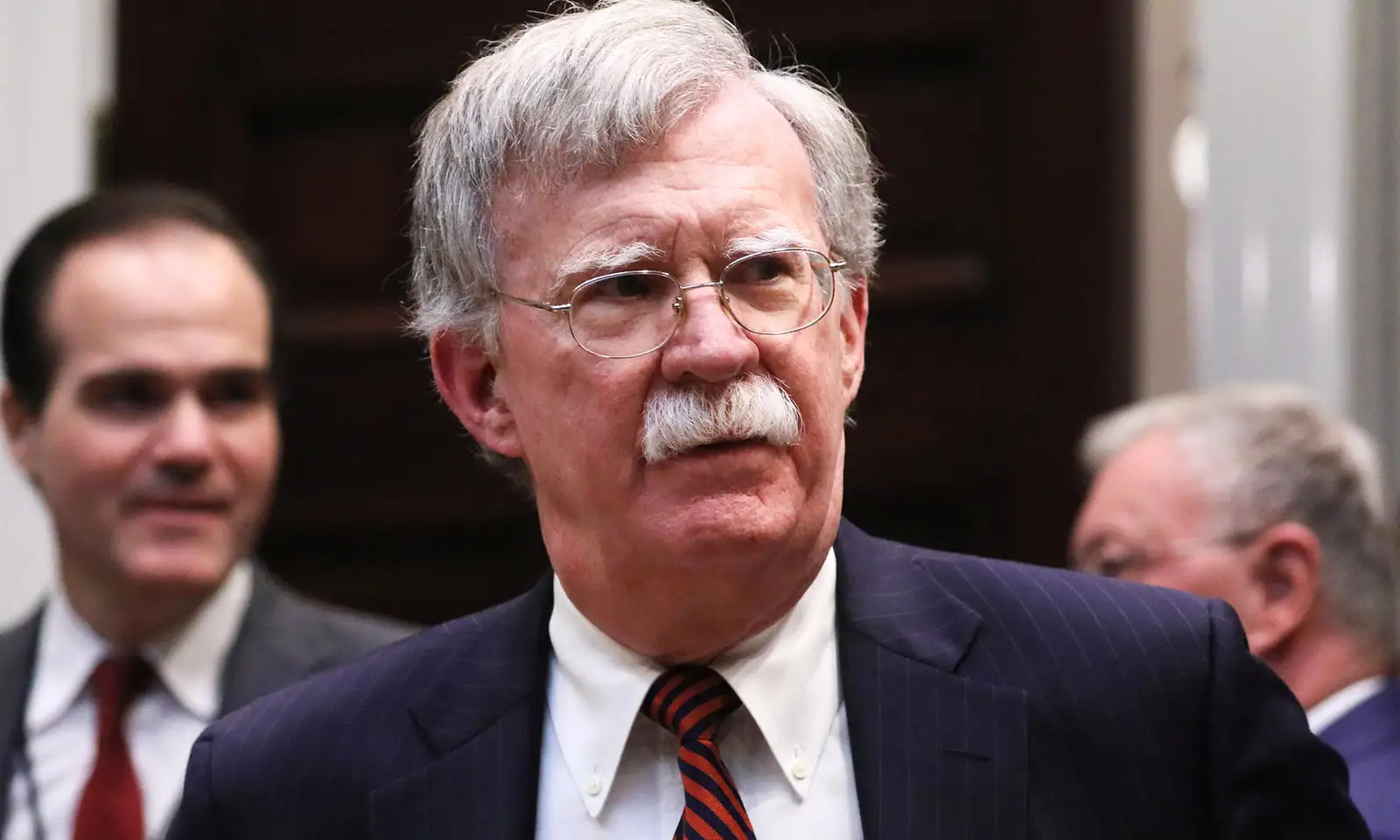
Whatever the opposite of a rush to war is — a crawl to peace, maybe — America is in the middle of one. Since May 5, when John Bolton announced the accelerated deployment of the Abraham Lincoln carrier group to the Persian Gulf in response to intelligence of a possible Iranian attack, the press has been aflame with calls for America to show restraint, pursue diplomacy, and rein in the madman with the mustache before he starts a war.
Never mind that President Trump, Mike Pence, Mike Pompeo, Patrick Shanahan, and Bolton have not said a single word about a preemptive strike, much less a full-scale war, against Iran. Never mind that the president’s reluctance for overseas intervention is well known. The antiwar cries are not about context, and they are certainly not about deterring Iran. Their goal is saving President Obama’s nuclear deal by manipulating Trump into firing Bolton and extending a lifeline to the regime.
It’s a storyline that originated in Iran. Toward the end of April, Zarif showed up in New York and gave an interview to Reuters where he said, “I don’t think [Trump] wants war,” but “that doesn’t exclude him basically being lured into one” by Bolton. On May 14, an adviser to Rouhani tweeted at Trump, “You wanted a better deal with Iran. Looks like you are going to get a war instead. That’s what happens when you listen to the mustache. Good luck in 2020!”
And now this regime talking point is everywhere. “It’s John Bolton’s world. Trump is just living in it,” write two former Obama officials in the Los Angeles Times. “John Bolton is Donald Trump’s war whisperer,” writes Peter Bergen on CNN.com. “Trump’s potential war with Iran is all John Bolton’s doing. But it might also be his undoing,” says the pro-Iran Trita Parsi on NBCNews.com. “Is Trump Yet Another U.S. President Provoking a War?” asks Robin Wright of The New Yorker. Guess her answer.
“We cannot repeat the days before the Iraq war when even many of our most reliable news outlets repeated and amplified what was, in fact, a flimsy case for war,” Wendy Sherman writes in the New York Times. She would rather our most reliable news outlets repeat and amplify anti-Bolton talking points instead. Sure, America suspects Iran was involved when “four commercial tankers were reportedly sabotaged off the coast of the United Arab Emirates,” and “Saudi Arabia also reported that drones sent by Iranian-supported Houthis attacked Saudi oil facilities.” But, look, “Iran has denied this.” What more do you need to know?
This is the Iran echo chamber at work. Recall former Obama deputy national security adviser Ben Rhodes’s admission to the New York Times Magazine in 2016, when he said, “We created an echo chamber” to attack the Iran deal’s opponents through leaks and tips to the D.C. press. “They were saying things that validated what we had given them to say.” And: “We had test drives to know who was going to be able to carry our message effectively, and how to use outside groups like Ploughshares, the Iran Project, and whomever else. So we know the tactics that worked.” They worked because “the average reporter we talk to is 27 years old, and their only reporting experience consists of being around political campaigns. That’s a sea change. They literally know nothing.”
And so, when President Obama framed the choice as between his deal and “going to war,” no one batted an eye. When Obama said the forces of good would triumph “despite the money, despite the lobbyists” — paging Ilhan Omar — the echo chamber repeated his words. When Obama’s administration portrayed President Rouhani and Foreign Minister Zarif as reformers eager to join the international community, even though real power lies with Ayatollah Khamenei and Qassem Soleimani of the Islamic Revolutionary Guard Corps (IRGC), reporters dutifully conveyed the preferred narrative. Iranian hostage taking, missile building, terrorism financing, and proxy fighting was downplayed or ignored. Israel and its prime minister, Benjamin Netanyahu, were portrayed as the real obstacles to peace.
What baloney. Still, President Obama got his deal — for a few years, anyway. When Donald Trump’s victory threatened Obama’s foreign-policy legacy, the echo chamber resumed operation. The same Obama officials, journalists, and foreign-policy experts who had pretended Rouhani was Gorbachev spent two years telling us that Donald Trump was a Russian asset, possibly had been since 1987, had committed “treason,” and would be driven from office after Robert Mueller exposed his crimes. They were ready to throw Trump’s incoming national security adviser in jail for violating the Logan Act, even as John Kerry, and now it seems Dianne Feinstein, talk shop with Zarif.
Members of the echo chamber aren’t for attacking Iran, but they are all for slandering its American opponents. The latest target is Bolton. One of the most ferocious critics of President Obama, he has been an effective and hawkish national security adviser for President Trump. Why is he, not Iran, being blamed for heightened tensions? It’s because the Iran deal, and perhaps the Iranian regime, is on life support.
Context is all. On April 8, the president announced he was designating the IRGC a terrorist organization, threatening its financial base. On April 22, Pompeo announced that the United States would end waivers for sanctions on Iranian oil. That same day, Iran threatened to close the Strait of Hormuz. On May 8, one year after the United States withdrew from the nuclear deal, Iran threatened to follow suit.
“Rouhani did not signal the end of the deal entirely,” reported CNBC.com, “but gave Europe an ultimatum: It will have 60 days to either follow the Trump administration or resume oil trade with Iran to save the agreement, violating U.S. sanctions. A failure to do the latter would prompt Tehran to return to high level uranium enrichment, the Iranian leader said.”
This isn’t diplomacy. It’s nuclear blackmail. And it’s a sign of desperation. The Iranians are in a box. U.S. sanctions are crushing the economy, but if they leave the agreement with Europe, they will be back to square one. To escape the box, you try to punch your way out. That’s why Iran has assumed a threatening posture: Provoking an American attack could bolster waning domestic support for the regime and divide the Western alliance.
America faces a challenging international environment, with trouble spots in Venezuela, North Korea, China, Ukraine, Afghanistan, Syria, Iraq, and Iran. The breadth and depth of the crises requires dispassionate analysis and prudent judgment. It also requires us to remember the differences between deterrence, retaliatory strikes, and regime change and ground invasion. Only the first two things are under consideration, as Iran’s behavior in the Middle East grows worse. Guess what: We’ve got a peace fever. And the only prescription is more Bolton.
This column originally appeared in the Washington Free Beacon.




Comments
On “The Warmonger Canard”