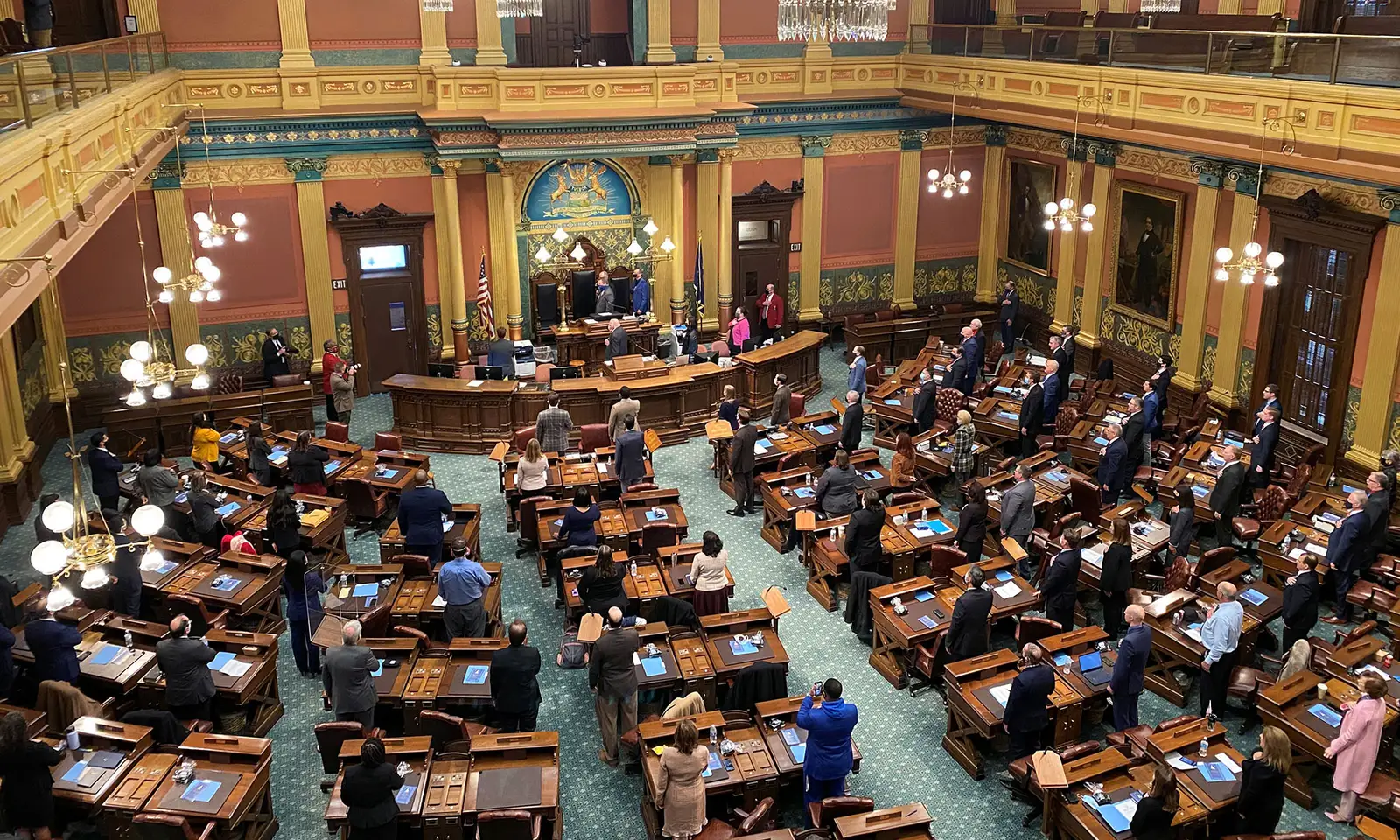
In 2022’s midterm elections, Michigan Democrats surprised political handicappers when they captured both chambers of the state legislature for the first time in 40 years. Now, with all the levers of state government in their control, Michigan Democrats are swiftly dismantling conservative policy victories that took Republicans years to achieve.
On Thursday, the lower chamber of Michigan’s legislature voted to repeal the state’s Freedom to Work law. This “right-to-work” provision prohibits organized-labor organizations from involuntarily levying dues and service fees on individuals whose place of work is covered by a collective-bargaining agreement, whether those individuals are union members or not. In a savvy maneuver, Democrats attached a modest $1 million appropriation to the bill. Republican lawmakers contend that this is designed to render the bill “referendum-proof” because Michigan law prohibits plebiscites on bills that include appropriations.
Democrats have admitted that the language in this bill does not comport with the U.S. Supreme Court’s decision in Janus v. AFSCME, in which the Court’s majority found that public-sector unions cannot extract agency fees from non-consenting employees without violating their First Amendment rights. Moreover, it’s unclear if Governor Gretchen Whitmer will sign it into law, since she already promised to veto any “non-appropriations bill [that] has a dollar amount added to circumvent the people’s right to a referendum.” But it’s reasonable to expect that Whitmer will find some way to justify violating her pledge so that private-sector unions may once again garnish the wages of nonmembers. For public-sector workers, Michigan Democrats plan to keep the bill on ice “as a placeholder should Janus be overturned.”
This Democrat-led assault on the rights of Michiganders to choose their own affiliations and withhold their support from political organizations that do not represent their values is just the beginning. The state’s Democrats have already prepared companion legislation that would exempt unions from contribution limits, make union dues tax-exempt, and allow labor organizations to make independent expenditures in support of or opposition to candidates without having to register as a PAC.
This is a tragic development, and not just because it is a step backward for liberty-loving Michiganders. It is a vivid illustration of the deterioration of the Republican Party in the Great Lakes State. The Michigan GOP was once an energetic idea factory. Republicans took great risks, endured savage attacks on their characters, and persevered against significant odds to transform a state with a labor-centric political culture into a freer and fairer place for all workers.
When Michigan passed its “right-to-work” law in 2012, its Republicans joined a vanguard of conservative reformers who engineered a sea change in American life. Conservatives may take the extent of those victories for granted.
The effect of Michigan’s right-to-work law was immediate. “From March 2013 when its law took effect through November 2014,” the Wall Street Journal reported, “the state saw 4% payroll manufacturing job growth, beating an average of 2.8% in right-to-work states and 0.9% in non-right-to-work states.” The wild boom-and-bust cycles that typified Michigan’s economy in the years prior to the Great Recession were replaced with steady annual GDP growth. By 2018, Michigan’s GDP grew at 2.5 percent, ranking fourth among all U.S. states. That same year, Michigan Republicans repealed the state’s prevailing-wage law — what one GOP lawmaker called a “discriminatory and racist relic” and a “price-fixing scheme” — that had inflated state-funded construction costs by forcing contractors to pay union wages and benefits.
Michigan’s experience became the nation’s experience after 2018. One year after the Court’s decision in Janus, AFSCME (the American Federation of State, County, and Municipal Employees) lost 98 percent of its agency fees, and the SEIU (Service Employees International Union) lost 94 percent. By 2019, the AFL-CIO could commit less than one-tenth of its operating budget to organizing — a decline of 30 percent from a decade earlier. That existential apprehension that accompanies terminal decline perhaps contributed to the mania that led the manager of the AFL-CIO’s Twitter account to fire off an image of a guillotine at Delta Air Lines amid a 2019 labor dispute. Desperation will make fools of us all.
President Joe Biden’s efforts to bolster union membership notwithstanding, the number of unionized wage and salary workers has continued its steady decline during his tenure. In 2022, just over 10 percent of the American workforce belonged to a union — the lowest percentage since the Bureau of Labor Statistics started collecting the relevant data in 1983, when over 20 percent of American workers were unionized.
That decline and the apprehension that accompanies it have led union activists and their allies in the Democratic Party to abandon all caution. As their efforts in Michigan attest, they make no pretense about their intention to transform labor organizations into Democratic political PACs.
And there’s little to stop them. The last state to enact a “right-to-work” law, Kentucky, did so in 2017. In the interim, the Right’s will to resist organized labor’s pressure campaigns has ebbed. For now, Republicans and conservatives who understand the threat posed by coerced unionization can take solace in the bulwark provided by the six right-leaning justices on the Supreme Court. But Supreme Court majorities come and go. Moreover, they are a lagging by-product of electoral victories at all levels of government, and electoral victories are won by parties with a coherent and attractive political philosophy. The Michigan GOP was once just such a party.
Today, the state’s GOP has traded managerial competence and incremental legislative gains for fratricidal purity tests and paranoia. And its members seem to like it that way. In February, the state GOP picked Kristina Karamo — a fierce advocate of Donald Trump’s stolen-election claims and a former candidate for secretary of state who has yet to concede her 14-point loss in 2022 — to lead their party. With leadership like this, Democrats can expect to claw back more hard-won conservative policy victories for years to come.




Comments
On “Michigan Democrats Want to Bring Back Union Coercion”