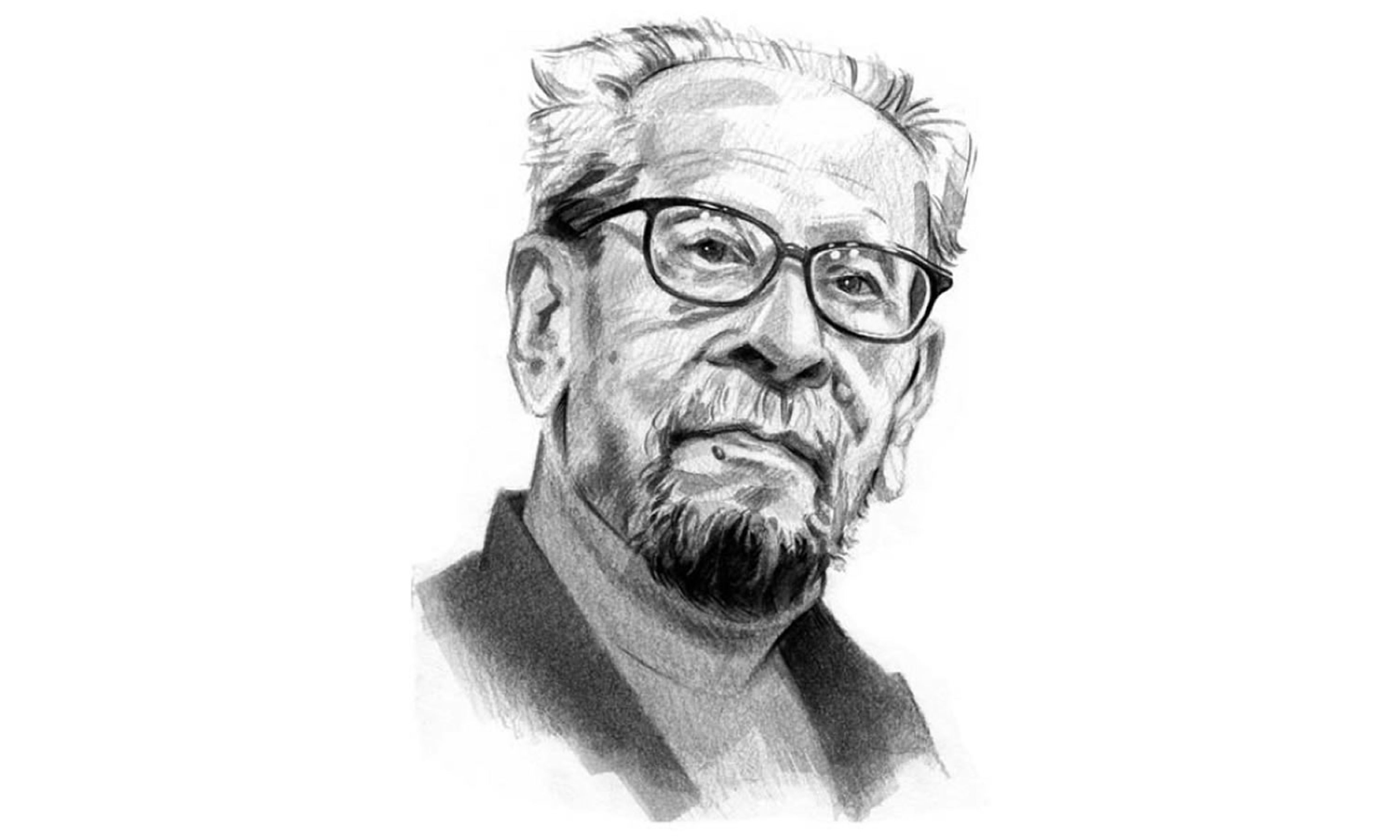
Naguib Mahfouz, the Egyptian writer who died on August 30, was something rare, more rare than you may suppose: He was a born writer. It’s not just that Mahfouz wanted to write, but that he was compelled by nature to. In the 1980s, shortly before he won the Nobel Prize, he told an interviewer, “If the urge to write should ever leave me, I want that day to be my last.” I don’t know whether the urge left Mahfouz on August 30 (or before), though I doubt it. But he died, aged 94.
In his long, productive decades, he wrote some 35 novels, hundreds of short stories, screenplays, etc. People have compared him to an Englishman, Charles Dickens, and to a couple of Frenchmen: Balzac and Zola. They have also compared him to a trio of Russians: Tolstoy, Dostoevsky, and Solzhenitsyn. But like all great artists—including the writers mentioned—he was primarily himself.
He pretty much invented the novel in Arabic—that language had always favored poetry—and, in fact, he wrote classical Arabic, a very elegant tongue (according to those who know it). When he gave his Nobel Lecture in 1988, he said that the “real winner” was this language. He also said some other things, about which more in due course.
When the Nobel Committee announced its choice that year, just about none of us had heard of Mahfouz—none of us in the West, that is. But he was a household word in the Arab world, a “conscience,” as has often been said, as well as a chronicler. An amusing headline appeared in al-Ahram, the Egyptian state newspaper: “Nobel Wins the Naguib Mahfouz Prize.” The rest of us soon caught up, and Mahfouz’s books made an impact, including on me.
The writer was born in 1911 in Cairo, where he would spend his entire life. As a boy, he loved European detective novels, and he would copy them over, rather as composers used to do. (Mozart, for example, copied earlier masters’ scores, in order to learn.) After university, Mahfouz achieved the goal of many young Egyptian men: to land a government job. He worked in a variety of ministries, including Religious Affairs and Culture. He ended up in the State Cinema Organization, where he acted as censor—a remarkable job for a writer and artist. A number of his fellows were resentful. But you might say that someone had to do it.
Mahfouz did his civil-servant work—diligently, by all accounts—mainly in the morning, and scribbled in the afternoon. He did this until 1971, when he reached the government’s retirement age of 60. Then he kept writing.
His magnum opus is The Cairo Trilogy, published in the mid-1950s. This trilogy—one massive book, really—is composed of three novels: Palace Walk, Palace of Desire, and Sugar Street. All three titles, not just the last of them, refer to Cairene streets. And Mahfouz knew those streets with extraordinary intimacy. Do you know that he left Egypt only three times in his life? He was sent on two governmental missions—to Yemen and Yugoslavia—and sought medical treatment in Britain. Mahfouz may not have been a man of the world, but he had no trouble finding the world in Cairo, and was clearly universal.
The Trilogy cannot be described in a couple of strokes, but suffice it to say that it is a sweeping, panoramic tale of a family across several generations, and that it stretches from World War I to the Egyptian revolution in 1952. Many critics have said that this is more a story of Egypt than of individual characters. I disagree. It is both, of course—but, for me, the personal transcends the national, historical, and political. Mahfouz is a historically informed novelist, not a literarily gifted historian. And he is at his best when he is being his least didactic.
POLITICS AND PROSE
I read the Trilogy in what may be considered peculiar circumstances. In November 2000—after our presidential election—I was scheduled to go to Egypt, for the first time. I wanted to prepare by reading Mahfouz, of whose books I had long been aware. (Well, since 1988, and the Nobel Prize.) And, during those weeks, I was working on the George W. Bush campaign in Austin, Texas. So I would do combat with Al Gore during the day, and return to a hotel room at night to plunge myself into Mahfouz’s world.
Here’s a confession that I know you’ll forgive me for: I had always assumed that Mahfouz was no good, or at least not strikingly good. I assumed that Mahfouz had won the Nobel simply for being an Arab—no Arab had won the prize, and the committee is a firm respecter of affirmative action. Indeed, many thought that, in the Mahfouz year, the prize should go to a woman, and Nadine Gordimer’s name was mentioned prominently. (She would be the winner in 1991.)
Whatever the Nobel Committee’s motivations, they chose a splendid novelist in Mahfouz, for those books are magical, enthralling, full of tremendous humanity and warmth. (That’s a word repeatedly applied to the Trilogy: warmth.) I lived and died with those characters night after night, not wanting the Trilogy to end. After I did, in fact, finish, I resolved to read all of Mahfouz’s oeuvre. I’m afraid I cannot recommend it, given limited time. In the Trilogy, Mahfouz seemed to touch a peak (and, in truth, the first of the novels—Palace Walk—is superior to the subsequent two).
After the election, I first went to Alexandria, then to Cairo. And there I wanted to walk Mahfouz’s streets, just like any other Trilogy-besotted tourist. My friends took me to Fishawi’s, the fabled café in which the writer had spent many an hour, and also to another establishment: the Naguib Mahfouz Café. Clever, alluring name!
One of the most interesting encounters I had was in Alexandria. This was with a woman who lectured at the university, and she was thoroughly modern (or at least she seemed that way): Westernized, multilingual, widely traveled. I told her of my love for the novels, and she said, “Yes, I often wish I could live in those times.” I said, “Sure, sure, I know what you mean—but without the subjugation of women, of course,” for they were once not allowed outside, or even to be seen through a window. She answered, “No, even with that. I’m not sure I’d mind at all.”
Speaking of windows, I felt that I had been afforded a rare glimpse through one. I think what the lady meant was that she longed for the protection and comfort of hearth and home, as against the hurly-burly of the “liberated” world. I’m not sure.
ANTENNAE AND KNIVES
Politically, Mahfouz was a mixed bag. Edward Said said that he had a “nineteenth- century liberal belief in a decent, humane society” (would that Said himself had had), and that seems plausible. Though a Muslim, Mahfouz married a Christian, and he despised Nasser. He backed Sadat and peace with Israel, which got his books banned in several Arab countries. At least one book was banned in Egypt, too: Children of the Alley, written in 1959. It is a religious allegory, which greatly displeased the religious authorities in Egypt. Thus was the State Cinema censor censored. But his political antennae were sharp, and he always had a sense of what was possible in Egypt, at any time.
You will recall that, in 1989, Ayatollah Khomeini issued his fatwa against Salman Rushdie, for The Satanic Verses. Others said, “Why not Mahfouz, too?” Egypt’s “blind sheikh,” Omar Abdel Rahman—whom you know as the guiding force behind the first World Trade Center attack, in 1993—was philosophical: “If this sentence had been passed on Naguib Mahfouz when he wrote Children of the Alley, Salman Rushdie would have realized that he had to stay within bounds.”
In 1992, an Egyptian intellectual, Farag Foda, was killed by Muslim extremists. Naturally enough, police found Mahfouz’s name on a list of targets. But the writer would not accept bodyguards and refused to alter his cherished routine (which included a long walk and cafés). In 1994, they got him, stabbing him through the neck. The 82-year-old Mahfouz survived, but was badly incapacitated. From his hospital room, he said, “I pray to God to make the police victorious over terrorism and to purify Egypt from this evil, in defense of people, freedom, and Islam.” He also displayed a Reaganesque sangfroid and humor: When the finance minister—one of a parade of officials—came in, he quipped, “I’ve paid my taxes.”
What about Mahfouz and Islam? In his Nobel Lecture, he tells the assembled grandees—through a proxy, for he did not travel to Stockholm—that he is “the son of two civilizations”: the Pharaonic and the Islamic. Concerning the latter, he will not talk of its “conquests, which have planted thousands of minarets” all over the world; nor will he talk about “the fraternity between religions and races” that has been made possible by Islam, thanks to its “spirit of tolerance” unprecedented in all human history.
That is something to ponder, before going on.
No, he will “introduce” this civilization to the Stockholm audience by telling a story: After Muslims defeated Byzantines in a battle, they would return Byzantine prisoners only in exchange for “a number of books of the ancient Greek heritage in philosophy, medicine, and mathematics.” This, in spite of the fact that “the demander was a believer in God” while what was demanded was the “fruit of a pagan civilization.”
So, by Mahfouz’s testimony, this was Islam, in its essence: generous, all-embracing, and humane. Later in his lecture, he undertook to speak for the whole Third World (and, frankly, there is a lot of claptrap in this text, especially concerning black Africans and Palestinians). Mahfouz told the West, “Be not spectators to our miseries. You have to play therein a noble role befitting your status. From your position of superiority, you are responsible for any misdirection of animal, or plant, to say nothing of Man, in any of the four corners of the world.”
THE BAD WITH THE GOOD
This view is taken by many people, both in the West and without. But what would Mahfouz have to say in October 2001, when President Bush—not being a “spectator”—went after the Taliban, that prime inflicter of misery? Mahfouz wrote that the “so-called war on terrorism” was “just as despicable a crime” as the 9/11 attacks. He repeated the woeful argument that counterattacks “give terrorism additional justification.” But worse—worse—was to come later: when he defended, excused, and flat-out glorified the suicide bombers in Israel.
That burst my bubble, as you might imagine. And it reinforced an old lesson: not to fall in love, personally, with writers or artists you admire. To put it succinctly, divorce, if you can, Parsifal from the man (or celebrate the Parsifal in the man, while rejecting what is ugly). At the time of the Afghan war, National Review observed sadly that Mahfouz was “only the latest in a long line of dazzling artists who have sided with the barbarians.” I tried to console myself with the thought that the writer was 90 and perhaps out of it, or that he had succumbed to some terrible pressure, or that he had been brainwashed by vile media. After all, the U.S. and its allies—including Israel—were confronting the very forces that had plunged a knife into his neck!
Nevertheless: For many, many years, Naguib Mahfouz represented an older, enlightened Arab culture, one that has been little in evidence lately. He was cultivation, not fanaticism and blood. Egypt is very proud of him—the most famous Arab writer—and well it should be: They gave him a military funeral, his coffin draped with the Egyptian flag. But Mahfouz was a writer for all the world, as the White House recognized when it lauded him on his death. (The U.S. also offered hospital treatment during Mahfouz’s final illness, according to Egyptian television.)
I have no doubt that, sometime in the future, I will go back to those marvelous books—that one big book, really—forgetting, or remembering less, what was ugly in Mahfouz. And I will renew my acquaintance with al-Sayyid Ahmad, Amina, Umm Hanafi, Yasin, Khadija, Fahmy, Aisha, Kamal, and all the other characters who thrilled me—with whom I lived and died—in the final weeks of the 2000 campaign.
— This article first appeared in the September 25, 2006, issue of National Review.





Comments