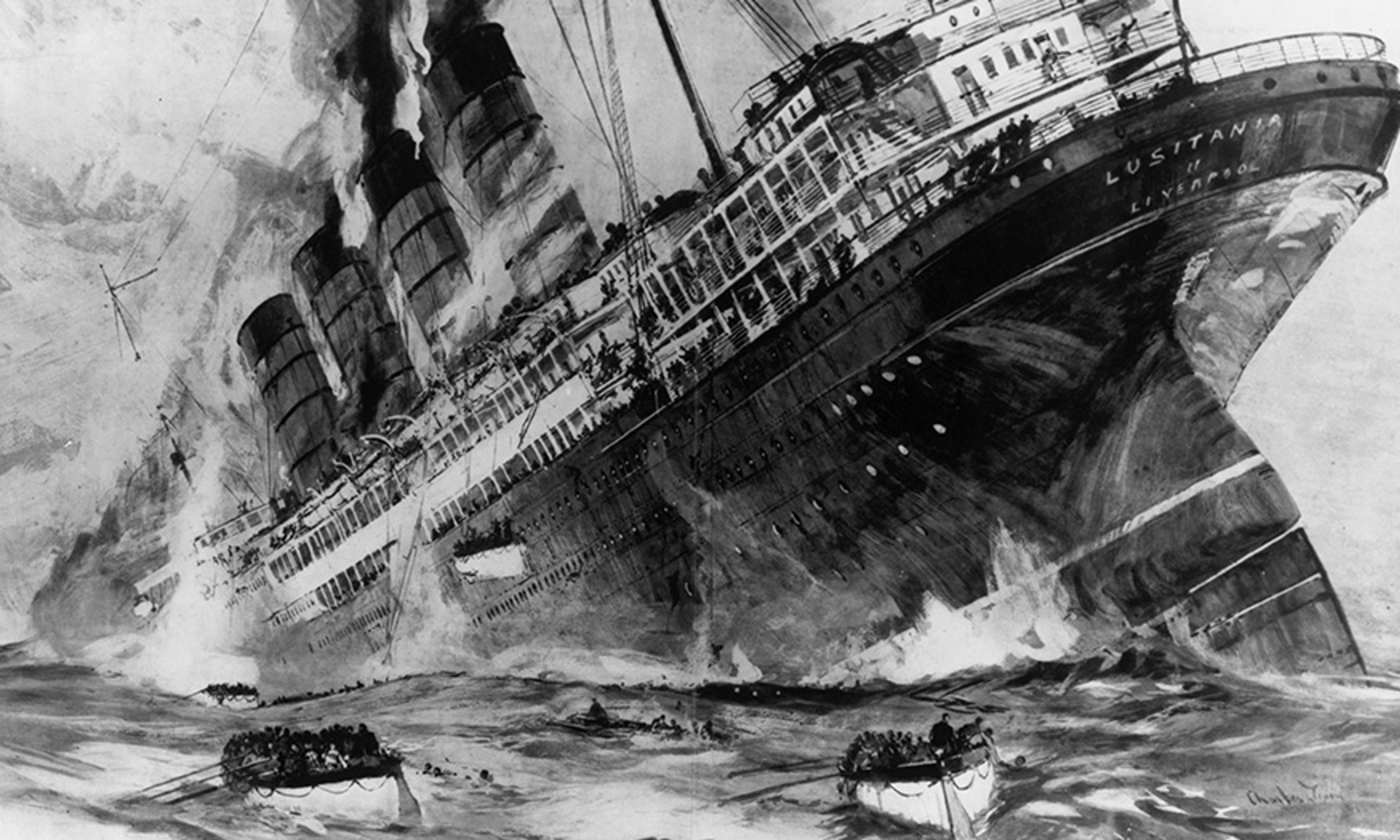
Owning a fragment of history — a Gettysburg bullet, a Coolidge campaign button — is fun, so in 1968 Gregg Bemis became an owner of the Lusitania. This 787-feet-long passenger liner has been beneath 300 feet of water off Ireland’s south coast since a single German torpedo sank it 100 years ago Thursday. It contains the 4 million U.S.-made rifle bullets and other munitions that the ship had been carrying from neutral America to wartime Britain.
It is commonly but wrongly said that the sinking altered history’s trajectory. Yet some people, including Britain’s first lord of the Admiralty, Winston Churchill, hoped an attack on a ship would pull America into the war. They may have facilitated Lusitania’s calamity by not taking available measures to prevent it. Of the 1,198 who perished, 128 were Americans.
In Dead Wake: The Last Crossing of the Lusitania, Eric Larson notes that early in 1915 warfare was evolving. On January 19, two zeppelins conducted Germany’s first air raid on Britain. On April 22, near Ypres, Germans sent a cloud of chlorine gas drifting toward French and Canadian lines.
Larson’s story concerns a technology central to Germany’s strategy: Submarines supposedly would interdict supplies heading to Britain, which imported two-thirds of its food.
Some people, including Britain’s first lord of the Admiralty, Winston Churchill, hoped an attack on a ship would pull America into the war.
The morning the Lusitania left New York, Germany’s U.S. embassy placed on the shipping pages of the city’s newspapers its usual notice that vessels flying the British flag “are liable to destruction” in the war zone, including waters around the United Kingdom. Captain William Turner soothed anxious passengers by noting that his ship could outrun a submarine. This was reassuring only assuming he would know where the submarines would be. Turner also said that upon entering the war zone, the ship would be enveloped by the British Navy’s protection. He was wrong.
Woodrow Wilson’s February 1915 protest about German submarines targeting neutral countries’ merchant shipping, Larson writes, “did not impress Germany’s submarine zealots,” who thought they could cripple Britain before America could mobilize to intervene in Europe. Germany’s policy put events in the hands of young, ambitious submarine captains, such as Walther Schwieger of U-20, whose movements were tracked by British intelligence capabilities unknown to Germany.
Because some passengers had to be transferred from another liner, the Lusitania left America two hours late. To pare costs in the face of declining wartime travel, the ship conserved coal by using just three of its four boiler rooms, which prolonged the voyage. If neither delay had happened, Lusitania’s course probably would not have intersected U-20’s. British officials did not tell Turner to alter Lusitania’s route to Liverpool and did not send even a single one of the available navy vessels for protection.
Churchill had spoken of attracting shipping to Britain’s shores “in the hopes especially of embroiling the United States with Germany.” And: “We want the traffic — the more the better; and if some of it gets into trouble, better still.”
In his World War II memoirs, Churchill recalled hearing about Pearl Harbor: “I thought of a remark that [Foreign Secretary] Edward Grey had made to me more than 30 years before — that the United States is like ‘a gigantic boiler. Once the fire is lighted under it there is no limit to the power it can generate.’ . . . I went to bed and slept the sleep of the saved and thankful.”
Churchill’s thinking about the Lusitania tragedy and the economizing of violence was similar. In his World War I memoir, he wrote that America’s entry into the war in April 1917 “could have been done in May 1915. And if done then what abridgement of the slaughter . . . would have been prevented.”
Larson notes that the day Lusitania was sunk, Colonel Edward House, Wilson’s adviser, was in London, where King George V asked him: “Suppose they should sink the Lusitania with American passengers aboard?” Hours earlier, House had met with Britain’s foreign secretary. “We spoke,” House remembered, “of the probability of an ocean liner being sunk and I told him if this were done, a flame of indignation would sweep across America, which would in itself probably carry us into war.”
American anger was more muted and the nation’s neutrality survived until two months after Germany resumed unrestricted submarine warfare in February 1917. A “dead wake,” Larson explains, is maritime vernacular for a trail of “a fading disturbance,” as from a torpedo. What Gregg Bemis owns is a relic of a tragedy that was a consequence, not a cause, of many others.
— George Will is a Pulitzer Prize–winning syndicated columnist. © 2015 The Washington Post





Comments