Oktoberfest isn’t happening this year because of COVID-19, but that’s not the only reason Germans could be disappointed this fall. After 16 years of Angela Merkel’s chancellorship, they will vote to elect a new leader on September 26. The winning candidate will have a golden opportunity to break with decades of weak China policy. Sadly, the willingness of the two leading contenders to do that is far from certain.
Starting with the chancellorship of Helmut Kohl in the 1980s, Germany’s approach to China has been more or less dictated by corporate economic interests. With leaders hoping that the now-disproven canard of “Wandel durch Handel” — “change through trade” — would trigger the democratic shift many sought for China, Germany’s foreign policy has for years hinged on guaranteeing access to Chinese markets for German manufacturing giants such as BASF, Siemens, and Volkswagen. Nothing has changed under Chancellor Merkel, who been reluctant to criticize China on human-rights grounds, didn’t lead on banning Huawei from German 5G networks, and has lobbied for European Union ratification of a landmark EU–China trade agreement. That deal is currently frozen in the EU parliament because of Chinese sanctions on European legislators and human-rights advocates who condemned the Chinese Communist Party’s genocide in Xinjiang.
More recently, Germany has sent a warship, the frigate Bayern, to the South China Sea for the first time in two decades, officially to help enforce United Nations sanctions against North Korea. But it’s hard not to see the mission as responsive to American calls for timid allies like Germany to take a more active role in protecting freedom of navigation in the Indo-Pacific. Not wanting to anger China, Berlin offered for the Bayern to make a port call in Shanghai as a friendly signal to Beijing. But China has so far insisted that Germany clarify its intentions with the South China Sea visit before granting the Bayern a friendly berth. Chinese dominance of Asia’s waterways would be a massive threat to the open sea lanes that undergird Germany’s export economy. Taking a stand for them shouldn’t be this hard for a chancellor with one foot out the door.
The German people have become consistent in advocating for a China policy whose organizing principle is not offending Germany’s largest trading partner. A new poll of Germans released on August 30 shows that 58 percent of Germans favor a tougher posture toward China, even if it affects economic relations. That tracks with a 2019 Körber Foundation survey in which 76 percent of Germans said Germany should defend its political interests more strongly in dealing with China, even if doing so might harm its economic interests. Even Germany’s manufacturing base has become more vocal in its concerns about China’s theft of proprietary German knowledge and about Chinese state-backed companies gaining ground in Europe.
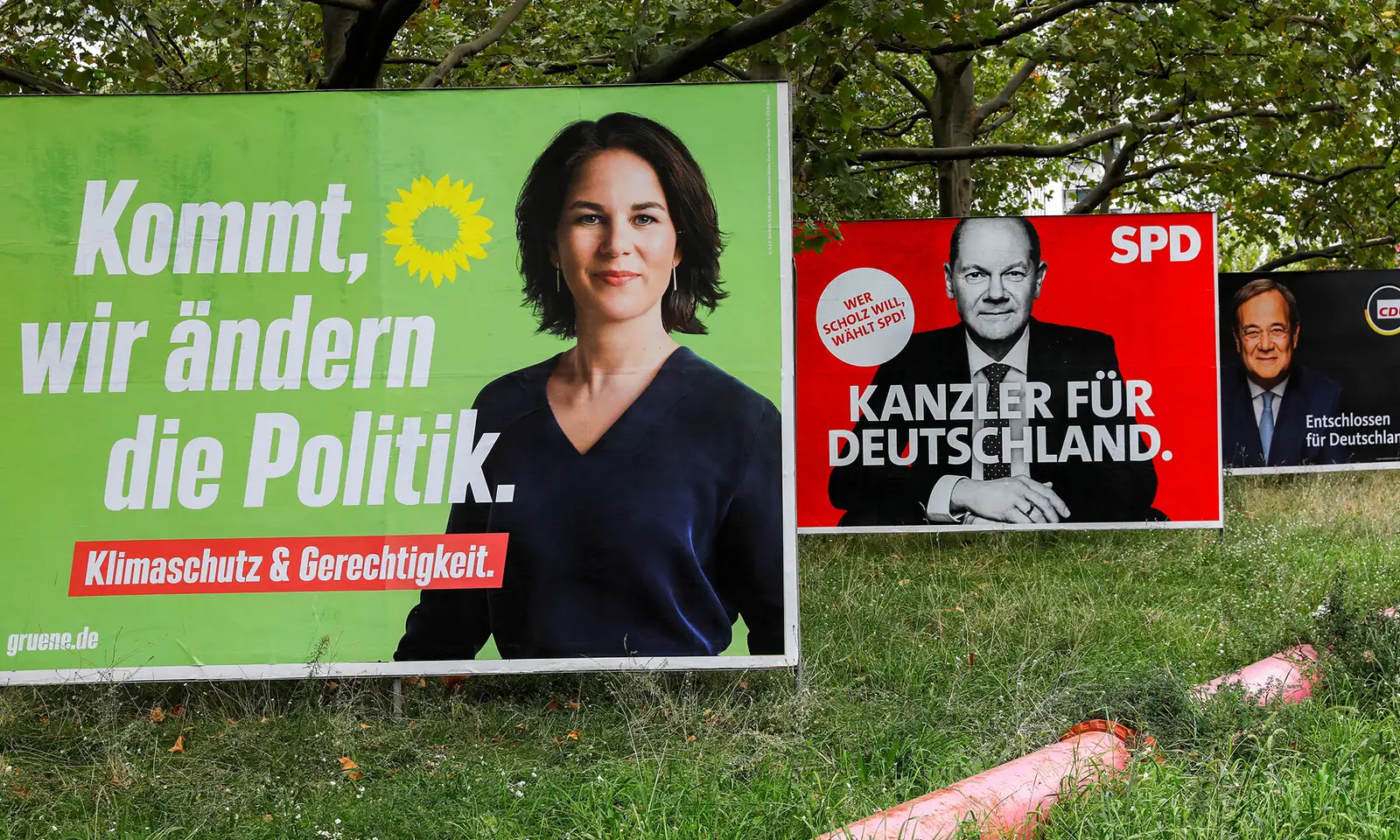
Unfortunately, only one leading candidate in the contest for the country’s chancellorship is unambiguously channeling this energy. Green Party candidate Annalena Baerbock has called for higher barriers for Chinese imports, urged China–Europe relations to be viewed as “authoritarian forces versus liberal democracies,” and said, on Twitter, “We allowed sell-out of key parts of infrastructure in Greece & Portugal to China. Europeans cannot allow this to happen again.”
While some elements of Merkel’s Christian Democratic Union (CDU) party have urged a harder line, its candidate, Armin Laschet, currently second in the polls, has taken a position resembling Merkel’s — not wanting to derail the Chinese gravy train with public criticism of human-rights abuses. To his credit, Laschet has said some of the right things about strengthening the relationship with the United States to compete against China, but he can’t have it both ways. Lamentably, such fence-sitting is regarded as a virtue in German politics.
Neither candidate seems favored, at this point, to win. After surging to a surprising lead in spring polls, a series of gaffes, as well as fears of the Greens harming the economy, have caused Baerbock to fade down the stretch. Laschet, once the frontrunner, has fallen off after being caught on camera laughing while German president Frank-Walter Steinmeier delivered a solemn speech mourning victims of floods that have killed hundreds in Germany’s Rhineland.
That leaves Social Democratic (SPD) candidate Olaf Scholz, currently holding a lead with about 25 percent of the vote. Scholz has been fairly mum on China, which could indicate cause for concern. Scholz is a former mayor of Hamburg, a port city that depends a great deal on Chinese cargo. As Germany’s finance minister and a director of the Beijing-dominated Asian Infrastructure Investment Bank, he has assuredly gotten close to Chinese leaders, no doubt on behalf of German business. Let’s hope that SPD foreign-policy spokesman Nils Schmidt spoke for SPD leadership when he said last January: “We need a real foreign policy for China — not just a business-oriented policy.”
The good news is that, no matter who wins, German public opinion, pressure from the United States, and the strong possibility of having to partner with the Green Party in a coalition government make it likely the victor will be pushed in a more hawkish direction. The same hardening found among the German public is also happening in Parliament and the foreign ministry. Conservatives in the United States rightfully lament how bureaucracies often influence policy outcomes against the wishes of the principals leading them, not the other way around. When it comes to the future of Germany’s China policy, those bureaucratic exertions might not be such a bad thing.

Comments
On “Germans Are Demanding a New China Policy. Will the Next Chancellor Deliver?”