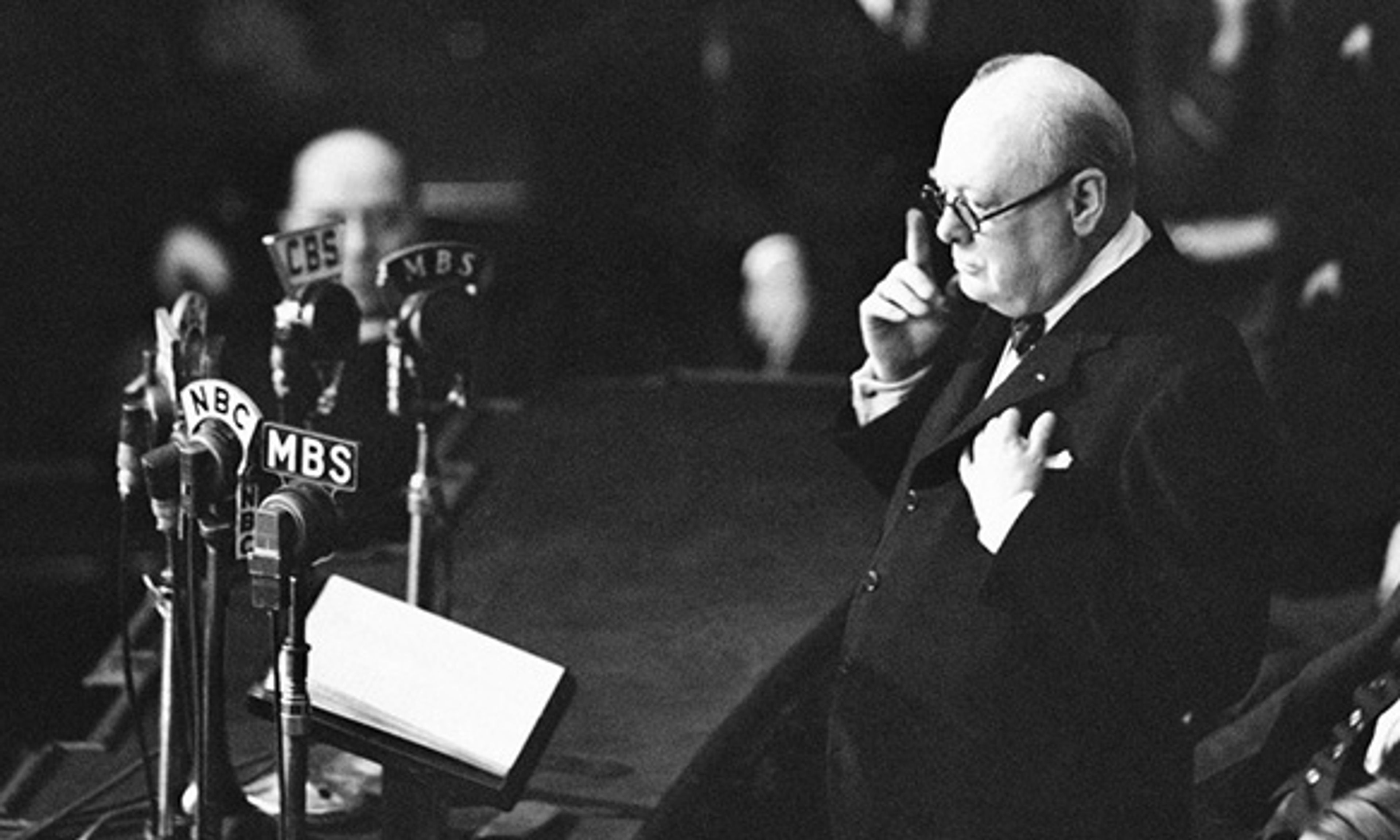
The British media now and again run polls to ask who are the greatest Englishmen of all time, and Winston Churchill invariably comes out on top, ahead of Shakespeare, Newton, and Darwin. His image, complete with homburg hat and bow tie, cigar and two fingers raised in his trademark V for Victory salute, is still within living memory, but the man has achieved almost mythical stature. Churchillian is the adjective commonly applied to anyone in public life making a spirited defense of democracy and freedom.
Born in 1874 into one of the grandest aristocratic families, he seems to have been very much a man of his era, with a belief in Britain and its empire, and the privileges and duties that went with it. Pushing himself forward, ambitious to a fault, he spent his life at the center of British politics as though by right. Contentious, he spoke and wrote as he pleased and at the time many people neither liked nor trusted him for it. (An anecdote: My father ghosted one of Churchill’s books, Great Contemporaries. Very strangely, Churchill retained for his version the structure of chapter, paragraph, and even sentence and punctuation, but none of the wording.) Perhaps he would have been just another 20th-century British politician, except that in the 1930s Adolf Hitler came to power in Germany.
The determination to resist Hitler was not a foregone conclusion. Elements of public opinion were in favor of coming to terms with Nazism. Lord Halifax, Lloyd George, and even the masochistic socialist Sir Stafford Cripps might have led the country in a policy of collaboration as Marshal Pétain did in France. In the background were the pro-German Duke of Windsor and Sir Oswald Mosley and his Fascists. Churchill spelled out that the independence of Britain and the safeguarding of the civilized world were at stake, and hindsight has only substantiated how right he was. It still seems slightly improbable, too quixotic to be true, that when Churchill became prime minister in May 1940 — already aged 65, what’s more — he offered defiance but no real prospect of defeating Hitler, and the survival of Britain could not be taken for granted. The Third Reich looked set to master Europe indefinitely and fatefully. Churchill’s alternative of solitary defiance from a position of weakness was a gigantic gamble.
Of the making of books about Churchill, therefore, there is no end. What is reality, what is myth? Revisionist arguments of several sorts spring up from the standoff between him and Hitler. Some depict Churchill as irrational, unnecessarily aggressive, sacrificing his own people out of bloodlust, or as immoral as the Nazis in waging war, for instance sanctioning the mass bombing of cities. He may even have considered using poison gas if circumstances demanded it. Others like to claim that victory came at too high a price, costing Britain its status as a world power.
In Warlord, Carlo D’Este investigates in detail how Churchill came to find the strength of character to oppose Hitler. A former U.S. Army officer who has become a military historian, D’Este takes the view that his early career of soldiering made Churchill the man he was, and gave him lasting heroic values. The sound of gunfire aroused every fiber in him; he could hardly keep away from any fight going. A biography written from a standpoint that necessarily limits treatment of other aspects of his career, this book is a thoughtful and authoritative examination of Churchill’s lifelong fascination with war. Importantly — but maybe a little contradictorily — fascination with war should not be confused with love of it; and D’Este insists that Churchill was no warmonger. For him, as for almost all who saw the man close-up in peace or war and left a record of him, Churchill was someone whose virtues and flaws were equally extreme, and often too close to be easily distinguished in his decisions and actions. Had he not been such a man, however, the course of history would undoubtedly have been different.
Churchill joined the British army when it seemed to offer adventure and invincibility all over the world. No matter the conceit or habitual blunders of politicians and their military advisers, decline and loss were inconceivable. As a junior lieutenant in a smart cavalry regiment, he was posted to India. There he took part in the Malakand Field Force, which was fighting tribal wars in what is now the frontier area between Pakistan and Afghanistan; the territory, the aims, and even the tactics of al-Qaeda and the Taliban would be recognizable to Churchill. Trading on his social position, he managed afterwards to transfer to the expedition led by Lord Kitchener in the Sudan against the Mahdi, an Islamist fundamentalist of that day. To the end of his life Churchill liked to reminisce about the spectacular cavalry charge in which he had ridden at the battle of Omdurman. Finally he contrived to cover the Boer War in South Africa as a newspaper correspondent with military connections. Ambushed on an armored train, he was taken prisoner by the Boers. Escaping in dramatic circumstances and writing up the exploit, he became a national hero overnight. The way was then open to a seat in Parliament, a deserved place among the great and the good, and in due course promotion to the cabinet.
The Boer War, Churchill was to say later, was “the last enjoyable war.” As D’Este rightly likes to stress, Churchill essentially imagined war as something having to do with glory and gallantry and drawn sabers. Even as prime minister he was still romanticizing in that outdated style. Preparation and practice were something else. Studying the changing nature of warfare, he made it his business to keep up with evolving technology, and even learned to pilot a plane. Attending what were rather ominous military exercises in Germany as early as 1906, he could write that “much as war attracts me and fascinates my mind with its tremendous situations, I feel more deeply every year . . . what vile and wicked folly and barbarism it all is.”
In World War I, he held the post of First Lord of the Admiralty, and was therefore responsible for the navy. The strategy of knocking Germany’s ally Turkey out of the war by a combined naval and military invasion at Gallipoli revealed the way that Churchill’s imagination could run away with him. With hindsight, the operation still seems to hold the prospect of a masterstroke. Poor execution, and the high casualty rate, made Churchill appear reckless with the lives of others. Forced to resign, he took the extraordinary step of returning to a regiment and spending half a year in the trenches in France. He was longing to be there, according to a well-placed observer, Margot Asquith (wife of the then prime minister), who noted in her diary that he was “dreaming of war, big buoyant, happy. . . . He is a born soldier.” D’Este quotes another biographer that even the “mechanised butchery of the Great War” did not completely dispel the “glittering lure” of war.
Opposing and defeating Hitler stretched Churchill’s imagination to the full. He was constantly coming up with fresh ideas for attack — in Norway, in Greece and Crete, in the Mediterranean from Sicily to Anzio, through the Balkans. At one point he became fixated on seizing the insignificant Italian island of Pantelleria. When such plans proved unfeasible or disastrous, he sulked. “Psalm-singing uniformed defeatists,” he said, were getting the better of him. A “Ministry of Negation” frustrated his every idea. His generals were cowards, they refused to go on the offensive, they couldn’t hold a candle to Rommel. Several were rather brutally sacked before he found in General Montgomery someone as set on victory as he himself was. A sense of the responsibility that rested with him and him alone seems to have been the cause of “black dog,” as he called the depression that sometimes afflicted him.
The chief of staff, Field Marshal Alan Brooke, had to bear the brunt of Churchill’s impatience and that “glittering lure” of action. The relationship between the two is always riveting. Churchill once complained that Brooke was too cautious, and therefore had to go: “He hates me. I know he does. I can see hatred looking out of his eyes.” When this was reported to Brooke, he replied, “I don’t hate him; I love him, but the moment I tell him that I agree with him and I don’t, that’s the time to get rid of me.” Informed of this, Churchill’s eyes filled with tears. (The impossibility of such an exchange between Hitler and his generals, Jodl or Keitel, is one of the many reasons why they lost the war.) After wrangling for months over the strategy to be pursued in invading the continent of Europe, General Eisenhower, then the commander in chief of Allied forces, rather similarly described Churchill as “a cantankerous yet adorable father.”
Tears also filled Churchill’s eyes when he became prime minister and well-wishers in the street cheered him. “Poor people,” he said, “they trust me, and I can give them nothing but disaster for quite a long time.” He quite often wept at the sight of bomb damage in London. He shed tears over the sinking of the French fleet at Mers-el-Kébir, when singing “Onward Christian Soldiers” with President Roosevelt, when inspecting troops in the desert after the battle of Alamein, and when marching with General de Gaulle in liberated Paris — once again such reactions are inconceivable in the case of Hitler. It might seem mythical that Churchill could give way to his emotions so easily and yet be fascinated by war, but that was the reality, and the achievement of this book is to demonstrate that this is what made him a great human being in the time of testing.




Comments