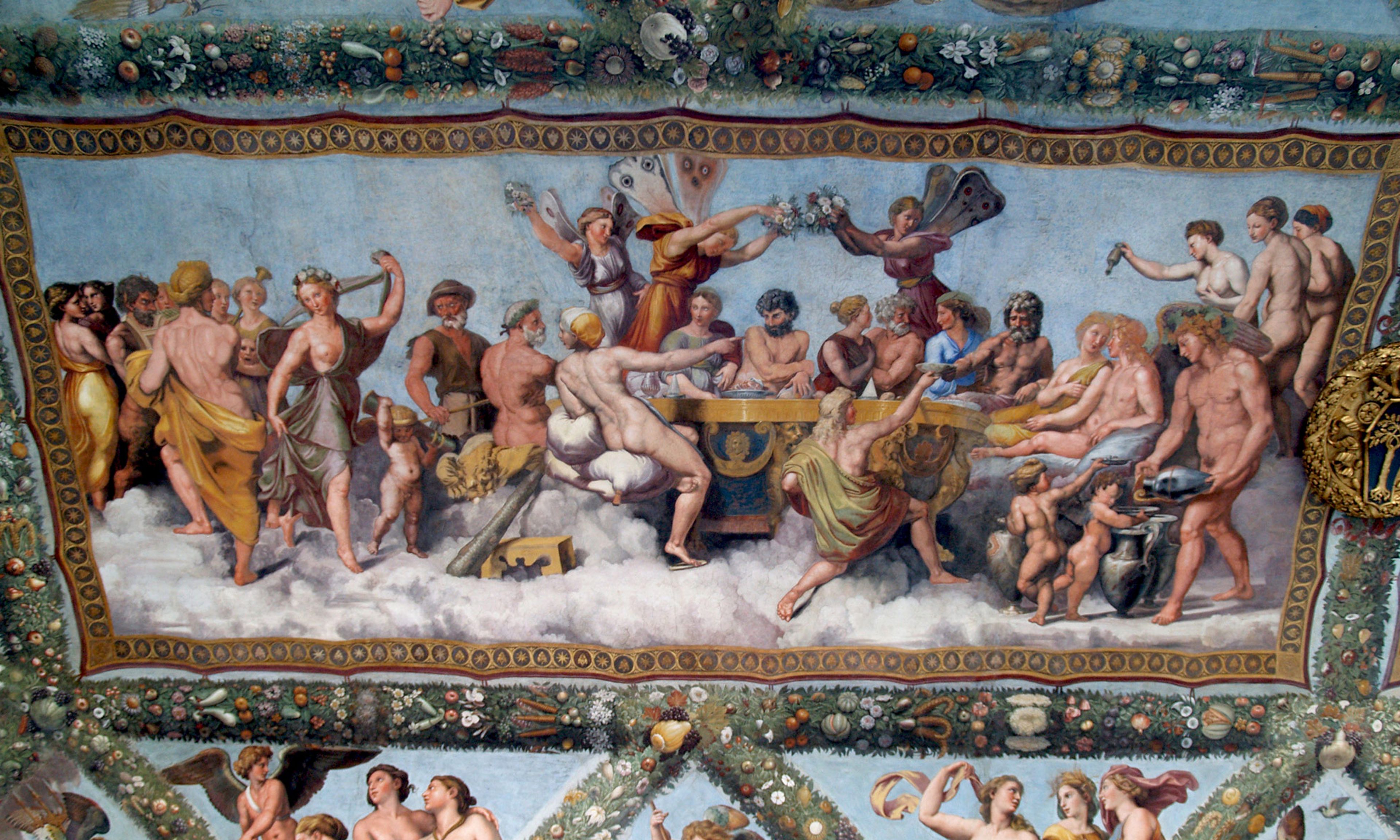
Most people probably know Raphael (1483–1520) for his Madonnas, his late Transfiguration, and The School of Athens. This year, the 500th anniversary of his death, lots of museums are doing exhibitions pulling from their paintings and drawings collections, but what about the immovable Raphael, his frescoes and architecture? While I was in Rome, I visited two chunks of Raphael that aren’t going anywhere. One is a group of frescoes, and walls neither talk nor travel. The other is a chapel. These works changed my view of Raphael, both through learning new things and through thinking about what I already knew.
I’ve written about Raphael’s work in Urbino and Florence and also about his work for Julius II and Leo X, and that’s where most scholars focus. I’m not naturally contrarian but like doing something different. I’ll look at his work for Agostino Chigi (1466–1520), going from Chigi’s love nest, where he cavorted with his beautiful mistress, to his tomb, where he cavorts with eternity.


Comments