
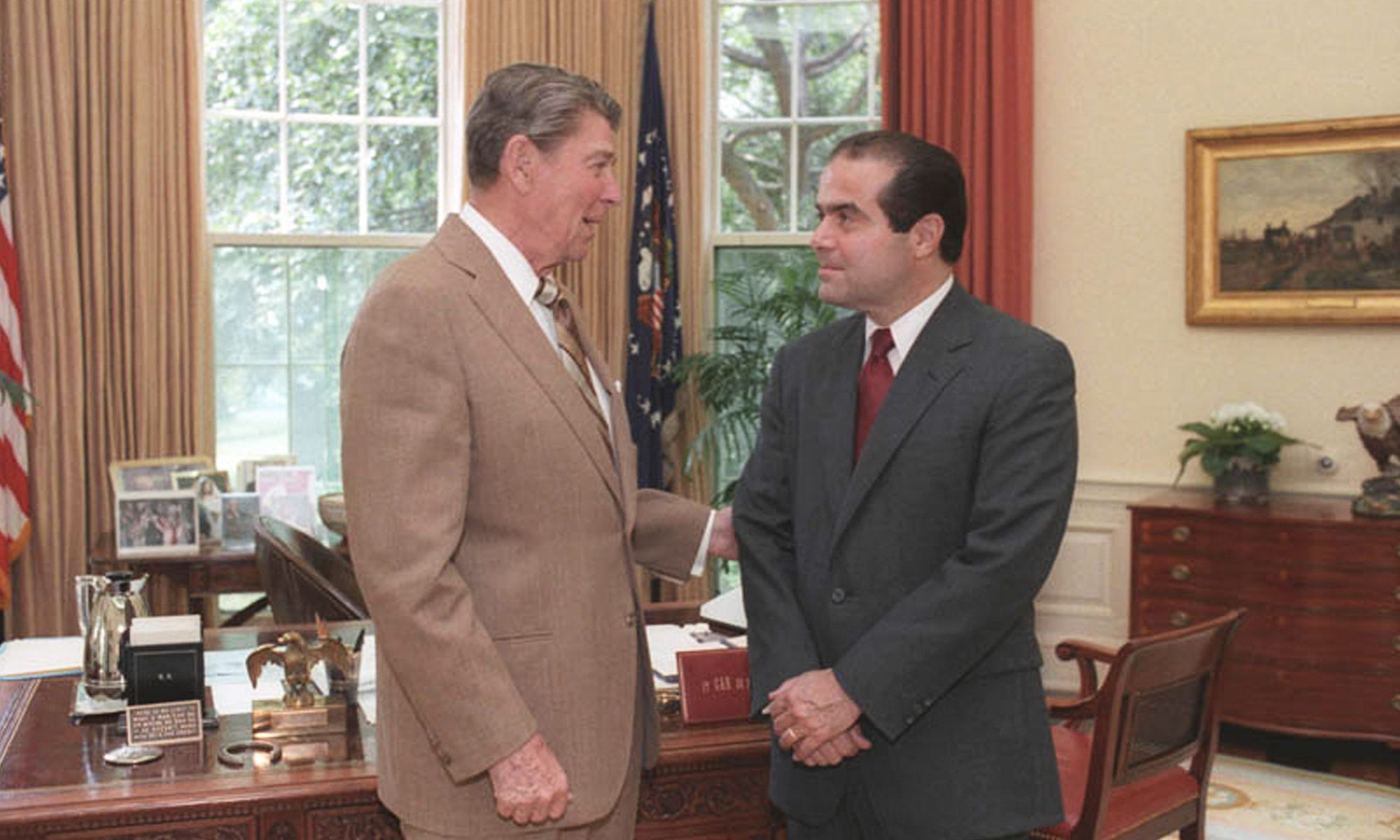
Today marks the 90th birthday of Justice Antonin Scalia. This, of course, follows the tenth anniversary of his death last month, which was an occasion for reflection on the sudden loss in 2016 of the lion of originalism after almost three decades of service on the Supreme Court. Today I begin a three-part series on the principles and legacy of the most transformative figure in the modern history of the Supreme Court—and of the law in general.
Recall the state of the law prior to Scalia’s appointment to the Court by President Reagan in 1986. For generations, the principles of originalism and textualism had been widely stigmatized, from law schools to the courts, as the preferred theory of cranks. The notion of the “living Constitution” reigned supreme under the Warren Court and fueled activism that continued under the Burger Court. Scalia’s arrival coincided with the advent of the Rehnquist Court since the new justice was appointed to fill the seat as associate justice that William Rehnquist vacated upon his elevation to chief justice.
Originalism at the time had other champions in Attorney General Ed Meese, who made it his mission to cultivate originalism during Reagan’s second term, and Judge Robert Bork, who sat with Scalia on the D.C. Circuit. Of course, Bork would be Reagan’s nominee for the next Supreme Court vacancy, which occurred in 1987, but that year, the Democrats had regained the majority in the Senate, and the nomination was defeated with a notorious campaign of vilification of the nominee and his originalist philosophy. Originalism was not going to prevail on the Court or in the broader legal culture without a fight—and that fight would last generations.
Just days before his June 1986 interview with Reagan, Scalia delivered a speech in Washington that discouraged judicial use of legislative history as a tool of interpretation. He asserted:
Statutes should be interpreted . . . not on the basis of the unpromulgated intentions of those who enacted them (assuming—quite unrealistically as to most points of interpretation—that such unpromulgated intentions actually existed on the part of more than a few legislators) but rather on the basis of what is the most probable meaning of the words of the enactment, in the context of the whole body of public law with which they must be reconciled.
In the process of explaining the aversion to legislative history that would become a recurring theme during his tenure, Scalia made an important clarification of what originalism was: “Even beyond the unreliability of almost all legislative history (most of which is now cooked-up legislative history) as an indication of intent, it seems to me that asking what the legislators intended rather than what they enacted is quite the wrong question.” While originalism used to be regarded as synonymous with the search for original intent, Scalia closed his speech: “In the interests of precision . . . I suppose I ought to campaign to change the label from the Doctrine of Original Intent to the Doctrine of Original Meaning. As I often tell my law clerks, terminology is destiny.” That originalism is in fact about adhering to original public meaning has since become deeply ingrained, so consider that campaign a success.
For Scalia, as he put it in a 1988 speech at the University of Cincinnati College of Law, “the main danger in judicial interpretation of the Constitution—or, for that matter, in judicial interpretation of any law—is that the judges will mistake their own predilections for the law.” That temptation had manifested itself in any number of areas of constitutional law, and on the Court, Scalia would periodically write separately to criticize, as he did in a concurrence directed to Justice Stephen Breyer’s dissent in Apprendi v. New Jersey (2000), “the erroneous and all-too-common assumption that the Constitution means what we think it ought to mean. It does not; it means what it says.”
From early in his tenure, Scalia also pointed out another vice avoided by originalism: the threat to self-government that comes with the invention of rights the Constitution does not contain. The consummate example of this in his time—the Court’s invention of an abortion right in Roe v. Wade (1973)—found no stronger critic than Scalia. In Webster v. Reproductive Health Services (1989), the justice wrote a partial concurrence in order to call “more explicitly” than his colleagues for an end to “this Court’s self-awarded sovereignty over a field where it has little proper business since the answers to most of the cruel questions posed are political and not juridical.”
When the Court reaffirmed much of Roe in Planned Parenthood v. Casey (1992), Scalia declared in his partial dissent, “The Imperial Judiciary lives.” He tore into “this Nietzschean vision of us unelected, life-tenured judges” and mocked the majority’s grandiose claim that the reaffirmation of Roe “calls the contending sides of a national controversy to end their national division.” When the Court struck down Nebraska’s partial-birth abortion ban in Stenberg v. Carhart (2000)—this time with Casey joint opinion author Anthony Kennedy protesting in dissent—Scalia could say in his own dissent that he was “in an I-told-you-so mood” about Casey’s failure to bring about any sort of “Pax Roeana” truce.
“I-told-you-so” aside, Scalia’s philosophy was one of judicial humility. He stated in a concurrence in Cruzan v. Director, Missouri Department of Health (1990), a case involving a patient in a persistent vegetative state, “that the point at which life becomes ‘worthless,’ and the point at which the means necessary to preserve it become ‘extraordinary’ or ‘inappropriate,’ are neither set forth in the Constitution nor known to the nine Justices of this Court any better than they are known to nine people picked at random from the Kansas City telephone directory.”
That humility also means following the law where it leads regardless of personal predilections. As Scalia put it in a 2005 speech at Chapman Law School, “If you’re going to be a good and faithful judge, you have to resign yourself to the fact that you’re not always going to like the conclusions you reach. If you like them all the time, you’re probably doing something wrong.” In Maryland v. Craig (1990), he authored a dissent—joined by Justices William Brennan, Thurgood Marshall, and John Paul Stevens—arguing that the Confrontation Clause’s guarantee of face-to-face confrontation between accused and accuser could not be sacrificed even to protect child witnesses from trauma. A year earlier, in Texas v. Johnson (1989), he had joined Justice Brennan’s majority opinion holding that burning the American flag as political protest was constitutionally protected speech. As Scalia admitted in 2013, “If I’d had my way, I would have thrown Mr. Johnson into jail immediately. But it was clear to me that the First Amendment permitted it.”
In District of Columbia v. Heller (2008), Scalia wrote one of his most important opinions for the Court, a magisterial opus affirming that the judicially long-neglected Second Amendment protects an individual right to possess a firearm and use it for self-defense at home. His opinion avoided appeals to policy preferences, instead conducting exhaustive historical analysis of the amendment’s text and the original public understanding.
Part of Scalia’s genius was his ability to make legal principles memorable and compelling through vivid language. His opinions are studded with phrases that have entered the legal lexicon. For instance, in his analysis of a question concerning EPA authority under the Clean Air Act in Whitman v. American Trucking Associations (2001), Scalia observed in his opinion for the Court that Congress “does not . . . hide elephants in mouseholes.” When the majority rewrote the Affordable Care Act’s text in King v. Burwell (2015) to allow tax credits for exchanges established by the federal government, Scalia’s dissent called them out on their “interpretive jiggery-pokery” and “[p]ure applesauce.”
Scalia’s dissent in Lee v. Weisman (1992), criticizing the majority’s psychologizing in a graduation ceremony prayer case about student peer pressure, included this devastating sentence: “[I]nterior decorating is a rock-hard science compared to psychology practiced by amateurs.” In his book How to Write a Sentence: And How to Read One, the literary critic Stanley Fish called this sentence “a projectile that picks up speed with every word,” a sentence he carried around with him “as others might carry a precious gem or a fine Swiss watch.”
Scalia left many gems behind as he effected a revolution in the law that will long outlast his tenure. His work to renew the structural Constitution was brilliant; that will be the subject of part 2.





Comments