
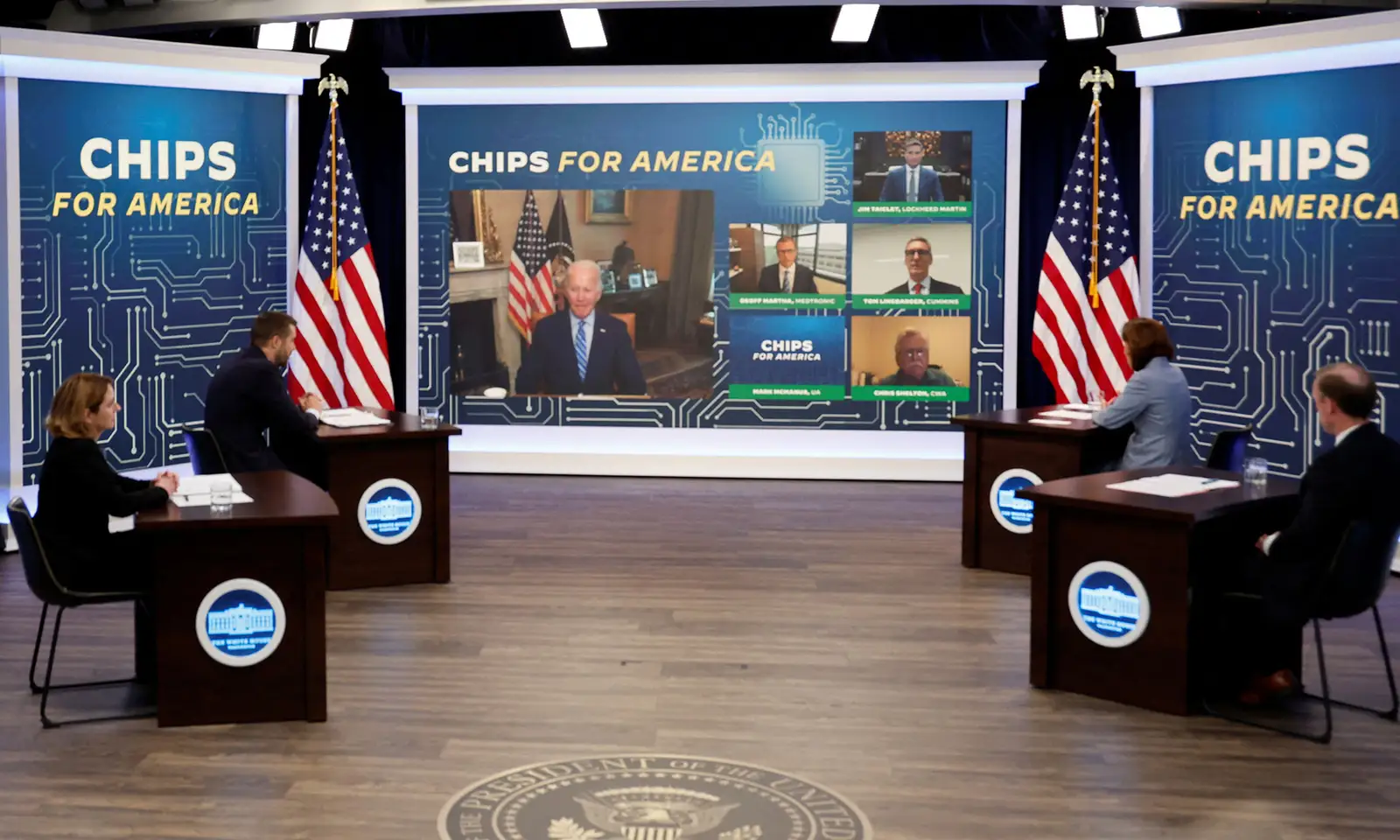
George Will senses mission creep in the implementation of the CHIPS Act, according to remarks by Secretary of Commerce Gina Raimondo:
Speaking in her office in the Commerce Department building, which is named for a previous secretary (an engineer: Herbert Hoover), Raimondo is emphatic: The reason for subsidizing the “on-shoring” of chips manufacturing is “100 percent national security.” Manufacturers should “produce what the market decides, but do it in America.” In a November speech, however, Raimondo said these “transformational” subsidies will enable “reimagining our national innovation ecosystem well beyond Silicon Valley.” And she anticipated “new collaborations among businesses, universities, labor, and local communities” concerning “advanced computing, biotechnologies and biomanufacturing, and clean energy technologies.” Hence, “we are working across the government” to “invest in core critical and emerging fields of technology,” for “revitalizing” manufacturing. So, far from being “100 percent national security,” the rationale for the $52 billion (and more; read on) is government-driven transformation of, potentially, American society.
This is an excellent example of how national-security justifications for economic policy can and will be warped to suit the aims of politicians and bureaucrats. You were sold a bill that would help pay for some semiconductor factories; you might end up getting a Democratic commerce secretary (who, as Will points out, may have presidential aspirations) attempting to transform American society.
Will continues to recount some of the actual history of the much-mythologized 19th-century U.S. industrial policy, while dispensing with the inevitable World War II comparison as well:
Congress has also provided a $24 billion tax credit (over 10 years) for “fabs” — chip manufacturing facilities — and more than $170 billion (over five years) for research. Raimondo says all of this “modern industrial strategy” (President Biden’s description) is “rooted deeply in America’s history — from Alexander Hamilton’s Report on Manufacturers to President Lincoln’s intercontinental railroad.” Not exactly. Hamilton’s protective tariffs, the “internal improvements” (roads, canals, etc.) of Henry Clay’s “American system” and the 1862 Morrill Act (which created land grant colleges, especially to promote scientific agriculture) were designed to facilitate individual striving to propel a fast-unfolding and unpredictable future. They were not measures to implement a government-planned future featuring things the government thinks it knows are, or should be, “emerging.” When during World War II the government dictated the production of ships, planes, tanks and howitzers, this was a focused response to an immediate emergency, not an attempt to be socially “transformational.”
For more on why the “American system” is not worth bringing back, check out this piece from Phillip Magness and James Harrigan of the American Institute for Economic Research.
Will continues:
Government always needs but rarely has epistemic humility, an understanding not just of what it does not know, but what it cannot know. Such as what unplanned-by-government human creativity will cause to emerge, over the horizon. And how government planning of the future, by allocating resources, can diminish it.
Technocrats such as Raimondo, and industrial-policy advocates of all parties, are especially unlikely to recognize such limits. The path from feel-good bipartisan win to no-good bipartisan boondoggle might not be very long.




Comments
On “Mission Creep on Semiconductors”