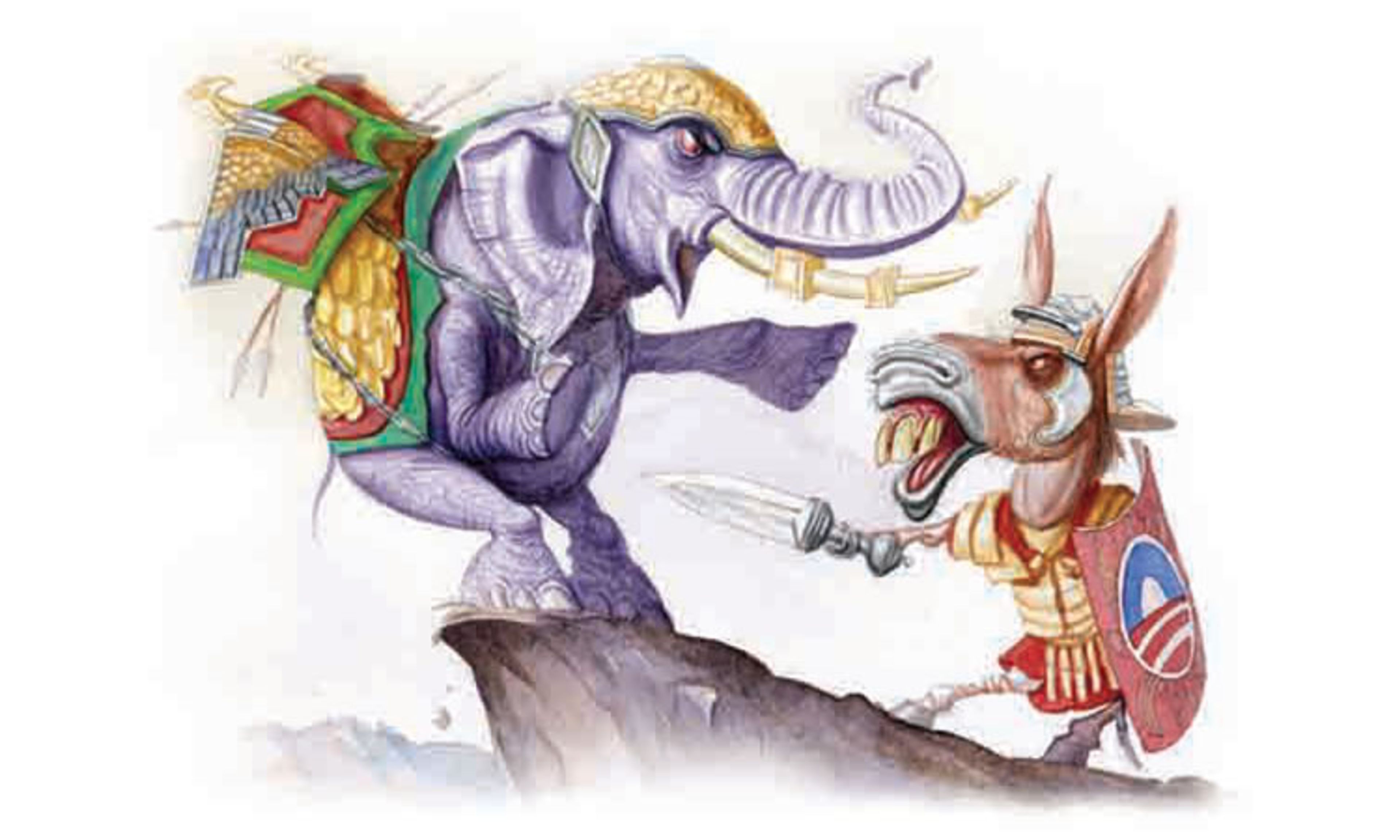
Whom should we blame for the enactment of Obamacare? Philip Klein, writing at The American Spectator’s site, nominates President Bush, for leaving Republicans in such poor shape. Noemie Emery reminds us in the Washington Examiner that Democrats would not have had such large majorities if not for the Jack Abramoff and Mark Foley scandals.
The Democrats’ victory was such a close-run thing that we can make an endless list of culprits if we are determined to go beyond the people who actually voted for the legislation. The Financial Accounting Standards Board’s regulations made the financial crisis much worse and thus took several Democratic candidates for the House and the Senate over the top in 2008. Sen. John McCain’s weak campaign didn’t help (although it’s not clear any of his primary rivals would have done better). If Sen. George Allen hadn’t said “macaca” in 2006, Democrats probably wouldn’t have had a filibuster-proof majority. If Pat Toomey hadn’t challenged Arlen Specter in a primary, Specter wouldn’t have left the GOP and would probably have voted against Obamacare on the floor, as Olympia Snowe and Susan Collins did. And on and on . . .
Conservative recriminations have dwelt more narrowly, and perhaps more reasonably, on how the party handled the health-care issue. Here too Republicans made several errors. But not the ones they’re being accused of.
Many critics — left, right, and center — say that Republicans did nothing about health care when they had power in Congress and the White House, and thus cannot legitimately complain if health policies not to their liking are now on the way. It’s true that conservatives and Republicans have not paid sufficient attention to health care over the years, and this neglect left them ill prepared for the debate of 2009–10.
But the actual Republican record on health care belies the do-nothing label. A Republican Congress passed a health-insurance-portability law in 1996 and created the children’s-health-insurance entitlement in 1997. In 2003, a Republican Congress and a Republican president created tax-sheltered Health Savings Accounts, a prescription-drug benefit for senior citizens, and a market-friendly component of Medicare.
Not all of these policies were wise, so Klein’s criticism has more force: “While they were in power, Republicans squandered an opportunity to push free market health-care solutions.” But how much opportunity was there, really? Republicans were unable to overcome Democratic filibusters of their proposals to reform medical-malpractice laws and to allow small businesses to band together across state lines to buy insurance. There is no reason to think that bold, free-market reform would have fared better. Republicans should still have tried. It might have helped educate the public about the issue and thus prepared the ground for the Obamacare debate. But Republicans never had enough senators to reform health insurance.
A second common criticism of the Republicans is that they should have cut a deal with President Obama and the Democrats. That way they could have improved the legislation, for instance by replacing its taxes on high earners with broad-based consumption taxes. Instead they turned the debate into an all-or-nothing fight and got nothing.
On this argument, Republicans would have had to acquiesce to the broad outlines of Obamacare. The Democrats never showed any interest in compromising on three core elements: They wanted to ban insurers from discriminating against sick people, to force people to buy insurance so that insurers could stay in business while following that rule, and to give money to help people comply with that requirement. These policies interlock: To accept the first is to accept all three.
Once these three points are conceded, the rest is details. The main question becomes what trade-off the government should encourage between cost control and patient satisfaction; and the trade-off it eventually lands on is likely to be determined by forces beyond the control of any political party.
Paying for Obamacare with consumption taxes would be less inimical to economic growth than paying for it with taxes on investment, but taking that line would have been a risky strategy for Republicans. It would have set up a debate between Democrats who wanted the rich to pay for health-care reform and Republicans who wanted the middle class to pay for the same reform.
Opponents of Obamacare came very close to defeating it. They would not have gained much by abandoning that ambition. They might have succeeded had they not made five other mistakes — one of tactics, one of message, one of timing, and two of policy.
The policy errors were perhaps the most important. Conservatives have long wanted to change the way health insurance is taxed. They believe that taxing individually purchased insurance more heavily than employer-provided insurance raises costs and keeps insurance from millions of people, especially sick people. Senator McCain, in his 2008 campaign, proposed to level the playing field; so, more recently, has Rep. Paul Ryan (R., Wis.).
But that reform would upend existing insurance markets. A lot of people with employer-provided insurance would drop out of it, and people who have it would find their rates going up or their plans being discontinued. Since most people get their insurance through their employers and like it, talk of change to this arrangement unnerves them. The Democrats contemplated a small step toward tax neutrality in their health-care legislation, but it has been postponed until 2018 at the earliest. A bigger step would be impossible.
Recognizing the difficulty, congressional Republicans got behind other proposals, such as removing the barriers to interstate competition in individually purchased insurance. But it is not clear that these reforms, without the tax-policy changes, would put much of a dent in the problem of the uninsured. The Congressional Budget Office did not believe they would. Republicans should have found a middle way between doing nothing and full tax reform: say, letting only those people currently locked out of the employer-based system use a tax credit to purchase insurance on their own. It would have been a big step toward tax neutrality that would have let the individual market grow without too much disruption to existing insurance arrangements.
The Republican solution for people who cannot afford insurance because of preexisting conditions was twofold: first, minimize the problem in the future by letting people buy renewable insurance policies they own themselves; and second, let people who already have these conditions into high-risk pools that would subsidize their health care. But the risk pools we have now are underfunded, and Republicans were not willing to devote much more money to them — so they were not seen as offering a new solution to one of the most vexing and emotional problems created by our health-care system. This was a classic case of pound-foolishness, given how much more expensive the Democrats’ solutions are.
The error of message was for conservatives to concentrate too much on the evils of the public option. Once it was dropped, the president’s plan appeared moderate even though its essentials had not changed. Worse, the debate on the public option put conservatives on the same side as the insurance companies. The months spent on the question could instead have been spent on such issues as the individual mandate, which really was at the heart of Obamacare and allied the Democrats with the insurers. These other features of Obamacare generally polled worse than the public option, too.
Republicans may have hoped that when Obama was forced to ditch the public option, the Left would oppose the bill and help doom it. But while many leftists made threats to that effect, in the end they did not follow through — and nobody should have expected them to pass up the chance to expand government control of health care.
The tactical error was to provide insufficient funding to pro-life groups that opposed Obamacare. Most Republicans spent the first two-thirds of 2009 underestimating how big a problem pro-life resistance would be for the Democrats. If they had run ad campaigns based on the issue in the districts of pro-life Democrats, it would have made it harder for those Democrats to back the bill in the end. Those Democrats could well have been the decisive holdouts. Here, again, Republicans were on the popular side of an issue — even many supporters of legal abortion don’t want government funding — but failed to press their advantage.
Finally, the error of timing: Conservatives grew complacent after Scott Brown’s victory in Massachusetts, exactly the wrong moment for them to have lost steam. Obama strategist David Axelrod recently attributed his side’s victory in part to conservatives’ dampened opposition in this period. Republicans missed an opportunity to make a counteroffer that might have been attractive to some on-the-fence Democrats who had qualms about Obamacare but wanted to help people get health insurance.
These errors cost Republicans and conservatives dearly. But it may not be too late to correct some of them. Republicans are saying they want to repeal Obamacare and replace it with conservative reforms. This time, they have to propose reforms that address the problems of the uninsured and those with preexisting conditions. Because now, as they must surely realize, they have no margin for error.











Comments