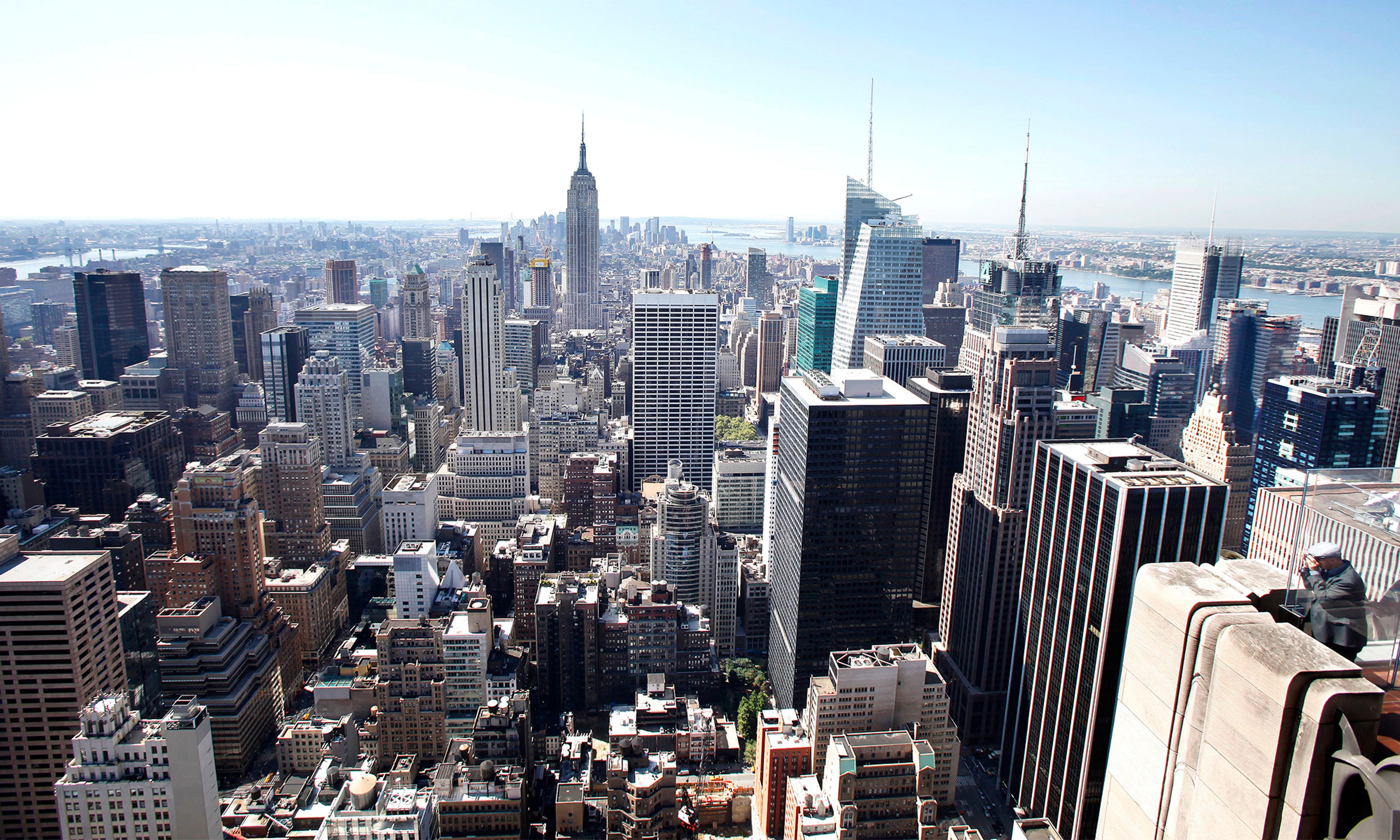
Walk around the streets of New York City today, and you will experience one of the great American success stories of the last quarter century. New York, like much of urban America, was written off in the wake of the social and economic upheavals of the 1960s and 1970s. Even as late as the early 1990s, decline was in the air. New York Times reporter Sam Roberts has called 1990 “The Year New York Lived Really Dangerously.” In 1992, New York Review of Books editor Jason Epstein saw New York as a dying city. Barring a federal bailout, Epstein worried, “there is probably nothing left to do but join the majority of New Yorkers who are already planning to leave.”
In 2010, that seems like ancient history. Crime is at 50-year lows. Tourists flock to Midtown. Central Park is restored, and once again a city jewel. Neighborhoods from the Lower East Side to Williamsburg have been gentrified, while new immigrants from around the globe bring energy to the city. Many cities, especially those in the Rust Belt, have continued their downhill slide, but New York and a few other cities have avoided that fate.
Who is responsible for the decline, and the rebirth, of the city? Roberta Brandes Gratz has an answer. In her new book, The Battle for Gotham, she places the blame for the city’s decline squarely on the head of Robert Moses, New York’s “master builder.” Gratz argues that Moses’s urban-renewal projects and massive road building destroyed the fabric of the city, displaced thousands, elevated the needs of cars over those of people, and especially hurt the city’s minority residents. Almost every ill the city has faced since the 1960s, argues Gratz, can be laid at Moses’s doorstep. The hero of Gratz’s tale is her old friend Jane Jacobs, author of the very important book The Death and Life of Great American Cities. Jacobs was a tireless activist against the kind of big projects that Moses championed, and her book extolled the virtues of small-scale urban life, such as that found in her own neighborhood of post-war Greenwich Village.
One thing that makes the Moses–Jacobs fight so interesting is that it transcends the classic Left/Right ideological boundaries. Jacobs is adored by many on the cultural left, because she was anti-war and a vociferous critic of government authorities; but she was also an early “crunchy con.” The Death and Life of Great American Cities is an anti-statist polemic, as Jacobs was skeptical of centralized state authority and of rule by an enlightened elite. She argued for the organic nature of cities, the notion that cities are created and re-created by the actions of thousands of ordinary individuals. Urban renewal, using the power of eminent domain, ignored the fabric of city life as well as property rights.
William F. Buckley Jr. understood this and praised the book, as did the Wall Street Journal. It is also no surprise that one of the earliest critiques of urban renewal came from Martin Anderson, who would later become White House domestic-policy adviser to Ronald Reagan. Too often, urban renewal resembled crony capitalism, with favored developers using the powers of government for profit, displacing people from their homes and leaving behind for the public a brutalist style of architecture, cold, impersonal, and out of scale with the rest of the city.
But Moses’s critics, including Gratz, too often ignore the fact that Moses, too, failed to conform to his public caricature. Moses was not a right-wing reactionary, but a man rooted from his youth in the politics of Progressive reform. He believed in using the power of government to improve and modernize the city.
Moses was made infamous by Robert Caro’s book The Power Broker, in which Caro argued that although Moses began as a reformer, he sold out the idealistic principles of his youth for power in his later years. In this, Caro misunderstood the nature of progressive reform: Moses’s arrogance was a byproduct of his reforming zeal, not a deviation from it. Whether he was building playgrounds, roads, or beaches, Moses believed in a top-down approach to development that implied that it was government officials, not the people, who knew what was best. On top of this, Moses’s projects were in keeping with New Deal–style economics: large, government-funded public works that would boost employment and government power. It was a plan that won the support of business, labor, and government.
In detailing this story, Gratz, a former reporter for the pre-Murdoch New York Post and an urban critic and activist, has written a book that is part memoir, part history, and part polemic. There is much to like in this book and much that is questionable. It is too disjointed and meandering to serve as a useful history or memoir; what makes it worth reading is the author’s polemic against urban renewal and her vision of what makes cities work.
Gratz rightly points out that much of New York’s revival happened from the bottom up, driven by individuals who clung to the notion that city life was both possible and rewarding and by communities that fought to preserve themselves against the larger tide of decline. Whether these people had read Jane Jacobs or not, they understood the lessons of her book. Gratz does paper over whether the newly gentrified city has become merely a plaything for the upper-middle-class. Restricting development and preserving the small-scale nature of urban life makes for picturesque — but very expensive — neighborhoods.
Gratz is also correct that it is probably a good thing that Robert Moses was finally stymied in his grand plans by the 1960s. Urban renewal was stopped in the West Village and proposed expressways across Manhattan were blocked, allowing neighborhoods like SoHo and the Lower East Side to gentrify on their own. It is a good thing that the glory days of urban renewal are behind us, although the 2005 Supreme Court decision Kelo v. City of New London shows that some cities are still relying on urban renewal.
Just as the ideas of Jane Jacobs bridged the Left/Right divide, a good deal of Gratz’s book appeals not just to the Left (it’s published by Nation Books, after all), but also to Reason-style libertarians. Gratz is fundamentally skeptical of big projects to revitalize cities. Too many cities rely on building sports venues or convention centers to stimulate their economies, and these usually end up costing lots of money and adding little economic development.
The Battle for Gotham is filled with ideas and proposals. Gratz lauds historic preservation for saving the character of cities and reining in developers. She pleads for “green jobs” and praises urban agriculture and farmers’ markets. Like many on the left, she believes in “taming” the automobile and thinks the 21st century will be the century of mass transit. (If Gratz wants a city with few cars clogging downtown streets, I suggest she check out Detroit.)
She is very good on the plight of small business and manufacturing in the city (perhaps because her husband’s family owns a small manufacturing company). She rightly notes that in New York’s quest to build an urban economy around the financial, insurance, and real-estate interests (FIRE), small business and manufacturing have been ignored. These small enterprises create jobs and keep together the social fabric of cities; Gratz could have said even more about the tax and regulatory burdens on these companies.
What about Gratz’s underlying thesis that urban renewal destroyed New York? Gratz blames Moses’s projects for problems relating to law enforcement, education, welfare, taxes, regulation, and the administration of city services. Of course, something that can explain everything usually explains nothing. Too often Gratz makes her arguments by assertion. Her chapter on Moses is titled “Reconsidering Robert Moses: What’s to Reconsider?”
Yes, urban renewal destroyed neighborhoods and displaced many people. But did that necessarily lead to urban decline and chaos? By Gratz’s own admission, the development of Lincoln Center did not lead to the decline of the Upper West Side, even if it may not have singlehandedly saved the neighborhood. Some 30 miles north, White Plains was home to one of America’s largest urban-renewal projects, one that completely reshaped its downtown and displaced several hundred residents and businesses. While the promised benefits of urban renewal never quite panned out, White Plains today is largely a stable, thriving, diverse community that seems to have avoided the virus of decay that Gratz implies went hand in hand with urban renewal.
One can point to other cities and find the same thing. In Boston, the West End and Scollay Square were both destroyed in massive urban-renewal projects in the 1950s and 1960s. What replaced these areas is certainly not pretty, but one would be hard pressed to make the case that it caused any kind of long-term, massive social and cultural disorder in Boston. Moses’s critics continually overstate the negative aspects of his project and understate or ignore any kind of benefits it may have brought.
Gratz also makes a surprising number of mistakes, especially for a native New Yorker and urban critic. Abe Beame did not succeed Robert Wagner as mayor (John Lindsay did). The crack epidemic hit the city during the 1980s, not the 1970s. Columbia University’s campus is at 116th Street, not 110th. The Georgetown area of D.C. and the Back Bay neighborhood of Boston were never “deteriorated slums.”
Worse still, Gratz has a penchant for conspiracy theories. She buys into the theory that America’s mass-transit system was killed off when General Motors bought up streetcar companies and forced the country into cars, a theory made popular by, among others, Michael Moore. She also claims — bizarrely — that New York deliberately pursued policies that allowed for poor neighborhoods to be burned out and vacated.
Despite this, her book is worth reading. As the city now faces another fiscal crisis, there remain serious questions about its future. If Wall Street loses its position as the financial capital of the world, what would that mean for the city’s fiscal health? New York is turning into what Mayor Mike Bloomberg hails as a “luxury” city, a place for the rich and the poor, but one in which the working and middle classes are increasingly marginalized. How will the city generate new industry, business, and entrepreneurship to create new jobs? How can it keep the middle class from leaving?
New York’s recent renaissance was only a partial victory, and it would be a mistake for the city to rest on its laurels. If The Battle for Gotham does anything, it forces us to continue to ask the question: What makes great cities great? Roberta Brandes Gratz may not always have the right answers, but at least she is asking the right question.












Comments