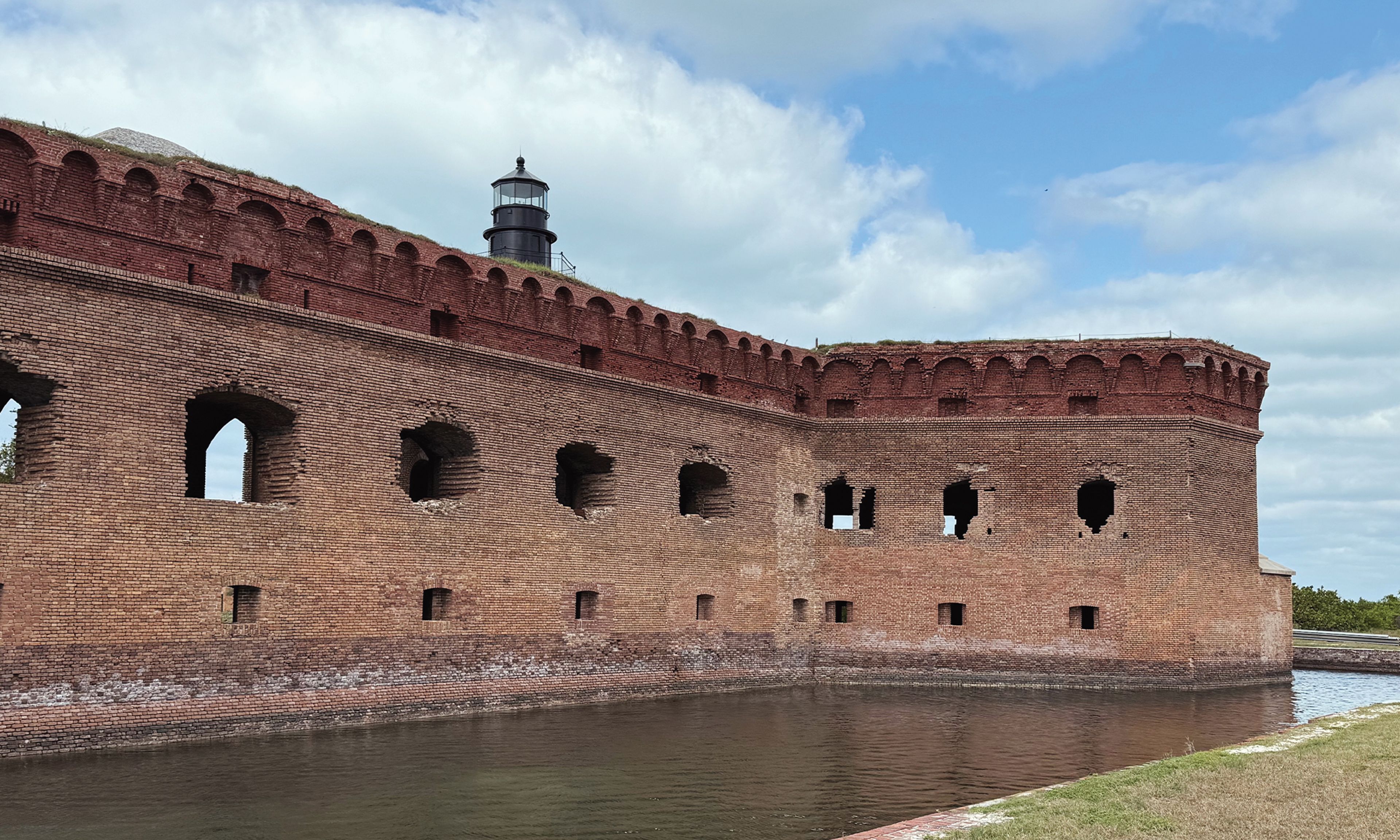
Dry Tortugas, Fla. — The inscription above the doorway is long gone, but it once proclaimed the famous words marking the portal to hell in Dante’s Inferno: “Abandon all hope, ye who enter here.” Today a broken sign inside Fort Jefferson identifies the room as “Dr. Mudd’s Cell.” This is a reference to Samuel Mudd, the man who splinted the fractured leg of John Wilkes Booth hours after Booth shot a bullet into the brain of Abraham Lincoln. The commandant of the fort called the cell a “dark and gloomy dungeon.” It wasn’t underground, in the way of a typical dungeon, but it was a wretched chamber for the hard cases.
An opening in the thick wall presents a view of the dock and the Yankee Freedom III, the ferry that has brought me, my wife, and several dozen other tourists to the Dry Tortugas, a small and uninhabited group of coral islands some 70 miles to the west of Key West. The fort, on Garden Key, the second-largest of the group, is a grand ruin — a massive and crumbling structure from the 19th century, when it was built to defend American coasts and commerce. During and after the Civil War, as it drifted into obsolescence, it served as a slammer for court-martialed soldiers as well as for Mudd, whose imprisonment has become an enduring dispute between two factions, those who believe the doctor conspired with Lincoln’s killer and those who see him as an innocent victim of fanatical federal prosecutors.









Comments