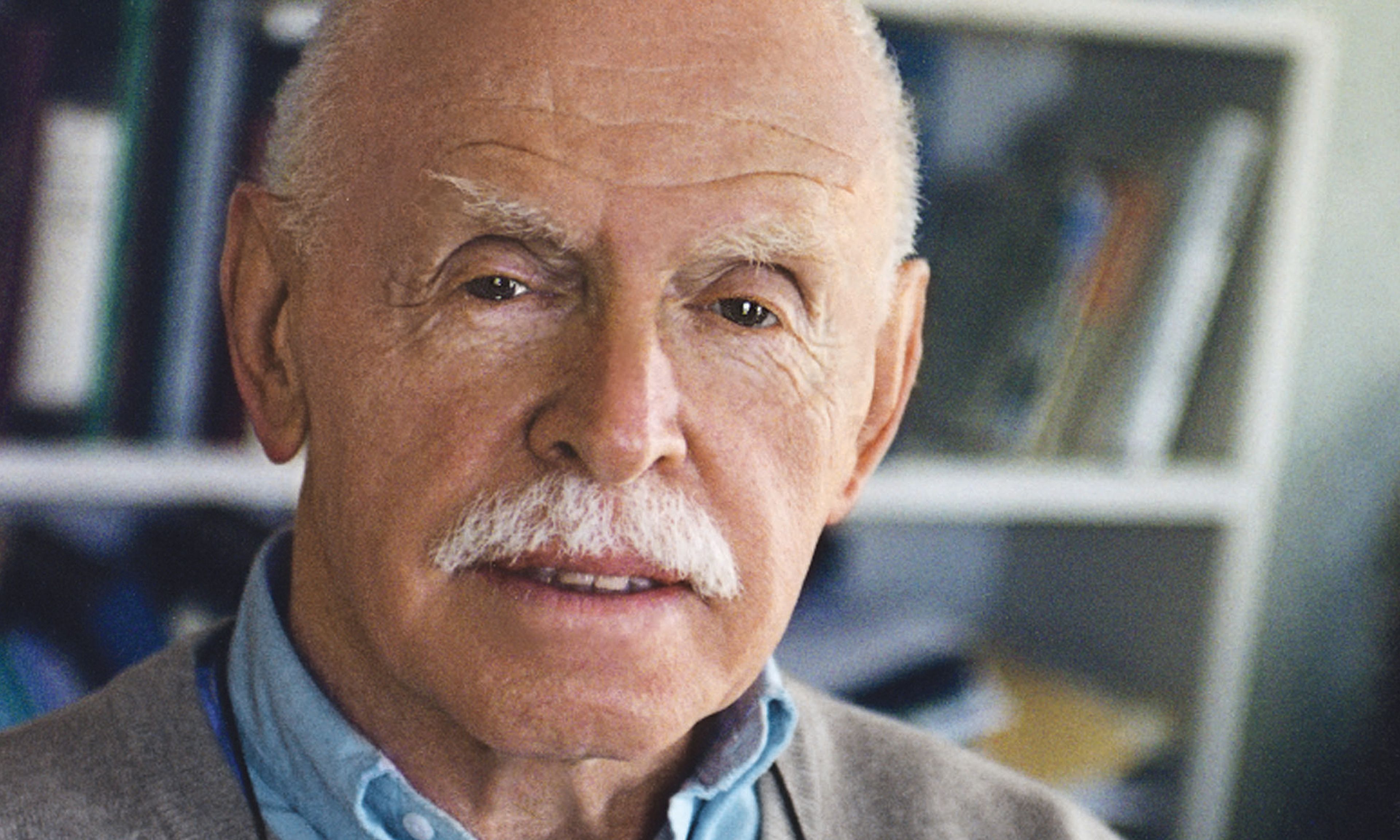
‘As they say in the Ministry of Public Security — shoot.” These are the words of Jerry Cohen as we begin our interview. The MPS is essentially the Chinese KGB. Jerome A. Cohen is one of the foremost China scholars in America. Specifically, he is an expert on Chinese law. He has been studying China, and dealing with China, for almost 60 years. Some of his admirers refer to him as “the Great Helmsman,” borrowing one of Mao’s titles.
I’m reminded of Bernard Lewis, the venerable historian of the Middle East. Some of his students refer to him as “the Imam.”
More than an academic, Cohen is a friend of Chinese dissidents, democrats, and political prisoners. One of the many he has helped is Chen Guangcheng, known as “the blind barefoot lawyer.”
While best known for his work on China, Cohen has had an impact on American relations with East Asia in general. For instance, he established the East Asian Legal Studies program at Harvard. And the U.S.-Asia Law Institute at New York University. The government of Japan has just conferred on Cohen its Order of the Rising Sun. For those keeping score, the specific degree is “gold rays with neck ribbon.”
So, how did a kid from New Jersey get mixed up in China and the rest of that region? This is an interesting story, which we will get to in a moment.
Cohen was born in 1930. His dad was the city attorney in Linden. He was also the head of Jewish War Veterans of New Jersey. (The senior Cohen had enlisted in World War I.) Jerry went to Yale College, majoring in international relations. He later went to Yale Law School. While in college, he met Joan, the sister of another Yalie. Joan was going to Smith. Theirs was “a very conventional Yale–Smith romance,” Jerry quips. They married after her graduation, while he was a student at the law school.
He clerked for Earl Warren, the chief justice, and Felix Frankfurter, another justice. He was the first person ever to serve full clerkships with two members of the Supreme Court. Those two men could not have been more different, says Cohen: Warren the politician — a former governor of California — and Frankfurter the professor. But he liked and admired them both.
Cohen decided on an academic career. He was courted by UCLA, which threw a party for him. The dean of the law school said, “You know? Somebody should study the law of Red China.” Young Cohen found himself saying, “That’s the zaniest idea I’ve ever heard.” In any event, he signed on with the law school at Berkeley. The year was 1959.
The incoming dean of the school, Frank Newman, had been a law-school classmate of Dean Rusk. Rusk was then president of the Rockefeller Foundation. He had been assistant secretary of state for Far Eastern affairs. He would soon be secretary of state (under Kennedy, and then Johnson). Newman’s idea was to establish a chair in African law, with the Rockefeller Foundation’s help. Rusk said, “How about Chinese law?”
Newman said to Cohen, “You’re a young fellow, and I can tell you what to do. Find me somebody for this offer, so the law school doesn’t lose the chance. Find me an East German who has studied law in China. Find me a grad student in the social sciences who knows Chinese and is willing to study law. Find me a Chinese graduate of an American law school who can meet faculty standards. Just find me somebody.”
Cohen found no takers. But, strangely enough, he started to be interested in the challenge himself. Some of his colleagues, hearing about this, thought he was going through some sort of nervous breakdown. The outgoing dean, William Lloyd Prosser, told him, “Don’t throw away your career on China.” Frankfurter said much the same thing, though he later came around. The incoming dean, Newman, was fully supportive — but even he asked, “What will you talk about at cocktail parties?” No one was interested in China.
One of the things that attracted Cohen was the chance to be a pioneer — to stake a claim, and make a name, in uncharted territory. That’s what he did. At 9 in the morning on August 15, 1960 — a month and a half after his 30th birthday — he took his first Chinese lesson. He likes to cite a maxim of Confucius: “Establish yourself at 30.”
Furthermore, the date — 8/15/60 — has some significance to him. That was 15 years after the Japanese surrender. And this event had marked the beginning of a new and rising Asia.
In 1964, Cohen decamped from Berkeley to Harvard. In 1972, he took his first trip to China. On that occasion, he and John K. Fairbank, the father of Chinese studies in America, had a four-hour meeting with Zhou Enlai, Mao’s No. 2. “The most charming dinner host I’ve ever had,” says Cohen.
Though Cohen has often been at cross-purposes with the Chinese dictatorship, they have never denied him a visa. Chiang Kai-shek, the dictator on Taiwan, once denied him a visa. (The generalissimo changed his mind.) Park Chung-hee, the dictator of South Korea, once denied him a visa. (He changed his mind when the New York Times reported the denial.) But the PRC never has. “Last year, in a fit of optimism — after all, I’m 87 years old — I applied for a ten-year visa,” says Cohen, “and to my delight, I got it.”
In January 1979, Deng Xiaoping made a historic visit to Washington. In anticipation of this event, William F. Buckley Jr. invited Professor Cohen to be a guest on his television show, Firing Line. “I had just broken my arm skiing,” Cohen recalls. “When I walked into the studio, Bill said, ‘That’s the way you should look when I get done with you!’” (Here we have a classic example of WFB’s mixture of competitiveness and good humor.)
The Cohens lived in China from 1979 to 1981. They have lived in China at various points in their long marriage. (Japan, too.) In 1990, Jerry signed on with NYU, and there he remains.
Like everyone else who knows anything, he is gloomy about China at present. “This is the tightest period since the end of the Cultural Revolution in 1976,” he says. By “tightest,” Cohen means most repressive, least free. Xi Jinping has just been made president for life. “He now has unfettered power,” says Cohen.
In search of a substitute for Western or universal values, such as judicial independence and human rights, Xi has been invoking Confucianism, Cohen explains. This is curious in that the Communists always denounced Confucius as the progenitor of feudalism and backwardness. But about ten years ago, they started to use him as a symbol of nationalism.
A big Confucian concept is xiao, i.e., filial piety — but this is ignored by Xi, Cohen points out. The leader’s father, Xi Zhongxun, was an early Communist leader who in 1962 fell out with Mao. He was punished in the usual and horrible degrading ways, and was not rehabilitated until Deng Xiaoping came to power, 16 years later. When he came back, he “preached openness,” as Cohen says. His message was: Unless the Party allows differences of opinion, both at the elite level and at the mass level, it will never be able to govern China successfully.
Xi Zhongxun’s son — who has more power than any Chinese leader since Mao himself — has gone in the exact opposite direction.
What consumes Professor Cohen now is Xinjiang — the region in northwest China where the Uighurs live. (They are a Turkic minority.) Almost a million people have been locked up, herded into concentration camps in the name of “patriotic education.” The world has more or less ignored this situation.
The Uighurs are routinely tortured, but they are not yet being killed, unless they resist. Still, Cohen can’t help thinking of Austria and Germany under Hitler. Some 40 distant relatives of Cohen’s were killed there.
For years, many of us have been taught, “Political liberalization follows economic liberalization, as Tuesday follows Monday.” Indeed, Condoleezza Rice once described this to me as an “iron law.” Is China defying that law? The answer is complicated, says Cohen.
China has obviously made great strides in the economic realm (genuine leaps forward). “People live much better than they used to,” Cohen says. As a result, “the regime is caught in the same problem that the Shah of Iran had in the 1970s: You improve people’s lives, and they want more.” China now has many educated people, and wealthy people. They don’t know why they have to go without freedom, democracy, and the rule of law.
Today, political liberalization is stalled, even crushed. “We’re in a trough,” Cohen says. But, president for life or not, Xi Jinping won’t last forever — and his successors might resume an upward path.
Cohen is an ardent admirer of Taiwan, which evolved from dictatorship to democracy. “For decades in China, I had to hear defenders of the government’s repression say, ‘You don’t understand Chinese political-legal culture. We didn’t have the two English revolutions of the 17th century, we didn’t have the American Revolution and the Bill of Rights, we didn’t have the French Revolution and the Rights of Man. Our culture doesn’t permit the development of democracy.’ Well, Taiwan is a living refutation of that claim.”
Asked whether he worries about Taiwan’s future, given Beijing’s designs on it, Cohen says, “I worry about it every day, including this morning.” Beijing is using political and economic pressure against Taiwan, yes — but it is also using military threats, as Cohen details.
Through it all — hopeful times and gloomy times — Jerry Cohen has been a China engager, having worked with countless Chinese lawyers, judges, and others. “They crave this contact,” he says. The Chinese government has not decorated him, as the Japanese government has. Instead, “they’ve given me a few shots across the bow.” But many Chinese esteem this Great Helmsman, who will have a place when the story of China’s democratization is written.











Comments