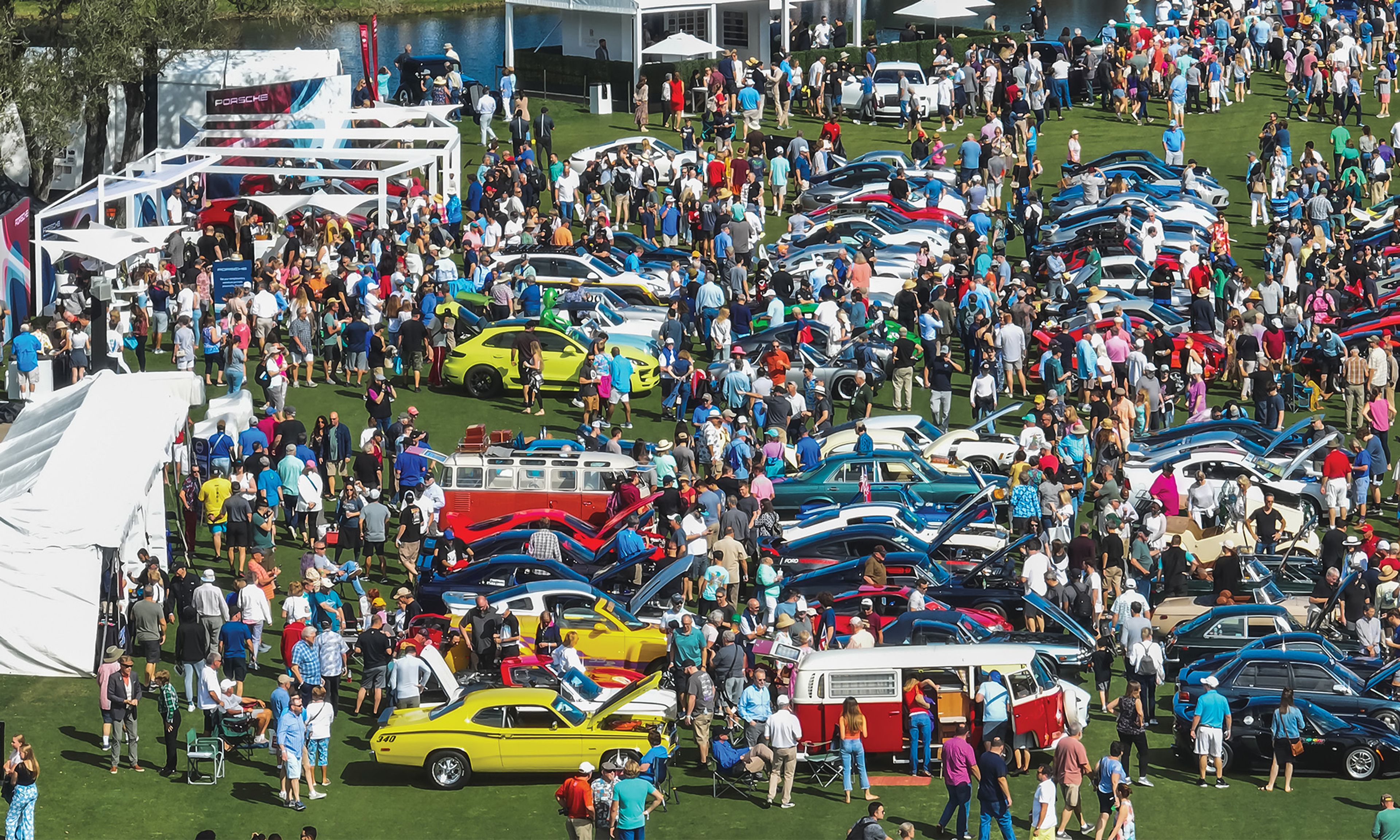
You can tell who is headed to Amelia Island 30 or so miles before you get there. On any other sun-soaked weekend, Florida’s salty coastal roads are filled with nice cars, but there are nice cars and then there are nice cars, and it is the latter sort that predominate here. They are Ferraris, Porsches, Alfa Romeos, and more, and their owners have come from all over the country. Some have come to admire. Some have come to be admired. All have come to celebrate the beauty of the well-designed automobile. Along with 100,000 other people, they are headed to the 27th Amelia Island Concours d’Elegance car show — now known simply as “the Amelia” — which, since its inception in 1996, has grown from a meet-up into a spectacle. Four hundred cars will be on official display this year, with many more parked along the roads that wind their way up to the venue’s entrance. Little platoons, meet the V-8 piston engine.
The lion’s share of the cars on offer at the Amelia are from Italy, Germany, Great Britain, and beyond. And yet to watch the ecstatic reaction of the crowd is to be reminded that there is no country that has taken as enthusiastically to the automobile as the United States. Nine out of ten American households own cars, the average household owns two, and 35 percent of families own three or more. Tales of the open road are fixtures in American songs, movies, and novels — and in a way that they are not in other nations. Thanks to the country’s size, the car is inextricable from liberty in the popular imagination. We are One Nation, On the Road. As of yet, there exists no mainstream anti-car movement in this country, but if one were to arise, one suspects its fate would be similar to the fate that has met gun control. From my cold dead hands, come and take it.
This enthusiasm goes double for racing cars, which thrill people of all ages and backgrounds, and have for nigh on a century. I had wondered how my children, who are four and five, would respond to the endless parade of automobiles that is the Amelia, but I needn’t have worried. Their response — repeated incessantly — was “Whoa,” and, before long, they had both been taken under the wings of the cars’ proud owners, who ranged in age from 30 to 90, and who were only too thrilled to share their complicated hobby with a couple of wide-eyed, grubby-fingered kindergartners. And down the generations it goes.
As with music, a well-designed car instantly transports the observer back to its moment in time. The overblown confidence of the 1961 Lincoln Continental screams Sinatra, Monroe, JFK, and Pan Am. The Googie-inspired 1955 Siebler Special recalls Sputnik before Sputnik. The outrageous curves of the ’37 Lincoln Zephyr suggest Jimmy Cagney as caricatured in an early installment of Tom and Jerry. The Aston Martin DB5 will forever be James Bond. There is real history here — all the way back to the row of fully restored “horseless carriages,” whose proud owners sport thick goggles, worn-leather driving gloves, and plaid-linen coats from the turn of the century. As the entrants file past during the parade — kicked off, of course, by a World War II–era flyover — the roars of the engines and the intoxicating smell of gasoline serve to remind spectators just how sealed and sanitized modern driving has become. The Best in Show winner is a 1934 Duesenberg J-531 Convertible Coupe. It’s stylish, naturally. But it’s also practical, with a spare wheel mounted on the side and a hood that opens to reveal an engine that can be repaired with everyday tools. Just don’t check its gas mileage.
Today, most cars are glorified computers. Not so here. These are art. Men being men, one hears a great deal of talk at the Amelia about cylinders and transmissions and the relative merits of water-cooling versus natural aspiration, but the overwhelming instinct here is toward the aesthetic. One does not painstakingly restore a 70-year-old Ferrari in order to drive it to the supermarket, one does it for the same reason that one might restore an old painting or a badly mastered record: because it is beautiful, and because beauty ought to be cherished. Practical though we may be, there is something deep in the human condition that wants even our quotidian appliances to be exquisite. Steve Jobs understood this well. Guccio Gucci did, too. So do the visitors to the Amelia. Sure, that Aston Martin is fast and comfortable, but will you take a look at those lines.
Still, this is no mere nostalgia event. In addition to the vintage collections, Porsche, Ferrari, McLaren, Rolls-Royce, and more had exhibits full of contemporary vehicles that, 20 or 30 years hence, may also stand the test of time. It is tempting to look back at the rows upon rows of the past’s most glorious cars and to assume that everything that was produced in those eras must have been superb. But that, of course, is nonsense — akin to assuming that all the rock acts of the early 1970s belong in the Hall of Fame. The Concours d’Elegance exists to celebrate the wheat, not the chaff, and so the chaff has been assiduously discarded. This is the best of what’s left — what’s entered the canon.
I am struck, as ever, by how contagious passion and obsession can be. On paper, the cult British television series Top Gear was a show about pretty cars and the men who like to drive them, and yet, properly understood, it was a show about infatuation and ardor. As the near-endless supply of reality TV shows illustrates, Americans enjoy watching experts create and restore things of quality — whether those things are automobiles, watches, furniture, firearms, arcade games, or homes — in much the same way as they enjoy watching athletes who are at the top of their game. Most of us do not spend our days examining deviated stitching or heated steering wheels or aerodynamic turbo intakes, but we are happy to talk to those who do because we find their enthusiasm appealing. America, still, is a haven for evangelists.
In Europe, motorsports are typically regarded as being of the upper classes, with the Monaco Grand Prix, the gentleman racer, and the Veuve Clicquot tent at Le Mans serving as cultural touchstones. In America, where the most popular racing events feature the stock cars that were born of moonshine runners, the opposite usually obtains. In its spirit and its tone, the Amelia represents a curious bridge between the Old World and the New. This event is a melting pot worthy of the United States itself. It is mature and contemporary, high-brow and low-brow, graceful and visceral, and, above all, it is a great way to spend a sunny Sunday afternoon in the spring.












Comments