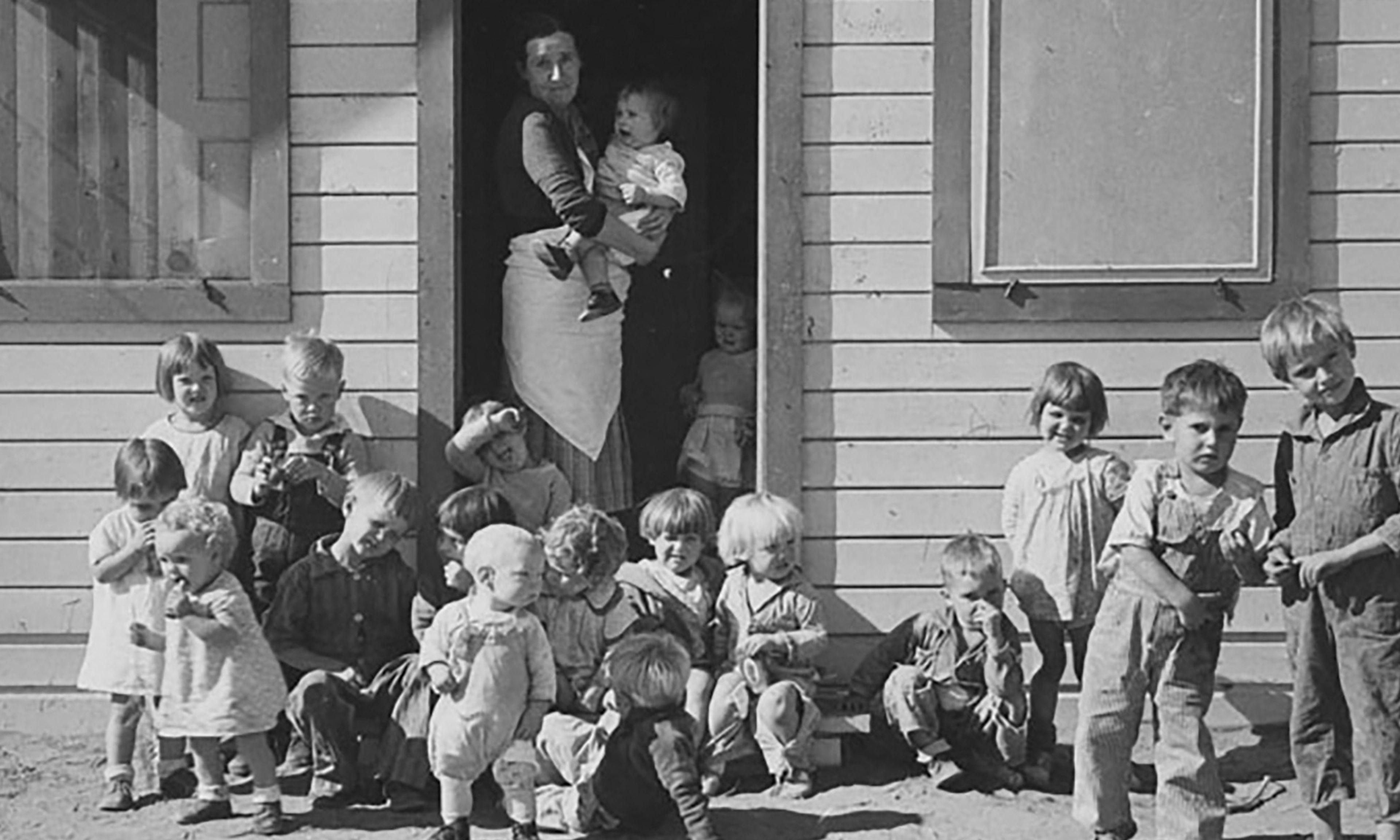
My children love bedtime stories, and we’ve collected many favorites over the years. One particularly memorable book is worth revisiting in this turbulent moment. It’s Children of the Dust Bowl, by Jerry Stanley. It’s a story about a school.
The school in question was built during the Great Depression, in the Arvin Federal Camp, of Grapes of Wrath fame. Constructed by the Works Progress Administration, Weedpatch Camp, as it was called, brought relief to destitute Oklahoma migrants who had streamed into California after their farms were ruined by cataclysmic dust storms. The humanitarian crisis was effectively curbed, but there was no quick fix for the social crisis. Native-born Californians were enraged by the influx of “Okies” and wanted them to leave. When the migrant children started attending local public schools, things came to a head, and superintendent Leo Hart devised a prudent solution. He secured permission to build a school within the camp itself, specifically for the Okie children. Weedpatch School would become his enduring legacy.
Under Hart’s leadership, the camp residents built classrooms, ball fields, and a chemistry lab. The children learned history and geography, but also shoe-cobbling, sewing, butchery, and aircraft mechanics. They cultivated vegetable gardens and kept livestock. They studied music. Eventually, they even dug a swimming pool, where camp residents could relax on summer afternoons. Despite the grim experiences of their earliest years, graduates of this school went on to be engineers, professors, judges, and entrepreneurs. In a way, Hart’s compassion and resourcefulness saved them. But they also saved themselves. They built Weedpatch School with their own hands, and it built them up too.
As I read this book to them during the Covid pandemic, my children were engrossed. Every angle of the story had to be discussed and explained: the ecological and economic crises, the thorny local politics, the literal nuts and bolts of the school’s construction. I was bemused. Why were they so impressed with this story? Was it just that they had relatives in both Oklahoma and California? Or did they understand that they themselves were beneficiaries of a heroic effort not totally unlike Hart’s? They were saved by a school too.
Perhaps that sounds melodramatic, and I don’t wish to trivialize the appalling hardships the Okie migrants faced. We read these stories in part to remind ourselves how fortunate we are to have lived our entire lives in warm houses with full pantries. Our society has its own forms of poverty, though, and they can be debilitating in different ways. As parents we look at our kids, and then at the wider world. Can’t we identify just a little with those migrant parents and the crushing anxiety they must have felt for their children’s futures?
The Covid pandemic has exposed some unhappy truths about our society. Most chilling, perhaps, is the widespread indifference to the welfare of our youngest citizens. Some people, it seems, view children primarily as disease vectors, not as this nation’s future. That attitude would be repugnant anywhere, but it is particularly shocking to find it in schools. What chance do children have if their needs are a low priority even for their own teachers?
The Republican Party is poised to make use of the current crisis, and hopefully it will succeed. For policy-makers, this lesson at least can be learned from Hart’s example: When existing schools prove intransigent, redirection may be the best strategy. Mulish ideologues can’t be coerced into building us the schools we want, but it may be possible to give parents the wherewithal to find or build their own. That’s only the beginning, though. Failing schools must be rebuilt or replaced, and that work must be done near the ground, where our children actually live. Every kind of contribution will be needed: more money, more volunteer hours, more dedicated teachers and administrators. Many families will need to shift their entire paradigm concerning their children’s education. Our schools will not prioritize our children’s needs unless we make them our own. Paying taxes and voting isn’t enough. A school is a community, and communities by nature reflect the values and priorities of the people who build and maintain them.
I myself learned this lesson only when it was presented to me in enormous, Dick-and-Jane-style lettering. Back in 2014, when my eldest was reaching kindergarten age, I agonized over school choices for months. It should have been simple, because our Catholic parish had a reputable K–12 school, with a classical curriculum. But we were raising four kids on a philosophy professor’s salary, and the financial commitments felt overwhelming. We weren’t even done having children, and parochial schools would mean even more budget stress, no school bus, and more pressure on me to earn real money. In masochistic moments, I found myself running the numbers and calculating what our retirement account might look like in 2050 if we invested that sum instead of spending it on tuition. Just then, the St. Paul school district sent me their mailing. Though it may have smelled faintly of sulfur, it offered a dazzling array of options, with healthy children beaming at me from every page. “It’s time to choose a great school for your child,” declared the cover.
My next-door neighbor won me over in the end. She worked for the school district. Over the fence and at the neighborhood book club, she chattered on about the wonderful developments coming to our public schools. I heard about transgender accommodations, and promising initiatives to smother “patriotic education,” which seemed to involve things like displaying American flags and teaching kids to take pride in the Constitution. I heard rants about public schools elsewhere (not in our district!) where Christmas decorations still hung in classrooms. Her proselytizing finally silenced my inner financial planner. If I sent my kids to St. Paul public schools, the environment she described would be their other community. That was unacceptable. Parochial school would involve real sacrifice, but we would have to find a way.
I no longer live near that chatty neighbor, but I recall her now with a strange affection. She was like the casual acquaintance who inadvertently gave me a great stock tip. Nowadays, my four school-aged sons come home quoting Cicero, discussing the techniques of Fra Angelico, and telling stories about the Science Sisters, a wonderful group of Dominican nuns who instruct them in the natural sciences. Meanwhile, through the Covid pandemic, their lives have been a variation of normal. They’ve been in school full time since the fall of 2020, playing sports and having band concerts. St. Paul is hardly an oasis of political sanity, but my kids laugh in surprise on those rare occasions when they’re asked to mask. Are people still doing that? How funny.
When I read about the harrowing experiences of other families across the country, it doesn’t feel like hyperbole to say that my children were saved by a school. Parochial schooling hasn’t been any cheaper, or easier, than I anticipated, but I understand now that those were never the right criteria. Our school is worth the investment, and not only because St. Paul public schools are bad. It’s worth it because this school and its community deserve our support.
Naturally, our school has its own origin story. It involves a visionary pastor and a generous philanthropist who teamed up some years ago to transform a failing parochial school into a thriving classical academy. Like Hart, they saw a community-wide need and developed a plan. They were clear-sighted. Weedpatch School taught trades, so that students could rise out of the poverty into which they had been born. Our school teaches the liberal arts, so that students have a fighting chance of keeping their balance in our topsy-turvy culture. Both were built and maintained by people who viewed the school community as their legacy and their life’s work. There is no adequate substitute for that kind of commitment. Teachers’ unions have been giving us an ongoing demonstration of what can happen when it is lacking.
My parish was blessed. It may turn out, though, that every successful school exists only because somebody took similar initiative in an hour of need. There is no generic recipe for building an excellent school. Each one will have its particular backstory: its own Leo Hart, its own defining vision, its own supportive community that came together to realize the dream. It takes both prudence and wisdom to understand what sort of school is needed in a particular time and place.
After the ball starts rolling, both parents and students themselves may need to dig deeper than they believe they can, to maintain that momentum. That may mean working longer hours, or trimming the family budget. It may call for extra volunteering in classrooms or serving on school committees. For some people it involves a move, or a full career change. None of these changes are easy, which is why some of us resist. We grouse and procrastinate. Then one day it dawns on us that it really doesn’t matter if the task at hand is difficult. Our children need us to step up for them. What choice do we have?
Hart built a school under incredibly difficult circumstances. We can do it too. In a way, my school district’s catalogue had things almost right. It’s time to build a great school for your child.












Comments