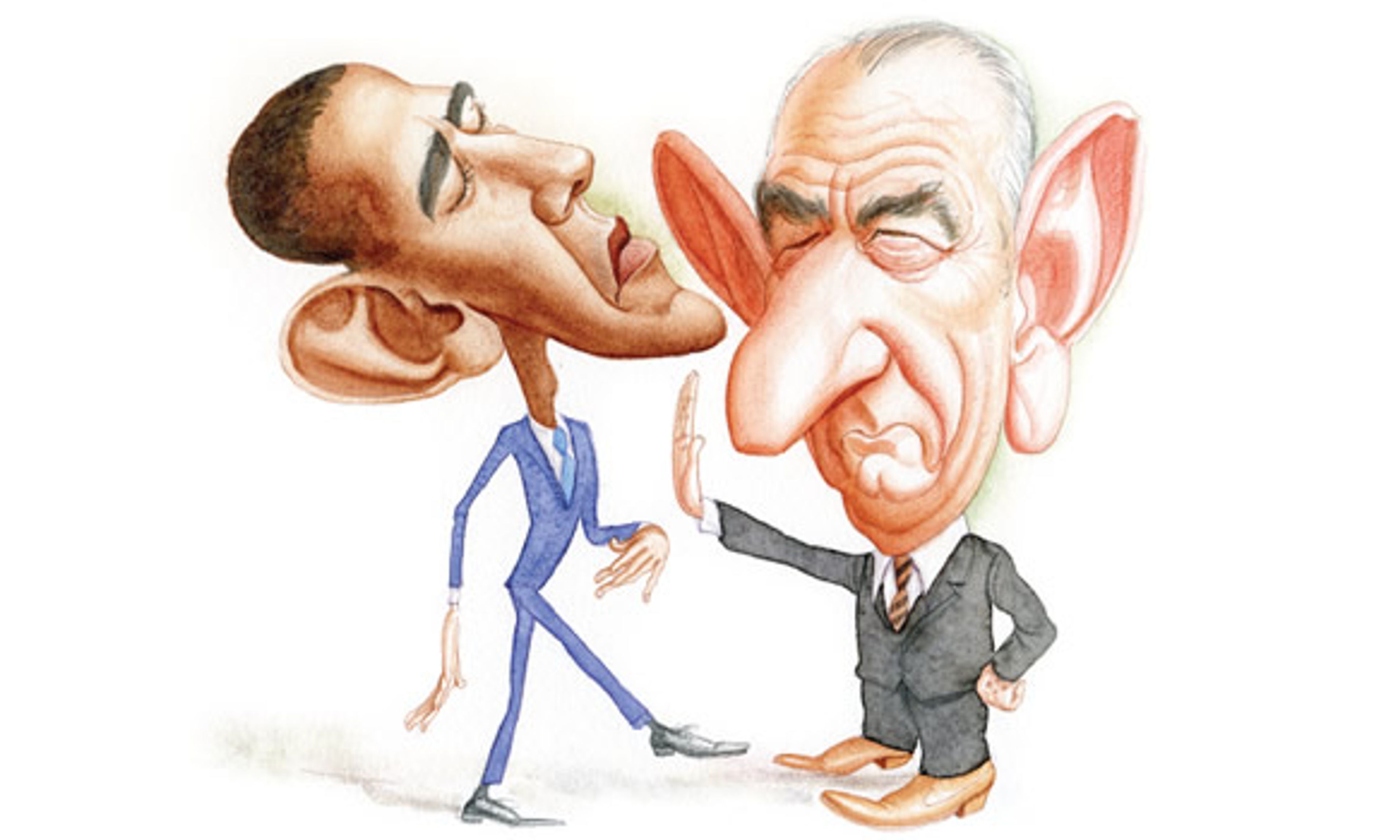
The chief obstacles to new liberal policy victories these days are past liberal policy victories. As a matter of political philosophy, contemporary liberalism may exalt government, but in practice, it enfeebles it.
No group of voters has resisted the president’s project of transforming American health care more than senior citizens. Their health care was already transformed, by Medicare. That program is one of Lyndon Johnson’s great liberal achievements, but also a major source of funding for Obama’s health-care initiative. The old beneficiaries, in both senses of “old,” don’t want to give new beneficiaries a cut.
The very recent beneficiaries don’t, either. When Massachusetts elected Republican senator Scott Brown in January, liberal commentators pointed out that he had argued that the state’s voters already had universal health coverage and thus had no incentive to sacrifice to cover people in the rest of the country. Some Brown backers, they said, were not so much voting against liberal health-care reform in principle as voting for the one they already had. They were voting, in other words, like Medicare recipients.
Brown’s election threw Congress into turmoil. Senate Democrats had passed a health-care bill that sought to raise funds and control costs in part by taxing expensive insurance plans. A large bloc of House Democrats who favor the legislation in general were unwilling to vote for it because unions had negotiated those plans and wanted them left alone. Their unhappiness is the principal reason that Democrats spent February and early March trying to figure out how the Senate could pass a second bill amending the first before the House voted.
The pattern goes beyond health care. The unpopularity of the stimulus bill has been a major headache for Democrats, dragging down support for all of their other plans. One reason the stimulus is widely seen as ineffective is that it has taken a long time for projects it funds to get under way. And one reason for that slowness is the burden of compliance with environmental and labor regulations. In 2009, only 9,100 homes were weatherized under the $5 billion program that the stimulus devoted to the purpose. Weatherization grants are subject to the government’s Davis-Bacon rules, which require that federal projects pay the “prevailing wage.” The Department of Labor had to figure out the prevailing wage for weatherization work in each of the country’s 3,000-plus counties.
During the Bush presidency, liberals were taken with the argument that conservatives, because they oppose much of modern government, cannot run it properly, and then use its mismanagement to justify their ideological predilections. But the fact that California is increasingly described as a “failed state” cannot plausibly be attributed to mere defects in administration, or even to underfunding caused by conservative anti-tax activism. The state’s revenues per capita are among the highest in the nation, notes William Voegeli.
Writing in City Journal, Voegeli has argued that California came to grief because its government offers high spending, high taxes, and lousy services. What makes up the gap are compensation for state employees and transfer payments. For example: “California government workers retiring at age 55 received larger pensions than their counterparts in any other state (leaving aside the many states where retirement as early as 55 isn’t even possible).” The state’s bloated government is incapable of doing a good job of the many tasks liberalism has given it; its incompetence then reduces public support for handing it more responsibilities.
Contemporary liberalism both presupposes and desires a government that is flexible, competent, energetic. It wants and needs a government that can mobilize society’s resources to accomplish a long list of difficult tasks, including the reduction of economic inequality, the education of children, the protection of the environment, the elimination of unjust discrimination, and the safeguarding of consumers — to name just a few. Yet in operation, it weighs down the government with interest groups that first make it inefficient and inflexible and then make it impossible to reform.
Another example. Liberalism is as committed to fighting global warming as it is to any other cause. It believes that the fate of the earth — literally — rests on changing our patterns of energy consumption. Some liberals, notably including the president, have gone so far as to abandon earlier liberal leeriness of nuclear power in the name of this urgent cause. But liberal laws enable environmental activists to file suits against, and otherwise impede, the spread of wind farms, let alone nuclear plants; and for all the urgency of the liberal crusade on climate change, nobody is proposing to change that.
It may be that liberalism’s political weakness, especially in the United States, forces it into these traps. It cannot survive without strong public-sector unions; the alternative to them is not a large, liberal government with less sand in its gears. One reason our society is so much more litigious than those of Western Europe is that, across the Atlantic, politicians can openly advocate social democracy. Here we have empowered the trial bar to serve as a force for piecemeal redistribution and regulation — a force that is often turned against governments as well as private-sector actors. Entitlement spending may crowd out the discretionary spending that liberals prefer, but the former does more than the latter to keep liberal politicians in power.
Social Security is an instructive case. In terms of redistributing wealth from rich to poor, the program is only very modestly progressive if it is so at all. The overwhelming majority of funds that go into the system from upper-middle-class people go right back out to upper-middle-class people. (Ditto for other economic groups.) The program’s goals could be much more efficiently served by splitting it into two programs. A mandatory savings program in which people had to make conservative investments could prevent most people from retiring in penury, while a small transfer program could help those who can’t amass enough savings. That efficiency would not just enlarge the private economy; by saving money, it would make it possible to increase types of government spending attractive to liberals.
Social Security’s seeming irrationality has a rational basis. That basis is political. It was designed so as to hide its redistributive elements, on the theory that a purely and visibly redistributive program would not have the necessary popular support. FDR called it an “insurance policy” that kept “individual accounts” for each contributing worker. If a program for poor people were funded out of income taxes, that program would be under threat at budget time. Instead, everyone gets benefits, and everyone feels that they have paid for their benefits with their contributions and are thus entitled to them. The program’s resultant popularity has benefited liberal politicians for decades.
Now that we have had those decades to watch the politics of Social Security play out, do liberals regret the bargain they made? Not really. In 2005, President Bush offered them a chance to move toward the safety-net-plus-forced-savings model for the program, and they vehemently and uniformly turned him down. Many of them said that he was attacking the program and thus a crown jewel of liberalism. Some of them openly warned that trimming the growth of benefits for high-wage workers, as Bush proposed to do, would reduce public support for the program.
If liberalism in operation subverts liberal aspirations, this tendency also undercuts some conservative critiques of liberalism. In the first issue of National Affairs, William Schambra wrote an influential essay on the limits of President Obama’s “policy approach,” in which disinterested experts seek comprehensive solutions to rationalize complex, interconnected systems. He cautions that “as Obama’s proposals begin their journeys through the requisite institutional hoops, they will inevitably begin to lose their coherence and uniformity.” He also notes that this model of policymaking, inherited from the progressives, both underestimates the fallibility of reason and imposes strains on democracy.
Contemporary liberals, including Obama, do indeed have excessive confidence in the power of their intellects to order society. But Schambra underestimates the extent to which the liberal dream of technocracy is a self-delusion. The policies that liberals propose do not become incoherent only upon contact with the political process. They start out that way because of preemptive concessions made by the would-be technocrats themselves.
The reason the Obama administration favors cap-and-trade legislation rather than a tax on the emission of greenhouse gases is not that the former is more elegant, simple, or efficient. It is that an explicit tax on energy would be less popular than a disguised one. The greater susceptibility of cap-and-trade to horse-trading exemptions makes it costlier as well as politically more attractive.
Nor does the administration’s health-care policy make any sense at a basic level. There is a reason that its most persuasive advocates, to a man, would actually prefer “single payer”: the abolition of private health insurance in favor of a government monopoly. Instead, the administration favors making the insurance companies behave in ways no free-market industry would, forcing everyone to buy their products, and subsidizing those who cannot afford the new, higher prices. The advantages of such an approach over single payer are purely political. Under this system, the profits of the industry serve little social purpose; they’re nearly pure waste. (The profits will still provide an incentive to classify and manage risk, but acting on that incentive will generally be illegal.)
“No menace of socialism threatens the United States,” conservative scholar Michael Greve has grimly written. “Socialism implies a seriousness of purpose and a willingness and ability to impose order, none of which is in evidence.” Again, the health-care overhaul has shown the pattern. What began as an effort to reorder important parts of American society became a series of bargains and shakedowns in which progressives could not tell which groups would be their clients and which their targets from week to week. The progressive project remains obnoxious to liberty, and it retains, in some sense, its ideals. But it lacks a coherent and determined purpose. More and more, liberalism has become a grift.












Comments