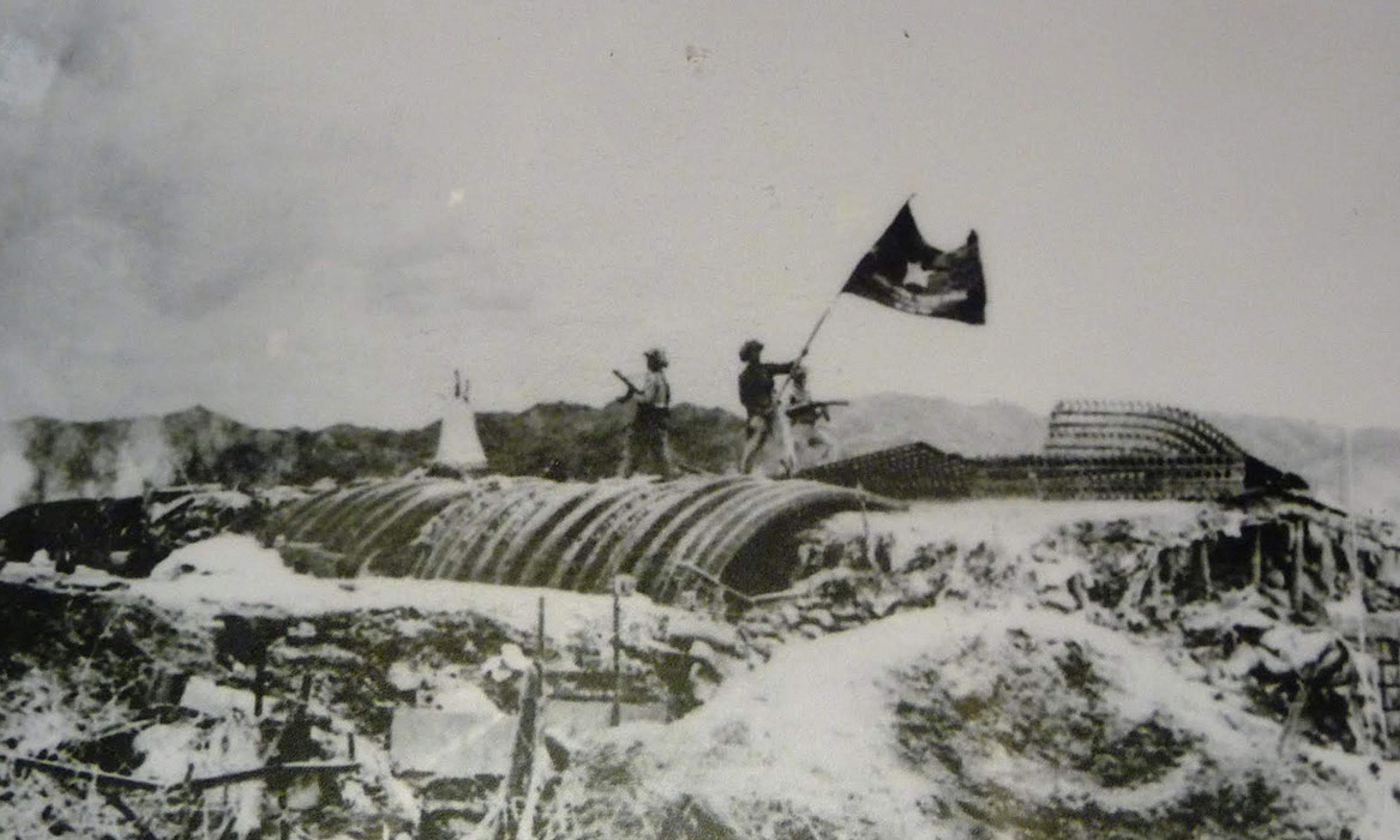
May I declare an interest, or two? While France was losing the battle of Dien Bien Phu in 1954 I was a young foreign correspondent, for the British Daily Telegraph, in Germany. I watched the course of the battle with mounting fear and dread. We were painfully conscious that between that “Valley of Death” and us there stood nothing but the apparently invincible forces of Stalinism. At the east end of the Rhine bridges at Bonn there was a sign in three languages: “No member of the Soviet Occupation Forces permitted across the bridge.” With the French still rejecting German rearmament, that was virtually it. And there, in far-off Vietnam, one of the West’s best-equipped armies was surrendering to a ragbag of oriental guerrillas in the most abject humiliation.
How had this come to pass?
Ted Morgan is superbly qualified to revisit the awful scene and reexamine the story. As an American who had the bad luck to be born in France, he found himself conscripted into the French army, so had to do his time as a “grunt” in the grim Algerian War. There he experienced at first hand the impact that defeat at Dien Bien Phu had on the French psyche. He has now returned to study, in great depth, the events surrounding that decisive battle — as well as the repercussions in the outside world. He is particularly skilful in counterpointing the grim struggle for strong points like “Eliane 2” with the epoch-making negotiations that were occurring simultaneously in Geneva, Washington, London, and Paris.
Following the terrible defeat of 1940, post-war France had a problem; to be accurate, it had many. In what de Gaulle dubbed “this absurd ballet,” governments of the Fourth Republic trooped on and off the stage with depressing regularity. In 1950, Queuille was followed by Pleven; then Queuille returned, to be followed by Pleven again. In 1953 came Laniel, who was followed by Pierre Mendès-France, the courageous little Sephardic Jew who took the brave, but inevitable, course of getting France out of Indochina, thus ending what most Frenchmen called the sale guerre, or dirty war, unwinnable as it was to prove for four successive U.S. presidents from the 1960s to the final disaster of April 1975.
Those poor French leaders of 1945 were weak men, presiding over a broken, divided, and bankrupt country — and plagued perpetually by the cancer-like presence of the most powerful Communist party in Europe, which commanded roughly one-third of the seats in the National Assembly. If Richard Nixon thought he had a problem, he should have looked at France in those years. There was also a dichotomy not unfamiliar to the U.S. in the 1970s — or indeed today, over Afghanistan: The majority of Frenchmen wanted “out,” and successive French governments wanted to win a military victory convincing enough for them to negotiate an “honorable” exit strategy. But the military remained convinced they could win a decisive victory.
In 1950s France, there was this difference: After the sore humiliations of the 1940s, the army had to win. There was an element of machismo involved, harking back to that old slogan that so haunts French history: la gloire.
In 1945, France had two military giants, Leclerc and de Lattre de Tassigny. Both were sent to try their hand in Indochina. The problem was that the French colony there, truly the jewel in France’s imperial crown, had been occupied by the Japanese from Pearl Harbor onwards, and under their presence a powerful independence movement, the Vietminh, had sprung up unchecked — under the aegis of two most remarkable men, Ho Chi Minh and Vo Nguyen Giap, respectively political boss and military genius.
Tragically for France — and maybe the West as a whole — Leclerc, who might have aimed for a sensible, negotiated withdrawal while France was still relatively strong vis-à-vis the Vietminh, was killed, in a 1947 plane crash over the Sahara. De Lattre, vainglorious and one of the most arrogant Frenchmen ever, came to Hanoi claiming that his presence was worth a division of French troops (which, of course, the Fourth Republic didn’t have). Nevertheless, a brilliant soldier, he saved Hanoi in 1951 — and might well have produced a solution. But de Lattre was already a burnt-out case, his son had just been killed in the sale guerre, and he would be struck down by cancer in January 1952. (He was posthumously nominated maréchal de France.)
De Lattre was followed by one of the most disastrous figures in French military history, Gen. Raoul Salan, the quintessence of the “political general,” an old opium-smoking Indochina hand, nicknamed “the Mandarin,” who thought he knew everything. (I got to know him well, in his Algerian War context — a slimy figure with mauve-tinted hair. He was to end his career in disgrace, running the terrorist OAS organization in Algeria, and sentenced to death in absentia by the de Gaulle government — but amnestied in 1968.)
In Hanoi Salan was followed by two commanders, Navarre and Cogny, who argued with each other incessantly. As Morgan puts it, the French were left “rudderless.” To try to preserve the crucial Hanoi delta, and at the same time defend inland Laos from the Vietminh threat, Navarre decided to establish an impregnable fortress in the middle of enemy territory at Dien Bien Phu, 500 kilometers northwest of Hanoi, and a safe 300 kilometers from the Chinese frontier. With occidental arrogance, Navarre assumed that because the French couldn’t access it by road, through what they deemed “impassable” jungle, the enemy couldn’t either. He forgot about the reinforced bicycle frame, and the limitless supply of commandeered coolie labor available to General Giap. With total command of the skies, Navarre would supply the fortress by air.
By the early 1950s, Giap had created a powerful force of 250,000 men. Released from commitment in Korea, the Chinese could supply them with quantities of U.S. 105mm artillery, captured from the defeated Chiang Kai-shek. Without the French noticing, the war in Indochina had been transformed by China. Rather like the U.S. and British in Afghanistan, unhappily, the French with all their sophisticated mobility were reduced to fighting a kind of Beau Geste war, defensively based on fortresses. It was the primitive foe who proved to have the mobility. Giap decided to commit all on winning a decisive, pitched battle — something guerrilla forces had never done before — with far-reaching political aims. He won.
By January 1954, Dien Bien Phu had been surrounded, invested like a fortress in a medieval siege, with all its attendant horrors — an extraordinary anachronism in the midst of the nuclear age. Foolishly the French allowed Giap to occupy the high ground ringing the fort, so he was able to dig tunnels through from the safe dead-ground behind. Thus those captured 105mms would command every inch of the defenders’ positions — and eventually the vital airstrip. Realizing what lay ahead, the French artillery commander, Col. Charles Piroth, blew himself up with a hand grenade.
Morgan rightly rates the two-month assault on Dien Bien Phu as “one of the great epics of military endurance.” With the advantage of all the documentation available since Bernard Fall’s 1967 classic, Hell in a Very Small Place, he describes the course of the battle day by day with most minute detail — perhaps almost to excess. To regain their reputation, tarnished by World War II, the French fought with a kind of World War I heroism. (Indeed, trotted out at various moments was the totemic word “Verdun” — that great Pyrrhic victory of 1916.) After desperate hand-to-hand fighting, one by one the French outposts (all, characteristically, named after women) were whittled away by Giap’s suicidal assaults.
Under the relentless bombardment of the Vietminh guns, the fate of the French wounded in their makeshift field hospitals was unimaginable; worse still was the death march of the POWs once Dien Bien Phu finally fell in May 1954 — comparable to America’s Calvary in Bataan in 1942. Out of 15,090 defenders, 1,142 were killed; plus 429 who died of wounds, and 1,606 unaccounted for, but presumed dead. Over 10,000 were taken prisoner, of whom 70 percent died (Morgan tellingly compares this to Dachau’s 80 percent).
Yet only 25 percent of the defenders were actually French; many were ex-Wehrmacht veterans from World War II; others were Algerian. The survivors would take home lessons of a French army defeated by Third World guerrillas. Revolt in Algeria would begin six months later; by 1962 France would lose that last jewel in its colonial crown.
Dien Bien Phu was unquestionably one of the stupidest battles of the 20th century, but it was also one of its most important, with consequences that reverberate even today. The Geneva Conference for a solution on Indochina began during Dien Bien Phu. That sealed its fate, says Morgan. Moral for today: Don’t begin political negotiations while a military campaign is still under way.
Worse than the military defeat at Dien Bien Phu, however, were the splits revealed in the Western Alliance. They mimicked France’s “absurd ballet.” Secretary of State John Foster Dulles — in Churchill’s memorable comment, “the only bull I know who carries his own china shop around with him” — raged ineffectually, while Ike, as was his wont, was indecisive. British foreign secretary Anthony Eden, vanity personified, was determined to prevent America’s Adm. Arthur W. Radford from unleashing a nuke in support of the French, or indeed any other kind of intervention over Dien Bien Phu. French foreign minister Georges Bidault was, perhaps understandably, drunk much of the time — and, when sober, he did not tell the U.S. (which was funding 80 percent of France’s war) what was going on.
When you read Ted Morgan’s account of this Allied disunity, you wonder how we ever won World War II. The divisions he so skillfully, and ominously, delineates led in a direct line to Suez, two years later. That was to mark the final collapse of Franco-British empire, which began in that hellhole at Dien Bien Phu.
In Hanoi, in 1998, I interviewed the victor of Dien Bien Phu, General Giap — a tiny walnut of a man. It was somewhat disappointing that, now in what Prime Minister Harold Macmillan once described as his “anecdotage,” Giap treated me to a thousand-year treatise on Vietnamese history. It was nevertheless exciting to meet the man who, never losing a battle, had vanquished successively the armies of France, the U.S. — and China. Of significance in today’s struggle with Islamic terrorism was his reminder that he and his ragtag guerrillas would, if necessary, have gone on fighting for another 100 years until victory was finally achieved.
How long can any Western democracy manage? President Obama, please answer.
So what did Giap glean from Dien Bien Phu? Plenty. But what did the Kennedy/Johnson/Nixon administrations learn from that one battle — which cost the equivalent of nearly one-fifth of all the 58,000 U.S. fatalities in the whole of their Vietnam War two decades later? Nil. What do the intelligent baboons who run our countries learn from history? Nil. It’s depressing. But let us hope the White House and the Pentagon will be reading Ted Morgan’s excellent, but depressing, book.










Comments