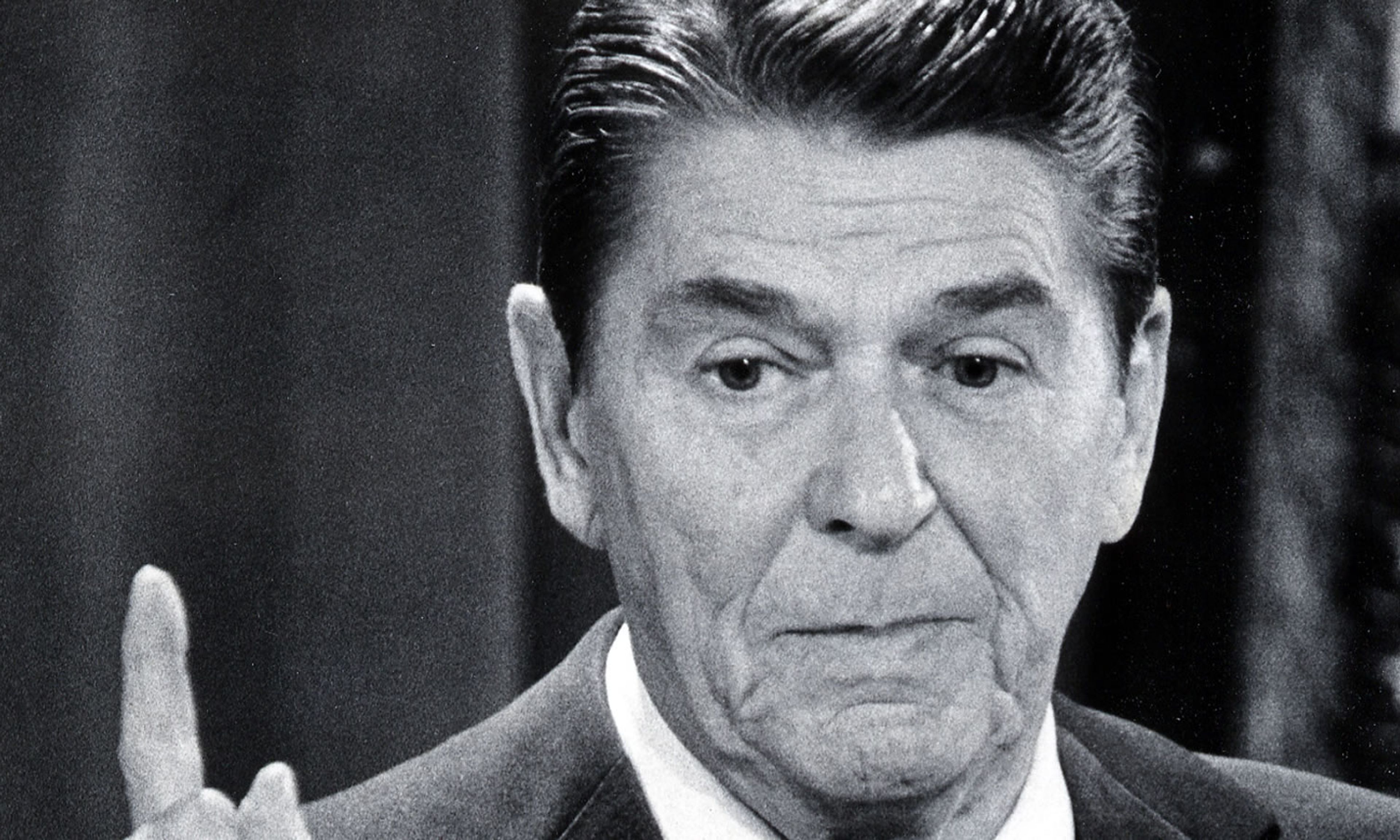
Gallup polls consistently show that the American public esteems Ronald Reagan as much as or more than any other president. Admittedly, such polls tend to favor recent presidents, along with those whose faces appear on our currency, but even so, Reagan usually manages to outpoll Bill Clinton, JFK, FDR, Lincoln, and the founding fathers. Reagan stands out so strongly not just for his economic and geopolitical achievements, but also because he realigned the American electorate both ideologically and on a partisan basis in ways that are unique in the period following World War II. Equally important, he did this by governing from a clearly articulated set of principles — strong bedrock values to which he returned time and time again to educate and, ultimately, persuade Americans.
Since Gallup first asked Americans about their party preference, the president’s political party has almost invariably lost ground during his years in office. This comes as no surprise; everyone wants to be on the same team as a newly elected president, but once in office, presidents face challenging situations that can require them to act in ways that burn their political capital.
Even during the unique political circumstances presented by World War II, and later amid the worshipful media coverage of JFK’s Camelot, the president’s party lost ground. The largest Democratic losses occurred during LBJ’s five years in office, which were marked by the rapid legislative march to his Great Society along with the frustrations of Vietnam. Those identifying as Democrats dropped by a full nine percentage points, while Republican identification inched up two points. Democrats incurred modest setbacks in party identification during the Carter and Clinton administrations, when Republicans posted net gains of three and two points, respectively.
Likewise, Americans moved toward the Democratic party when Republicans controlled the White House. Net Democratic gains were two points during the Ford administration, three points under the Eisenhower and George H. W. Bush administrations, six points under George W. Bush, and seven points under Nixon.
Ronald Reagan stands out as the lone exception to this rule. The percentage of Americans identifying as Republican increased by three percentage points between 1981 and 1988 (from 27 percent to 30 percent), while the Democrats’ fortunes plummeted six points, from 41 percent to 35 percent. And as a Pew Foundation study points out, this “probably understates Reagan’s overall legacy, as GOP identification had already spiked four points (and Democratic identification fallen four points) between 1980 and 1981.”
It is too early to know what effect Barack Obama’s presidency will have on his party’s fortunes, but it’s not too early to draw some preliminary conclusions. In 2008, 36 percent of Americans identified with the Democrats and 28 percent with the Republicans, the largest partisan advantage for the Democrats in over two decades. These numbers prompted a widespread burst of liberal gloating. We were told that America’s dalliance with market thinking and its fixation on individual liberty had run their course. America was moving inexorably toward collectivism and would soon resemble “a modern European state” like France. The GOP became the subject of what amounted to political obituaries. “These days,” Time opined, “Republicans have the desperate aura of an endangered species.”
Liberals often remind us that President Obama inherited many problems when inaugurated. But his most debilitating inheritance may have been this triumphalism and the arrogance it inspired, which led him to pursue the most ambitious liberal policy agenda in decades.
Obama’s first year saw many Democratic legislative accomplishments, chief among them a budget that contemplated tripling the national debt over the next decade. The American people were ambivalent, because they saw little or no benefit — and considerable harm — accruing from Obama’s marquee legislative achievements. The next year Obamacare passed, and its unpopularity hurt the Democrats even more. Not surprisingly, then, after two years in office, one out of every seven Democrats had left the fold. Identification with the Democratic party fell from 36 percent to 31 percent, while the GOP share of the electorate ticked up modestly, from 28 percent to 29 percent. Gallup characterizes this six-point shift in only two years as “notable.” Other national surveys, such as those conducted by the Washington Post/ABC News and the New York Times/CBS News, recorded even steeper net Democratic declines.
How does this record compare with that of Reagan’s first two years? In 1980, party identification averaged 45 percent for the Democrats and just 23 percent for the GOP. During his first year in office, Reagan fired thousands of striking air-traffic controllers, convinced Congress to enact his historic budget and tax cuts, retooled our military, and reversed virtually every aspect of Pres. Jimmy Carter’s failed national-security strategy. The mainstream media and Washington’s insiders roundly ridiculed these initiatives and warned that they would lead to further economic stagnation and even a full-scale nuclear war. The American public disagreed. They rewarded the Republicans with a four-point gain in party identification while setting Democrats back by the same amount.
Like our current president, Reagan assumed office during very challenging times. During his transition, a team of advisers wrote:
1980 may well have been the most crucial year for the American economy in half a century. . . . No American President since Franklin Roosevelt has inherited a more difficult economic situation.
Sound familiar? As with Obama, Reagan’s early years in office were dominated by a nasty recession — falling GDP accompanied by double-digit unemployment, interest rates, and inflation.
And, as with Obama, the recession was slow to dissipate. After nearly two years, voters had realized no dividends from the historic Reagan spending and tax cuts. But even after losing back some of 1981’s gains in 1982, the GOP was still up two percentage points since Reagan had taken office. Contrast that to the Democrats’ six-point decline in party identification during Obama’s first two years.
Of course, we know the rest of the Gipper’s story. With his economic plan in place, the economy took off, and his arms buildup cast the die for the ultimate fall of the Soviet empire and international Communism. Not surprisingly, Republican fortunes took off. Identification with the GOP surged from 24 percent in 1983 to 29 percent in 1984 and 32 percent in 1985. It would remain at 30 percent or higher for the rest of the decade. The Democrats’ party identification experienced a decline every bit as dramatic as the Republican gains, falling from 43 percent in 1983 to 34 percent in 1985, where it remained virtually unchanged throughout the 1980s.
Reagan’s success did more than just revive the fortunes of the Republican party. It also led to a renaissance for American conservatism. Surveys conducted since 1972 by American National Election Studies (ANES) tell the story. In 1980, 28 percent of Americans identified as conservative and 17 percent as liberal. Throughout the 1980s the percentage of liberals remained more or less constant, but the percentage of Americans claiming the conservative label increased steadily, rising to 29 percent in 1984 and reaching 32 percent at the end of Reagan’s tenure in 1988. Before Reagan, the conservative total had hovered between 25 and 27 percent. Since his departure from the Oval Office, it has been at 30 percent or higher in all but one of the ANES surveys.
The greatest lesson from the Reagan years is that not only must a president’s agenda achieve results, but the agenda must be in sync with America’s ideological center of gravity, which has long been located on the right. Given the historical norm in which there are roughly three self-described conservatives for every two liberals, that is a daunting challenge for a liberal president. The single greatest factor distinguishing Obama’s first 24 months from Reagan’s was his decision to advance a relentless big-government agenda at a time when conservative attitudes and values favoring limited government were on the rise. Both the 2010 exit polls and Gallup’s extensive surveys indicate that conservatives now account for roughly 40 percent of the electorate while only 20 percent acknowledge being liberal.
Another significant change in the political terrain since the early 1980s: There is now a nearly complete alignment of partisanship and ideology. Three decades ago, a significant minority of Democrats — many of them in elective office — were conservative, and overt liberals were not uncommon among the ranks of elected Republicans. No longer. Today, as ANES surveys have found, the overwhelming majority of Republicans describe themselves as conservative, and most Democrats claim the liberal mantle, though they are a smaller proportion of their party than conservative Republicans are of theirs.
The ongoing debate over the size of government will take place on conservative rhetorical ground. President Obama understands this. He routinely associates Obamacare with conservative values such as “self-reliance,” “rugged individualism,” “our fierce defense of freedom,” and “healthy skepticism of government.” His standard stump speech during the 2010 campaign channeled Reagan to the point of being intellectual-property theft:
I’ve never believed that government has all the answers to our problems. I’ve never believed that government’s role is to create jobs or prosperity. I believe it’s the drive and ingenuity of our entrepreneurs, our small businesses, the skill and dedication of our workers, that has made us the wealthiest nation on earth. I believe it’s the private sector that must be the main engine of our recovery.
Obama speaks in this — our — language not because he wants to, but because he has to. Skepticism of government is at a half-century high, and Americans are more willing than ever to embrace limited-government solutions to our existential debt crisis.
The battle can be won.











Comments