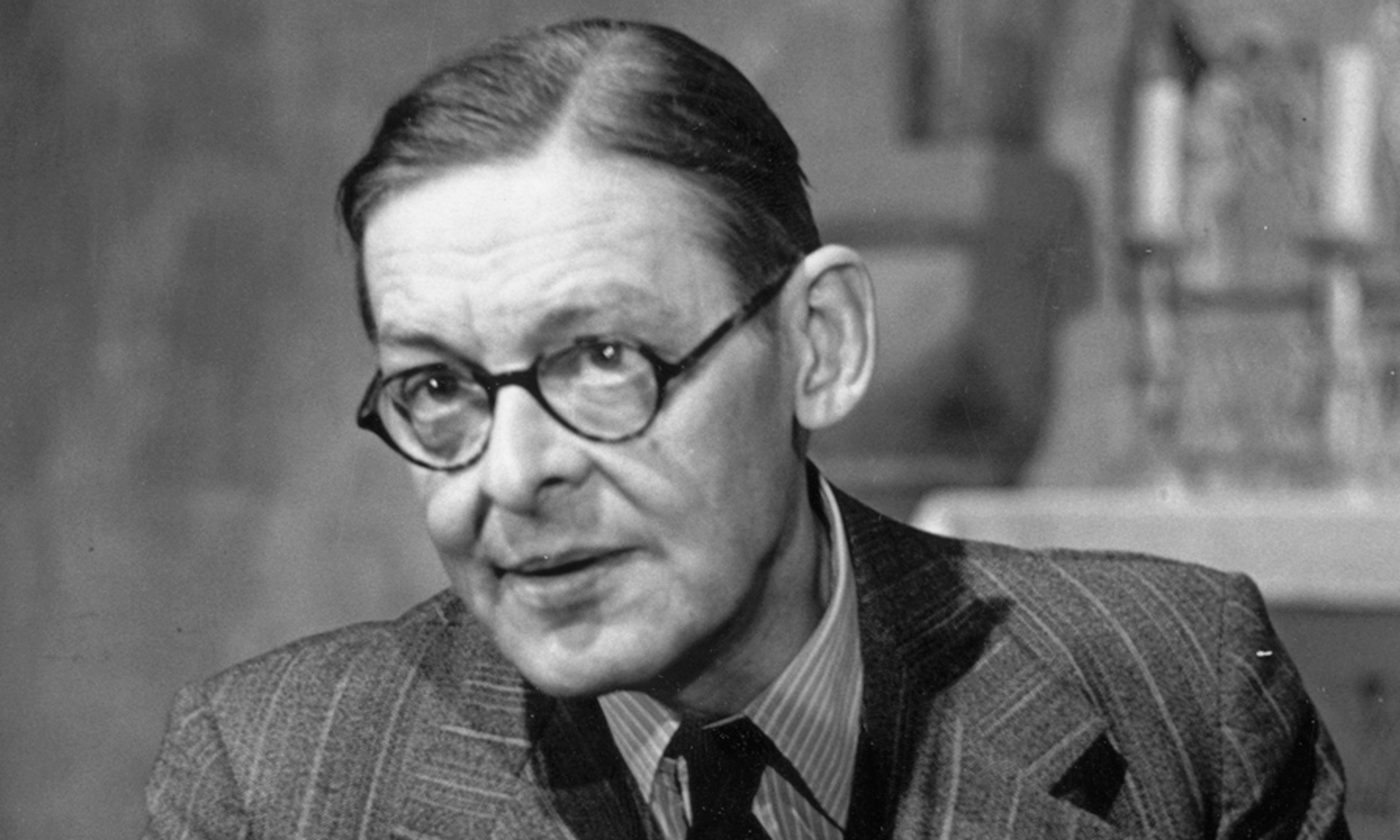
If we learn anything about living, rather than about literature, from the life of T. S. Eliot, it is this: If at some point in early middle age you find yourself desperately seeking the advice of madman Ezra Pound regarding the delicate health of your madwoman wife, you have taken a wrong turn down one of those certain half-deserted streets.
Thomas Stearns Eliot did not have an exciting life. There was abundant drama in it, even excessive drama, but the effect of it was not excitement — it was anxiety. The anxiety was particularly intense in the first half of his life, “from St. Louis to The Waste Land,” as the subtitle of Robert Crawford’s excellent new half-biography, Young Eliot, has it. There is, so far as I am aware, no other Eliot chronicle quite like it. Frank Kermode wrote incisively about Eliot’s literary mind, and Peter Ackroyd wrote a sensitive biography under nearly impossible conditions (the Eliot family limited his quoting from Eliot’s published work and forbade his quoting from unpublished work and correspondence). But Crawford has an unusual sense of the man himself, of his intellectual milieu, and of the material condition of the times — which is indispensable in accounting for the life of a poet who believed that “the only way of expressing emotion in the form of art is by finding an ‘objective correlative’; in other words, a set of objects, a situation, a chain of events which shall be the formula of that particular emotion; such that when the external facts, which must terminate in sensory experience, are given, the emotion is immediately evoked.” Young Eliot may be half a life, but it is a fascinating and whole portrait, if you can bear it.










Comments