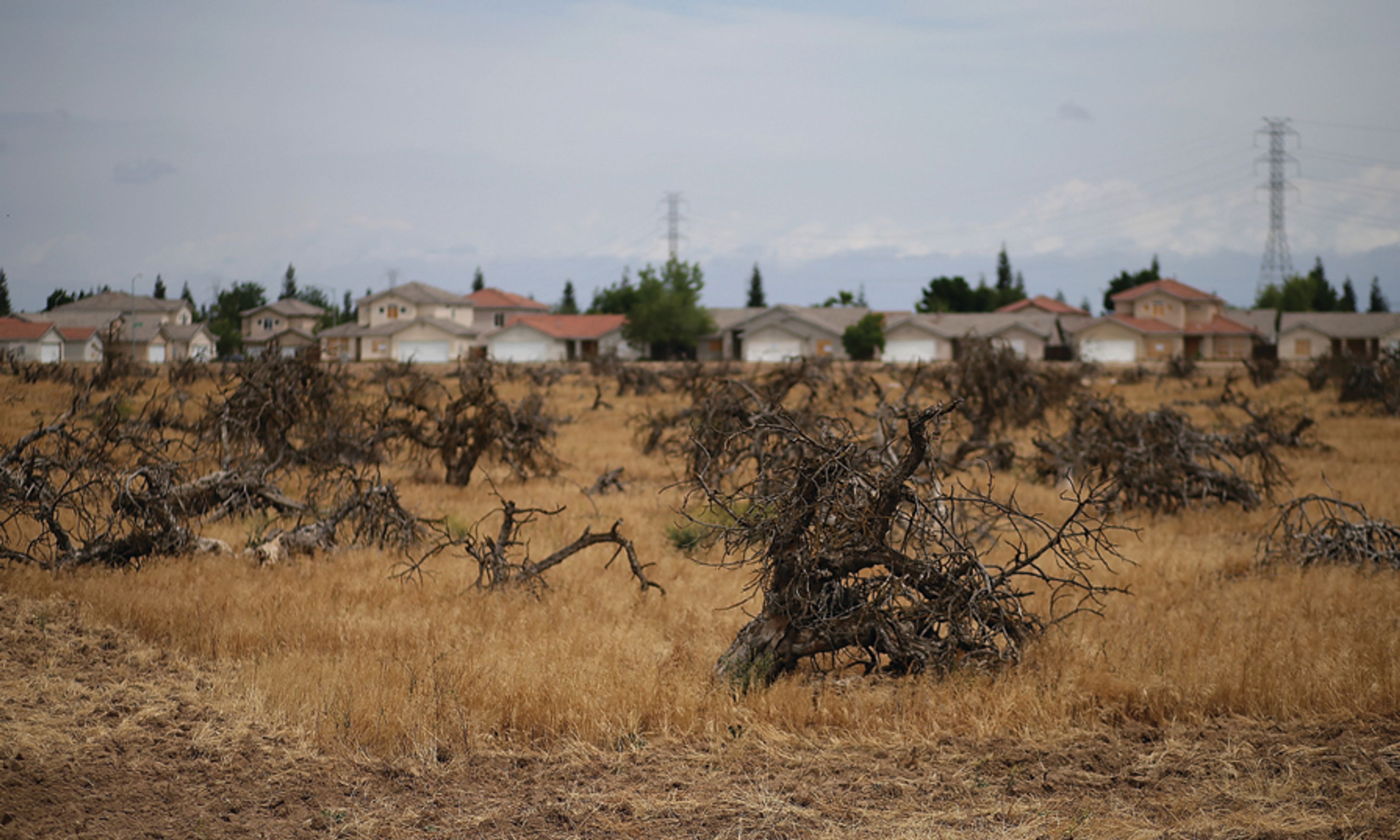
Central Valley, Calif. — The road to Fresno is flanked by missed opportunities. Just ten years ago, to drive across this extraordinary valley was to be blinded by miles upon miles of burgeoning green life. Now, the fields that run alongside State Route 180 resemble the squares on a giant, schizophrenic checkerboard. On one block there are pistachios, almonds, tomatoes, and grapes, stretching as far as you can see; on the next all is brown and fallow, and the dust swirls upward toward the heavens. On the edge of the small farm town of Mendota, an abandoned sugar plant stands defiantly against the sky. It is beautiful, in a peculiar way — a fading Hopper sketch for an unsure world. This was a resolute place, once.
That was before the decline; before the worst drought in 1,200 years turned some of America’s most fertile ground into a Dust Bowl; before soft-handed politicians in a faraway city took a look at an economic miracle and concluded that it was expendable. There is no question that God has played His role in bringing about this crisis: It has not rained consistently in the Central Valley for half a decade now, and the reservoirs in the northern part of the state are dangerously low. But Caesar must share in the blame. Because the valley is liable to become parched in rainless times, California has constructed a complex system of pipes and pumps that funnel lifesaving water southward from the Sacramento–San Joaquin Delta. Since 2007, that system has been deliberately crippled. In that year, the Natural Resources Defense Council convinced a judge that, by operating the pumps at high capacity, California was killing too many smelts — a small fish that is explicitly protected within the Endangered Species Act. In consequence, the throughput was severely curtailed, and the farmers, who under the state’s “seniority” system have the last claim on the water, were all but cut off. Two years later the drought began, and a blow was struck upon a bruise.










Comments