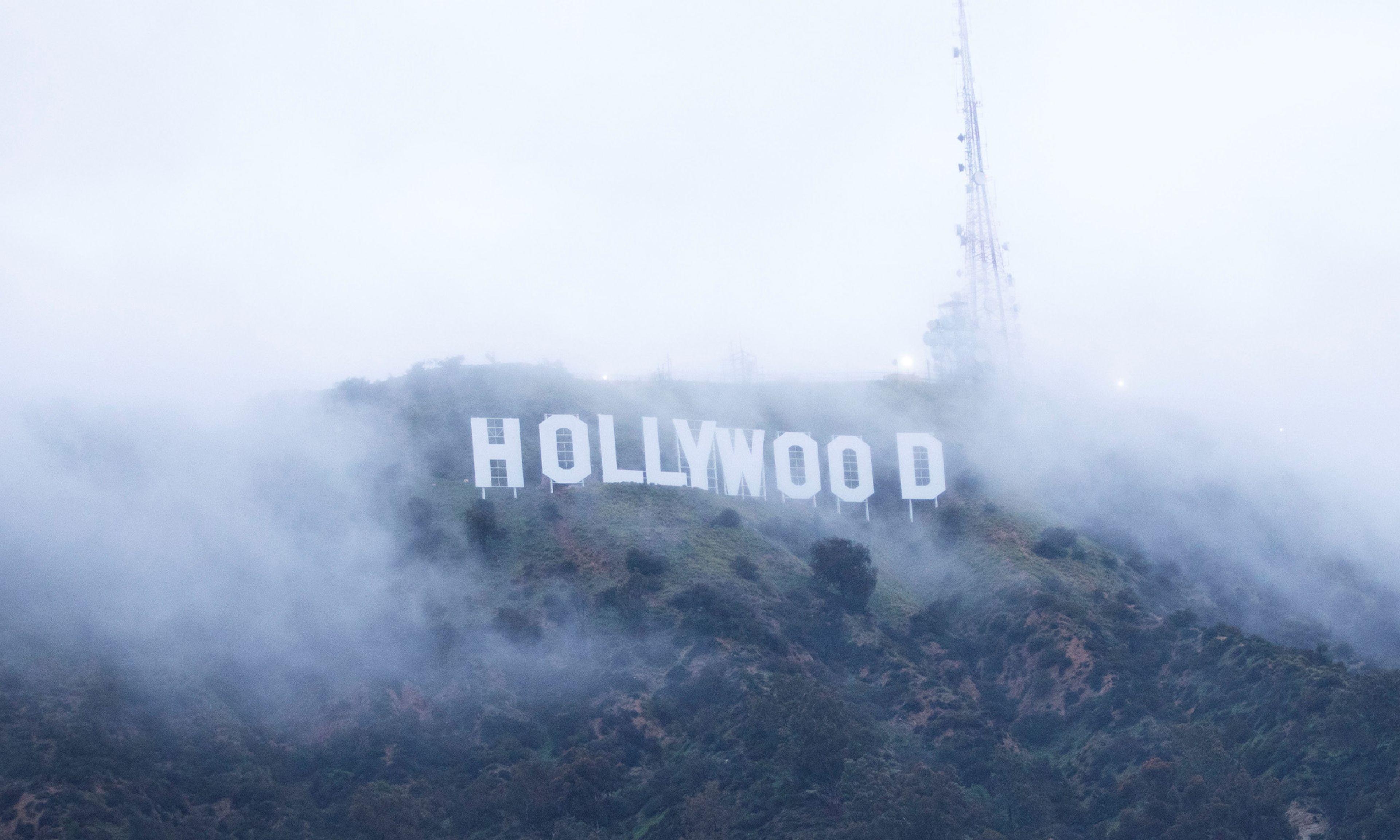
The existence of a “Hollywood novel” genre seems paradoxical; from its inception, the motion-picture industry — along with its offspring, television — has worked diligently to draw eyes away from the printed page. Yet Hollywood casts certain aspects of the human condition in stark relief. Money, power, sex, beauty, popularity, and (on occasion) creative excellence are pursued with singular focus in Tinseltown, with self-immolation a potential side effect. This is low-hanging fruit for novelists.
Kicking off in earnest with Nathanael West’s pitch-black The Day of the Locust in 1939, the Hollywood-themed literary genre has seen contributions from F. Scott Fitzgerald, Norman Mailer, Joan Didion, Eve Babitz, Gore Vidal, and Michael Tolkin, among others. To that list we can now add City of Blows, by Tim Blake Nelson and City of Angles, by Jonathan Leaf. Both men, accomplished in other creative fields, make their debuts here as novelists.
It is fitting that Nelson, a well-regarded actor, director, screenwriter, and playwright, has become a staple in Coen-brothers films, for the details of his life could have been crafted by the Coens. A former classics scholar and scion of a prominent Jewish family from Tulsa, Okla., he is equally conversant in cowboy culture, oil wildcatting, Sophocles, the Stanislavsky method, and Talmudic debate. If the first rule of being an interesting writer is to be an interesting person, he is well ahead of the pack, and perhaps for this reason he has broken the actor-author curse. City of Blows reads like a third or fourth novel by someone who does this for a living. The principal characters — earnest auteur David Levit (a Nelson stand-in), old-school industry curmudgeon Jacob Rosenthal, troubled upstart Brad Shlansky, and predatory agent Paul Aiello — are deep and alive. The central story, of a contested attempt on the eve of the Covid lockdowns to adapt and film a controversial race-themed novel called “Coal,” emerges organically, its tone alternating between darkly humorous and tragic. And the book’s climactic showdown between those four characters is startling. Much hangs in the balance: Will Levit finally direct the game-changing picture he has been striving toward for decades? Will Rosenthal, the film’s strong-willed producer, succeed in shepherding the idea to reality without getting everyone figuratively and literally killed? Will the emotionally damaged Shlansky, a desperate striver who has pinned all of his existential hopes on a Hollywood career, derail the whole enterprise? Will the equally volatile Aiello use the katana he ostentatiously carries around his office? Is the world even ready for a movie like Coal? And in the unlikely event it is, is it ready for a movie like Coal helmed by two Jewish-American filmmakers?
One of Nelson’s chief strengths is his willingness to interrogate received wisdom; he has stated in interviews that the character of Rex Patterson, the restlessly brilliant author of Coal, is inspired in part by heterodox black intellectuals Thomas Sowell, Glenn Loury, and John McWhorter: unconventional literary models to say the least. In his pursuit of racial and economic hard truths, Patterson ultimately alienates whites, by speaking truth to power — and blacks, in crafting African-American characters as morally flawed as their white counterparts. And although Patterson is more of a spectral presence than a tangible character in the novel, Nelson’s sympathetic portrait of his struggle speaks to his admiration for Patterson’s real-world models, outsiders several times over. That sort of empathy and unencumbered curiosity applies to nearly all the characters and situations portrayed in City of Blows.
Which is not to say there are not structural headwinds. Profanity can be powerfully effective if deployed with precision, but not if it’s laid indiscriminately into the dialogue as a base layer of paint. Nelson is hardly alone in this tic, but given the overall excellence of his dialogue, it’s frustrating — like hearing a great speech whose flow is broken by too many “uhs” and “ums.” The final third of the book also falters from a late-emerging compulsion to stuff the narrative with as many hot-button issues as it can bear. Readers may experience whiplash from the Me Too subplot that seemingly flies out of nowhere, and from the zeitgeist-clutching soliloquies on all manner of 2020s-vintage topics that explode from characters’ mouths like land mines — a development out of step with the carefully crafted earlier chapters. One example: After largely avoiding partisan politics for the first 414 pages of the book, Nelson inserts a Trump rant that threatens to date the material just as a Nixon rant would have time-stamped something from the ’70s.
The key word here is falters. Yes, in a perfect world, Nelson would have held some of these ideas back for a subsequent work. But his exploration of each is never less than fascinating. The Me Too material is harrowing and feels authentic. Even the expendable Trump monologue is intriguing. In its simultaneous pandering to the baser appetites of the masses and in its condescension toward those same masses with relentless “do as I say but not as I do” virtue-signaling, it holds Hollywood culpable for the recent ascent of angry populist politics in our country. And to add further complexity to the nesting-doll derangement of this scene, Nelson places this Network-style monologue in the mouth of serial rapist Aiello, an Iago type who, earlier on, sets the novel’s other strong-willed characters on their collision course with one another.
It’s a good sign when the throwaway material doesn’t exactly feel throwaway. Nelson could quit his day job tomorrow. And while that would be a loss to filmgoers, the literary world would gain something in this age of branding and algorithms: an unclassifiable and unsafe writer.
City of Angles, by journalist and acclaimed playwright Jonathan Leaf, is not quite at the level of its similarly named counterpart. It could be said that Leaf loses the overall war while winning many battles. But those wins are important. More than Nelson, he captures the place of Hollywood — that is, the geography, architecture, weather, flora. And he knows the movie industry’s rhythms, detailing with precision the elaborate dance of pitch meetings and audition callbacks. Most intriguingly, he explores the intersection of longing and opportunism in which spiritual cults take root, linking the mystery at the book’s center with a sci-fi-inflected religious organization that claims a major action-franchise star as an adherent. While Leaf is quick to distinguish his fictional Church of Life from the Church of Scientology, readers will naturally draw comparisons to the latter, and to other celebrity-centric spiritual groups and fads. His detailed depiction of the byzantine tiers of such organizations, and his not-unsympathetic portrayal of the people who get caught up in them, is one of his book’s strengths.
But City of Angles’s greatest strength — its central plot hook — is also its chief weakness. It’s the kind of hook that has you at hello: Aspiring actress Vincenza Morgan finds a dead body in the trunk of her car but proceeds with her previously scheduled audition, after which she drives around town, half wondering what to do about her uninvited cargo and half preoccupied with whether she made the cut in the new Reese Witherspoon film. This is, hands down, the single most brilliant set piece of either book, encapsulating just about everything either writer is trying to say about Hollywood. And it could have worked splendidly except that it’s just not believable that the sensitive, empathetic Vincenza could have gone on with her audition after discovering the body. Faye Greener from The Day of the Locust certainly could have. Nelson’s character Brad Shlansky could have. And either of Leaf’s other opportunistic actresses, Claire Hesper and Sara Kertesz, could have. But not Vincenza, not as Leaf has portrayed her. He does too good a job of connecting us with her inner life: her problematic relationship with her mother; her sincere desire to express herself meaningfully in film; her need for spiritual and emotional connection. Yes, like the other characters in the story, she is desperate to seize her angle (desperate enough to go in for cosmetic surgery), but not, in this reader’s view, desperate enough to walk away from a corpse. I sense that Leaf is too smart not to have grappled with this, but his conundrum is that neither Claire nor Sara could have carried the story, not unless Leaf had shifted his tone to something more along the lines of Locust. And would City of Angles work in such a style? I’m not sure.
In truth, City of Angles never quite settles on a tone. Whenever Vincenza is in frame, empathy punches through the satire. And Vincenza’s relationship with Billy Rosenberg — the hapless screenwriter who finds himself her unwitting benefactor — never quite coalesces. Leaf’s mastery of plot is not in question, but there is an impression throughout City of Angles that the needs of the characters are in conflict with the needs of that plot. Unlike City of Blows, the novel never adapts its plot to those needs; the two elements remain in tension.
Despite the noted flaws, both novels can be considered worthwhile additions to the Hollywood genre. And they take on added resonance because the rest of the world is coming to resemble the world portrayed in them, a process accelerated by social media and the attendant desire to “go viral,” to be an “influencer,” to be seen. Yes, influencer is the correct word here, but what kind of influence? The people jockeying for this power, in both the traditional media and the new Wild West of YouTube, Instagram, Twitter, and the like, are often willing to sacrifice their most human qualities to try to sate a hunger that ultimately can’t be sated. That frustrated desire gets passed on to the audience (the influenced), and the wheel keeps turning.
Yet in the midst of this desperation and spiritual vacuity, there are real-life David Levits, Rex Pattersons, and Vincenza Morgans at work — artists willing to subordinate their need for attention to the worthier goal of creating something true and lasting. We can count Tim Blake Nelson and Jonathan Leaf among them. Keep your day jobs, gentlemen; the screen and the stage need you. But also keep writing books. We will be richer for them.









Comments