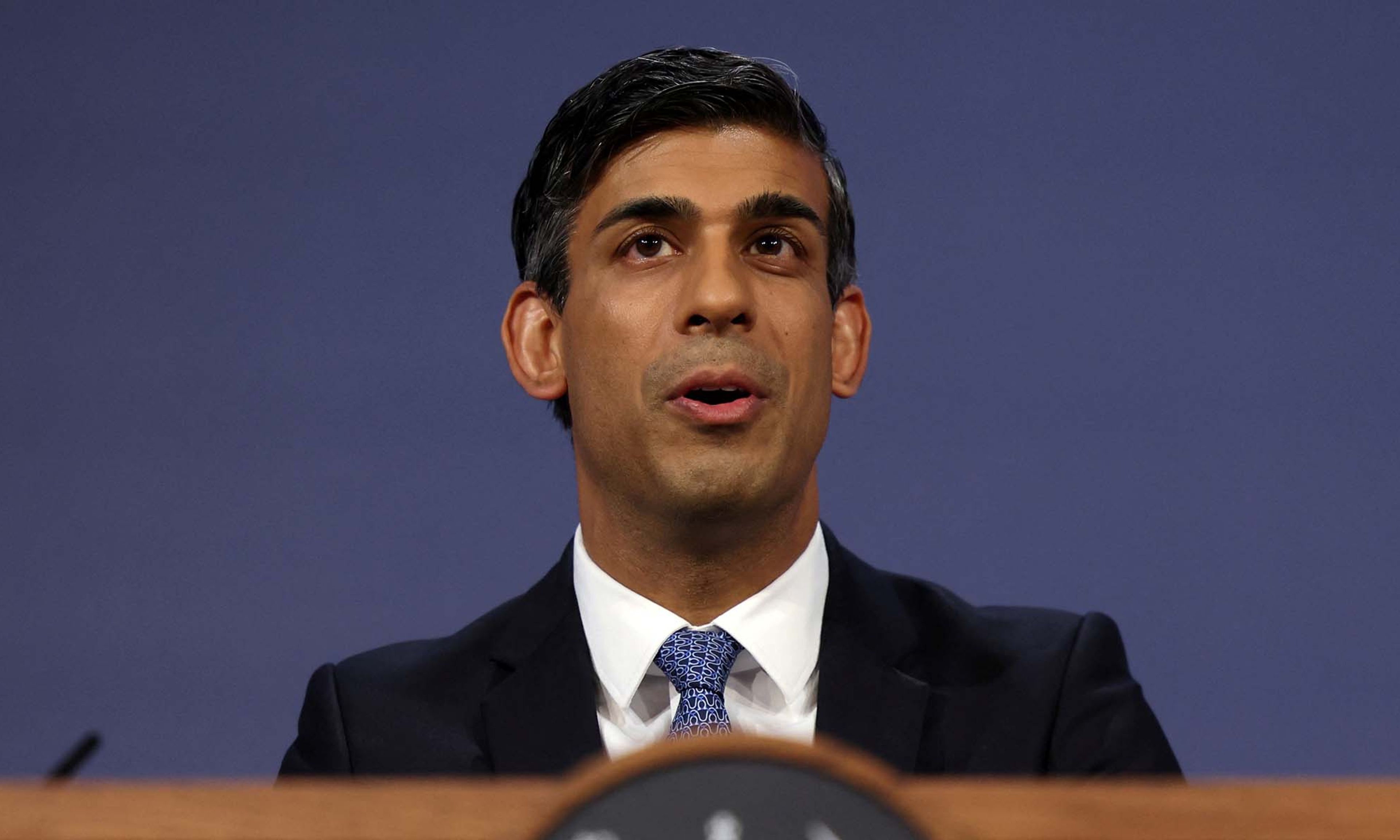
The first practical popularity test for Rishi Sunak’s post-Boris Tory government was held in the form of three by-elections (in U.S. English: special elections) in late July. The good news for the Tories was that their candidates lost only two of these three “safe seats.” These electoral swings, if repeated in a general election, would leave the party with about 100 MPs in Parliament. There are at present 354 Tory MPs in the House of Commons. They give Prime Minister Sunak a working majority of 60. Yet national polls show that the Tory Party’s current share of the vote is 26 percent, or almost 20 points behind Labour’s 45 percent. A far cry from Boris Johnson’s 2019 landslide.
But were the Tories daunted by the election results? Not nearly as much as they should have been. The reason is that they managed to cling onto the third seat, Uxbridge, with a majority slashed to a threadbare 495. Its local Tory candidate, Steve Tuckwell, saved it with a shrewd campaign of opposition to the expansion of ULEZ — London’s Ultra Low Emission Zone, which imposes high daily payments on petrol- and diesel-powered cars — to the city’s outer suburbs, including Uxbridge.
Altogether, the new national coalition that Johnson stitched together in 2019 to “get Brexit done” is fragmenting. The Tories have lost ground with all their constituencies — in some cases perhaps temporarily, but no other party has put together an equally dominant coalition. Unless one does, Britain is headed towards a hung Parliament. And as a result the Tories are headed for a historic defeat, even perhaps ceasing to exist as a national party, or, more likely, becoming the natural party of opposition — that is, losing most elections but winning occasionally whenever the natural party of government screws up.
The awkward truth is that they largely deserve such a fate. Here’s a laundry list — which could be longer — of reasons why:
First, Tory governments since 2010 and especially since 2019 have provided appallingly bad government. Only two substantial achievements stand out: education reforms that gave half of Britain’s schools a semi-independent “academy” status outside local-authority control, and “getting Brexit done” over and against strong resistance from most of Britain’s nonelected institutions — and the latter is not yet fully achieved. Their failures include inflation and the current cost-of-living crises; loss of control over tax policy leading to Britain’s most burdensome tax regime since the 1980s; acceptance of a flat or declining rate of productivity; an inability to control immigration, let alone to fulfill repeated promises to reduce it; an almost somnolent inability to respond effectively to wokeists’ subversion of national institutions and their attacks on British history and identity; the adoption of lockdown and anti-Covid measures that trampled over civil liberties, incurred enormous costs and indebtedness, and now look like major errors compared with earlier plans for epidemics that, as in Sweden, would have achieved more benefits with fewer costs; and much else. Not a proud record. And even when these policies were popular, as the lockdown undoubtedly was, the consequences were disastrous and thus eventually unpopular too.
Another factor that undermines support for the Tories is that the brief unity they showed in 2019 dissipated dramatically in 2022. Once the Johnson government ran into difficulties over its apparent breaking of its own anti-Covid regulations, an alliance of subversive Tory rebels and a hostile media mounted the “partygate” coup against Boris. This led to his ousting by orchestrated ministerial resignations, more divisions in the party, two leadership elections (one plainly in contravention of the party’s own rules), a second coup accompanied by signs that the Bank of England had shifted the blame for threatened market disasters caused by its own regulations onto Prime Minister Liz Truss’s proposals for tax cuts, and the emergence of a prime minister who had been rejected in a nationwide election by the Tory activists. Deep divisions thus remain underneath the superficial party unity at Westminster: one division between MPs and activists, and others between Boris loyalists, resentful Truss backers, and Sunak supporters whose admiring self-description as “the adults in the room” only increases the hostility of the first two groups.
Bad and divided governments don’t always lose elections, as the Spanish elections have just shown. All the same, that’s the way to bet. The Tories’ time of troubles, moreover, merely adds to the evidence of opinion polls and long-range social surveys that show their support falling disastrously, especially among younger voters. A study of party support even in the 2019 election showed that only in the 49-plus age cohort did the Tories plus the Brexit Party outpoll all the parties on the left side of the spectrum. And that disparity is steadily getting worse. As Eric Kaufmann, a political sociologist at Birkbeck College, told a London conference of the Danube Institute on “recovering conservatism” last month, the overriding reality seen repeatedly in surveys is that voters between the ages of 18 and 35 are massively unlikely to vote Tory. Only one in ten intends to do so.
That trend had set in even before 2010, when the Tories regained power. Their poor record in government cannot therefore be blamed wholly or even largely for it. Nor can it be attributed to specific social problems affecting the young — such as the difficulties they have in getting started in the U.K. housing market — which many Tories believe to be a main but remediable cause of their woes. Indeed, the vast disparity in support between the Tories and the Labour Party, the Liberal Democrats, and the Greens varies only slightly when we test it against orthodox assumptions on why different groups vote as they do.
As Kaufmann wrote in a recent UnHerd article:
Those who own their own home are five points more likely to vote Conservative than those who don’t, while young people in the top 15% of the income scale are two points more likely to say they will vote Tory than those in the bottom third. Even if you look at home-owning married 18-35s with children who earn in the top 15%, a mere 16% intend to vote for Sunak.
If traditional social markers of Toryism neither explain nor reduce the hostility of younger voters, what might do both? Kaufmann plumps for the zeitgeist or a “liberal post-national drift” among young British people, which is itself related to their indoctrination in schools and colleges with ideas of social justice and critical race theory (I would add gender theory, and the unholy trinity of diversity, equity, and inclusion). As Kaufmann points out in a study for the think tank Policy Exchange, these things are taught as incontestable facts or manifestly virtuous standpoints rather than as one among several possible interpretations of reality. That in turn produces an authoritarian moral hostility towards older or politically conservative people who presumably defend wrong ideas and practices of the past and may even have participated in them. It may surprise American readers that Kaufmann has concluded from his studies that British young people are even more influenced by the ideas and language of these doctrines than young Americans are. In both cases they are willing neither to date conservatives nor to debate them. Why waste time? Error has no rights. Nor, it seems, any sex appeal.
We don’t quite realize what those attitudes mean in politics or public life until something unpleasant happens to show us. In the same week as the three by-elections, it was leaked to the BBC that Coutts, an exceptionally “smart” bank — the late queen once remarked that its solvency was threatened by her mother’s overdraft — but today less glamorously a subsidiary of NatWest, had informed Nigel Farage that his account was closed, hinting that the reason was financial. That elicited much glee from the chattering classes who despise the cheerful Brexiteer, and it might have been an embarrassment to Farage if he had not gone on the attack, argued that it was seriously improper for Coutts to leak confidential information about clients, and demanded to see the internal discussions leading to his account’s proposed cancellation.
The documents, which he published, showed that the bank had lied in saying his account was being closed on financial grounds. In fact, Coutts had secretly compiled a 40-page dossier, full of wokeist clichés, on Farage’s political life from school onwards to show that it would suffer “reputational risk” from being associated with him since he didn’t align with its “inclusive” values. This was both sinister and comic. Almost no one knew that Farage had a Coutts account until the bank leaked its cancellation to the BBC; the excuse of inclusiveness given to justify excluding someone whose views are shared by half the country exposed the hypocrisy of the bank’s unaccountable power; and as the truth gradually emerged, Coutts rather than Farage suffered from “reputational” damage. NatWest’s CEO and the BBC have apologized to Farage, and they may face worse consequences, including resignations and lawsuits, down the road since many other people have apparently had their bank accounts canceled for similar reasons.
To judge from the media, public opinion seems to approve strongly of this outcome. Still, that approval is not quite universal. Labour spokesmen have refused to criticize the actions of Coutts, and Twitter is full of “progressive” tweets denouncing Farage and declaring with relish that right-wing people should be deprived of bank accounts and other services that make their lives liveable and their political activities possible.
This episode has been a window into a future in which social and economic institutions, not excluding the courts and law enforcement, are administered in accordance with DEI and ESG rules and who knows what other abbreviations. That may be why, politically speaking, ministers have shown unusual energy in denouncing the banks and promising new regulations to protect bank clients (and presumably the clients of other businesses) from discrimination on political grounds. Tory politicians may have a direct interest in such liberal principles and civil protections in the very near future. As Dr. Johnson remarked, nothing concentrates the mind so wonderfully as the prospect of being hanged in a fortnight.
That same principle may explain why the Tories in the aftermath of the by-elections suddenly grasped that delaying or diluting ULEZ might become a serviceable national political issue as well as a local one. That insight could extend not only to other “green” issues — net zero, of course, and ESG — and to CRT, DEI, and gender theory, but also to “15-minute cities” and all those other little local schemes that get adopted in international forums and slipped into law with little or no prior public discussion until one day the council workmen appear in your quiet suburban street and start building anti-traffic barricades or removing gas heaters. In their current desperation, the Tories are turning their minds to these issues when so many others, for instance tax cuts, are closed off by the nonideological conservatism of the adults in the room.
It’s a tempting strategy, but there are formidable obstacles. One is that many of these policies were introduced with great fanfare by the Tories themselves, often to “dish the Whigs” (i.e., to troll the libs). Boris in an earlier incarnation as London’s mayor introduced ULEZ, for instance, and later as PM he made net zero his personal crusade. People remember those things; the politicians who launched them had better have good explanations for changing their minds. Moreover, all recent U.K. governments have fostered a national belief in the overriding necessity to combat the climate-change emergency and save the universe. Not only has that pumped up fiery young zealots of the environmental group Extinction Rebellion; it has also persuaded the respectable middle class, including judges and chief constables, that they have no moral right to punish lawbreaking protesters or not to enforce the various global promises to cut carbon emissions. It is the working and lower middle classes, close to reality and not indissolubly wedded to their previous ideological convictions, who are likely to oppose policies that impose heavy economic costs on them without achieving any of their supposed benefits. Already we can see the germs of a class war around these issues in the fights developing between green zealots blocking the roads and people who have to get to work.
If such a clash broadens into other issues — essentially a struggle between an energetic, confident, and practical nation and a fearful, self-doubting, and passive one, the Tories have to choose the first. They are already hated by the second. And to prevail in such a struggle, the Tories would have to wage the kind of ambitious cultural war that they have been avoiding since David Cameron or indeed since Margaret Thatcher. Nor need they make a hard choice between cultural conservatism and free-market liberalism, as some distinguished commentators such as Matthew Goodwin argue (in his case, the choice is for cultural conservatism). Theoretically, free markets need strong families and the vigorous virtues in order to achieve a stable prosperity that in turn makes virtue easier to sustain. Practically, for more than a hundred years after Disraeli, the Tory Party managed to combine the two approaches and to retain both constituencies by adept political skills. As the late Labour politician Denis Healey remarked (rightly) when arguing (wrongly) that socialism had to be honestly funded: “If you can’t ride two horses at once, you shouldn’t be in the bloody circus.”
Does Rishi Sunak have the skills to lead such a party? The jury has to be out on that. On green issues, leaks depict him as “uninterested” rather than “hostile.” But that may be because, sensibly enough, he sees no practical way of achieving most of the goals of the extremist green movement and a great many ways of causing havoc while trying. He entered office with a reputation as a Thatcherite, a Leaver, and a social conservative. But he presides over a government following policies of high taxation and weak incentives; he seems to be mending fences with the EU rather than taking advantage of Brexit freedoms; and the most politically significant item in his government’s budget was to complete the transfer of child care from the family to the state’s welfare bureaucracy. But how much control does he have over his chancellor, a more progressive brand of Tory, who helped him into Downing Street and who enjoys some independent authority as a result? Sunak’s own priorities include both socially conservative ones (stopping the boats, parental rights) and economically Thatcherite ones as well (slowing inflation, increasing productivity). Or is he a technocrat, pragmatic and deaf to general theory? Or a patient and reasonable man who is trying to do the best thing in the midst of many highly unreasonable people?
To most Brits he is still an international man of mystery, quite popular but an unknown quantity. He therefore still has the opportunity to define himself politically, and an occasion to do so — his speech to the Tory Party conference in October. It is vital that he be clear and convincing.
Oddly, despite all the flaws and failings surrounding the Tory Party as an organization, conservatism in Britain, as in America, is experiencing a burst of intellectual debate and fertility of ideas, with new magazines, new think tanks, new factions, and new large audiences of smart young people. More than one-third of the attendees at a recent National Conservatism conference who filled a large hall throughout three full days to listen to serious political arguments were under 30, many of them students. If Rishi Sunak can capture their attention and loyalty with a bold vision of his own, the revival of conservatism and the recovery of the Tory Party are not beyond the art of the possible.
But it will probably happen in opposition.










Comments