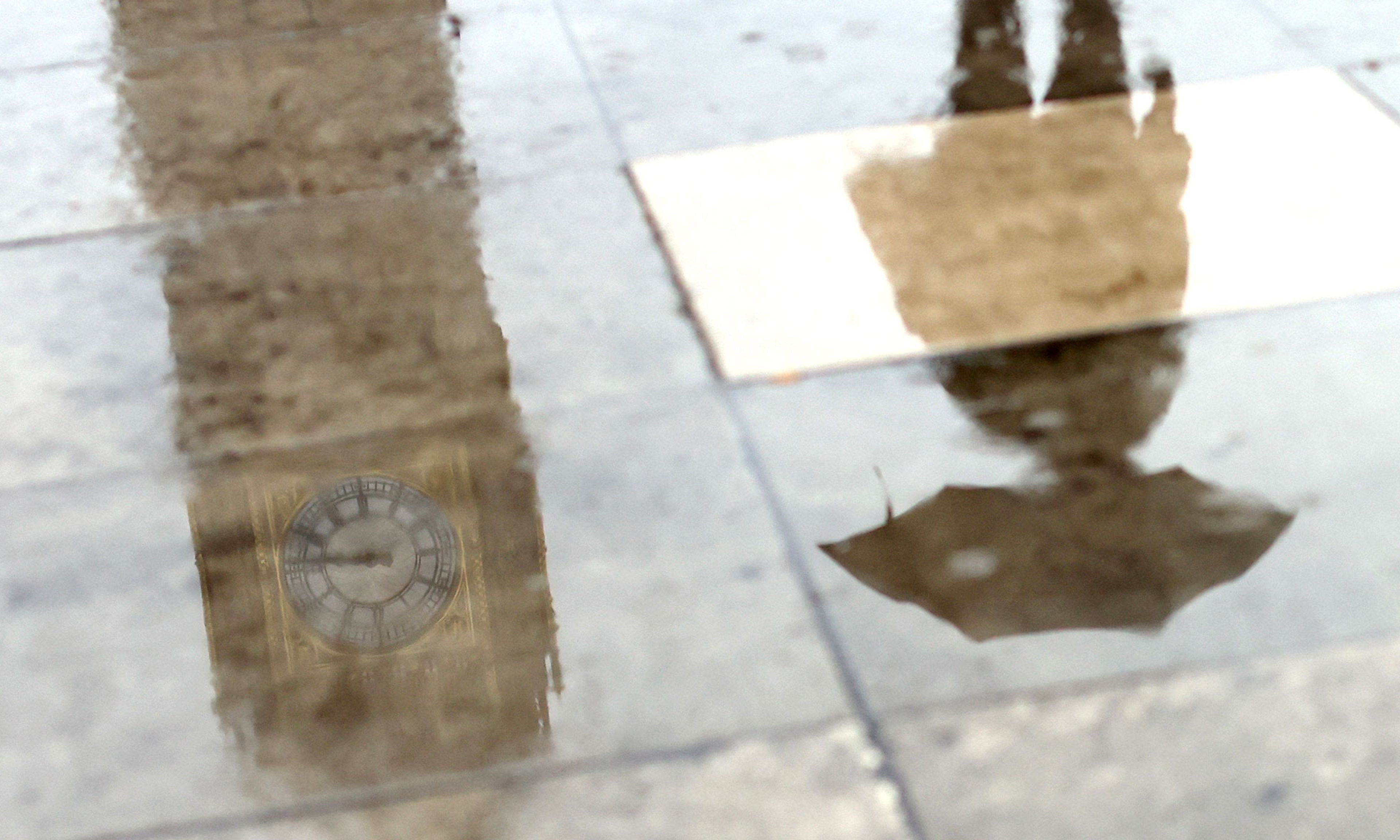
I was arriving early for a dinner appointment in midtown. The cabbie made a wrong turn several blocks away, so I got out to walk. The sun was leaning over the Hudson and a skyful of coastal clouds marched over the island. One I noticed was much larger than the size of a man’s hand.
Touches, stains: That cloud began to unleash itself in propulsive drops. A big ugly modern office building offered a sheltering porch, tall but deep. Unless the rain blew horizontally we would be fine in here.
“We” were a growing crowd of rain refugees. The first claim staker was a white-haired lady smoking a cigarette. These days a smoker in the city is odd enough to draw attention. Maybe she had fallen asleep, a brunette, in the Lindsay administration. We were joined by a young woman, zipped up in a windbreaker, standing silently by herself; by a UPS guy in his dress browns, pushing a handtruck of packages; by guys from the building leaving work late, their heads and their Blueteeth turning this way and that.
I was unprepared. I long ago gave up buying good umbrellas because I always lose them — to cabs, to coat-check girls, to the dark aisles of movie houses. Instead I steal them from my wife — small colorful numbers, in zebra stripes or leopard spots; or I buy cheap black junkers from holes-in-the-wall run by Africans: After a few good gusts they break their backs and die in a garbage can while I buy another. But I had brought no umbrella with me. Nor had I taken a raincoat. The hot, humid weather that produces thunderstorms is just the kind that makes wearing or carrying a raincoat hateful. I took an inventory of my clothing: a light linen sport coat; a short-sleeved linen shirt; light linen pants; socks; driving shoes (and of course gatkes, though hopefully they wouldn’t come into play). Not much in the way of useful rain gear. I was not even carrying a tabloid, so I couldn’t make a paper hat. But I still had time to watch and wait.
Various comrades, more pressed, braved the elements. A woman in a white blouse and some bright skirt saw a cab coming along the cross street, improbably vacant. She dashed out, waved and shouted, snagged it: well done. A young man in his office suit tried his luck with the traffic surging down the avenue. It was not to be. The cabs, full and indifferent, passed him by. He tried sheltering himself by hitching his jacket up over his head. In half a minute it was streaming like a fisherman’s slicker in Winslow Homer. Better luck next downpour. Pedestrians dressed down for the season did all right: A big guy in board shorts and an armless T skipped across the intersection in flip-flops. A woman in a blue sun (sic) dress plodded along stoically, resigned to fate.
These summer thunderstorms in the city can be intense. Judging by the splash patterns on the street, the rain swept by in sheets; sometimes the sheets curled like dragons. The bounceback of water from hard surfaces added an extra little mist. Every edge in the pavement became a gutter, every gutter was a gorge. The expression “raining cats and dogs” supposedly comes from the dead feral animals that would be flushed down the streets of early modern cities. Trash collection and the ASPCA have spared us the cargo, but the flow now still sufficed. Summer storms, though, can be as short as they are sharp. These are not the long baths, life-giving or dismal, of spring or fall. I had noticed that the sky was not deeply dark. A man in our cave who had an umbrella decided to walk on. He picked a course along the lee of our building, with a few slim projections overhead. He made a reasonable calculation. Unprotected, I stayed put; no sense risking everything in the bravado of imitation.
Besides, I was waiting for something. Thanks to climate and location, the city lies under wonderful skies. A few weeks earlier I had had occasion to take the Staten Island ferry. The sun hid behind a cloud and sent out rays like God making some grand undecipherable gesture. The only words to describe the sight were those of the old carol: “and glory shone around.” Tourists crowded the rail and snapped pictures of New Jersey as if it were the Grand Canyon. And well they might. On dry land the buildings block out big chunks of the view, but they also lead the eye up, to the unfolding show.
When the sun shines after it rains, there comes a sign that Jews and other primitive peoples believed they could decipher. My wife had to analyze the Book of Genesis for her most recent book, and I read it along with her. The Bible is right to put it first for many reasons, not least its unstinting record of cussedness: murder and perversion, of course, but also stubbornness, envy, and trickery. Nor is God spotless: He plays favorites, sets up people to fail, changes His mind. The Flood is one of His characteristic moments: the act of a brilliant parvenu, Michael Bloomberg or Rupert Murdoch, imaginative and vulgar: “Let’s start over.” Then, when the waters recede, He adds the rainbow, the gesture that almost makes us forgive Him. “There will be child murderers and Hitlers — those will be your fault; there will also be tornadoes, dementia, and cancers, which you might try to pin on Me. But I won’t do this again. I promise.”
Just as the rain stopped, down the cross street in the slice between buildings I saw a section of the colored arc. I wanted to tell the UPS guy, but he had gone. So I went over to the silent young woman, who had unzipped her windbreaker. “Look — a rainbow.”
“That is so cool. Thank you.”
We went our ways.











Comments