Pensacola, Fla.
‘If Americans don’t start eating seafood again,” Frank Patti tells me, “we’re lost.” His massive warehouse-size market on the edge of Pensacola Bay in the Florida panhandle is packed with fish and shellfish, but customers just aren’t showing up. Despite his many assurances that the merchandise is safe (here and there little tags proclaim “All shrimp from Caribbean and East Coast”), sales are down 50 percent compared with this time last year.
Joe Patti’s Seafood is a Pensacola institution. Started by Frank’s father, a Sicilian fisherman, and his wife in the depths of the Great Depression, this mom-and-pop business once sold only local seafood, much of it caught with the company’s own vessels. “When that fella from Georgia was president — what the hell was his name? — we had 18 super-trawlers in this fleet,” croaks Patti, thumping his desk for emphasis.
Now Patti’s fleet has just one trawler (which is currently on loan to the Coast Guard), but the business has grown to over $15 million in annual sales. Between restrictions on net-fishing close to U.S. shores and modern technology that enables fishermen to freeze their catch on board and transport it anywhere in the world, Joe Patti’s no longer fishes most of what it sells. Instead, it buys the bulk of its stock from international brokers while the catch is still far out at sea.
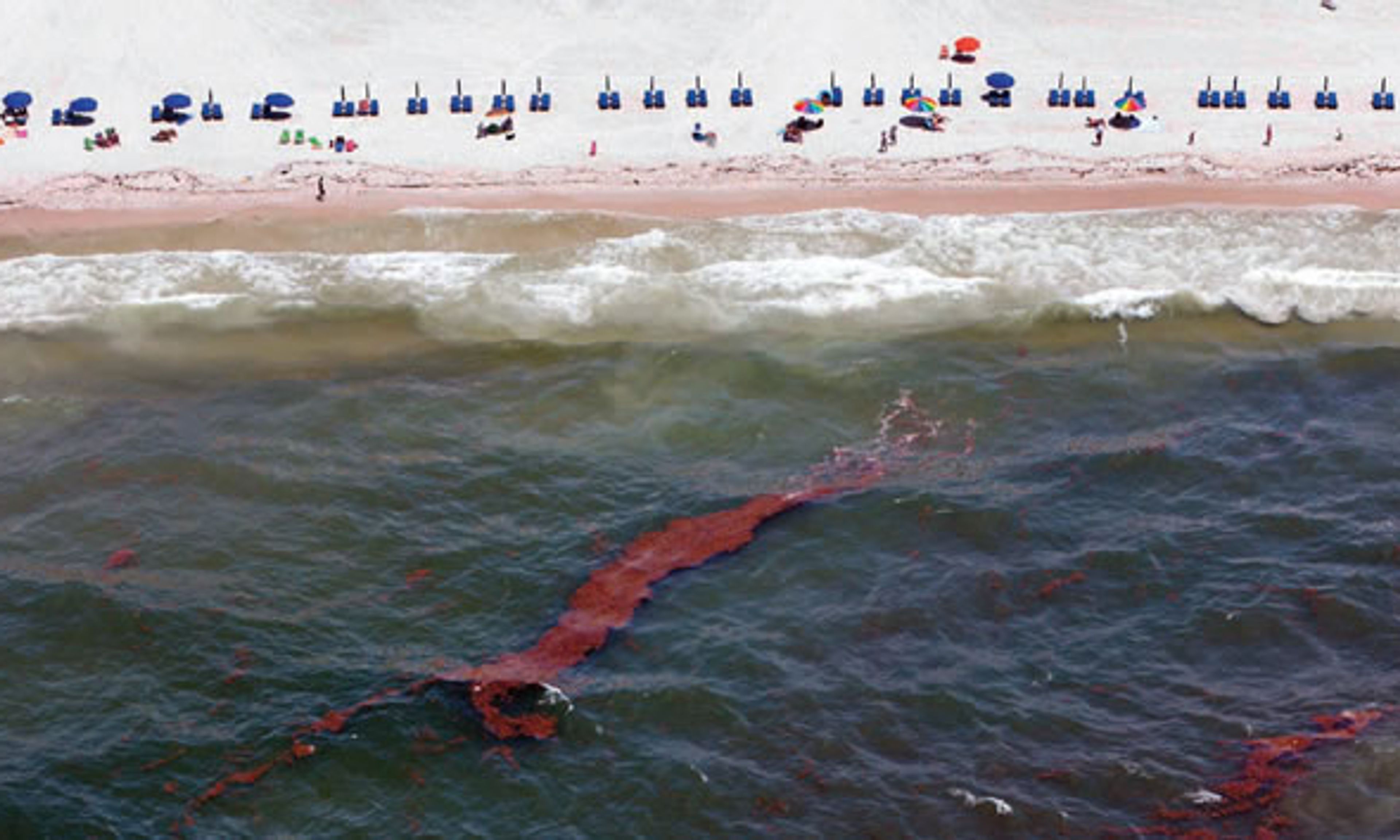
I had a chance to visit with Captain Frank (as locals call him) just a few days after part of an oil slick washed up on Pensacola Beach — the BP spill’s first landfall in Florida. By the time I got to Pensacola, the beach had already been cleaned, and not a speck of oil was visible on the sand or in the water. Yet although this gargantuan spill had barely touched Florida, it was already devastating the state’s economy.
The fate of businesses like Patti’s could have far-reaching legal implications. Frank Patti has filed a claim for economic damages against BP under the federal Oil Pollution Act, but it is far from clear that his claim is legally valid. Claims for lost income are compensable only when the loss “results from” some particular damage to property or natural resources as a result of an oil spill. Read narrowly, the law would not cover most of the claims in Florida, because Florida has so far suffered very little physical damage. Read broadly, the law could extend BP’s liability to the ends of the earth.
The uncertainty surrounding BP’s liability is just one consequence of the flawed regulatory scheme that was in place when the disaster struck. Now President Obama faces two challenges: He needs to get the emergency response right, and he needs to fix the legal framework that governs offshore drilling. On both fronts, he has paid close attention to immediate political expedience; but on the emergency response, he conveys little sense of command, while on the policy front, he shows scant appreciation of practical consequences, immediate or long-term. That is worrisome, because the long-term impact of the BP spill is increasingly up to Obama. Even if BP’s latest attempt to cap the well, which was being tested at press time, is a success, these issues will remain.
In January 2010, the semi-submersible Deepwater Horizon rig took over drilling in the Macondo field, about 50 miles southeast of Grand Isle, La., after another rig was damaged in a hurricane and had to be towed away. Drilling around the clock into sheer rock, it finally reached a massive reservoir of porous sediment, saturated with oil and natural gas, three miles below the ocean floor in the middle of April. At this point, the workers had just one more task to accomplish: cementing the well.
When a rig drills down toward an oil reservoir, the drill bit creates a ragged hole somewhat wider than the drill pipe. While this is happening, a special fluid (known as “mud” in industry jargon) is pushed down through the pipe to cool and lubricate the drill bit and carry away drill cuttings. The mud rises back to the surface along the outside of the well pipe. Once the reservoir is reached and the drilling is complete, cement is poured down to the bottom of the well, and follows the drilling mud back up the outside of the pipe. The cement is then allowed to set, permanently encasing the well pipe, with a cement plug at the bottom that will be drilled through when the production rig comes along to start pumping oil and gas.
Even for the deepest wells, cementing takes only a few hours, but it is the trickiest phase in the life cycle of a well. Oil and gas deposits in a reservoir miles below the surface are typically under enormous pressure, at temperatures reaching several hundred degrees Fahrenheit. During the months of drilling, there is virtually no danger of an accidental spill, because you’re drilling into sheer rock. During the years (and often decades) of production, there is also little danger of a spill, because the production well is designed to relieve the pressure in the reservoir by allowing gas and oil to rise to the surface, where it is collected.
But during the cementing phase, it is necessary to counteract the pressure in the reservoir, and the exact pressure cannot be known. Engineers have invented a series of fail-safes to ensure that nothing goes wrong, and those safety measures have always worked — in more than 42,000 offshore wells drilled in American waters in the Gulf of Mexico, including thousands of deep-sea wells, there has never been an oil spill when all safety procedures were followed.
The Deepwater Horizon, however, had started behind schedule, so BP decided to use a riskier single-bore drill pipe to drill faster. And when cementing finally began at the Macondo field, the corner-cutting continued. Some safety procedures were not followed exactly, while others were followed but failed to work. Inconclusive tests on the stability of the cement were ignored. A backup cement plug was skipped. What combination of these ill-considered decisions contributed to the accident may never be known.
What we do know is that shortly after sunset on April 20, the massive blowout preventer resting on the ocean floor failed to stop a dangerous gas leak, and seconds later, seawater and mud began spewing violently from the top of the drill rig. Workers rushed to prevent a calamitous blowout, but a short while later the gas ignited and a massive explosion engulfed the rig. Eleven rig workers were killed, and 17 injured.
Emergency responders fought the fire for two days, to no avail. On April 22 the charred rig collapsed through its pontoons, sinking all the way to the bottom of the sea. The mile-long “riser” pipe, which had connected the top of the subsea blowout preventer with the floating rig, now lay in a crumpled tangle on the ocean floor, leaking oil and gas in three places.
As it dawned on the White House that a catastrophic spill was occurring, the National Contingency Plan swung into action. In response to the Exxon Valdez spill off the Alaska coast in 1989, Congress had passed the Oil Pollution Act, which required the Coast Guard to lead the development of various regional contingency plans for oil spills in coastal waters, coordinating with state and local authorities. Unfortunately, while the Coast Guard’s “incident commander” trumps state and local authorities, there is little guidance on resolving interagency conflicts at the federal level — for example, between the Coast Guard and the Environmental Protection Agency, which has incident jurisdiction for inland zones and issues permits for response operations. The absence of a single central authority produced agonizing delays and conflicting decisions.
In Louisiana, Gov. Bobby Jindal’s early appeals — to declare a fisheries failure, permit dredging for massive sand berms to protect coastal islands, and provide desperately needed equipment — went unanswered by federal bureaucrats for weeks. After President Obama intervened in early June, the Army Corps of Engineers quickly approved Louisiana’s dredging plan, but it had already been three weeks since the state’s initial permit application. Moreover, just a few weeks later, with oil slicks assailing more than 150 miles of Louisiana coastline, the Corps of Engineers revoked the permit and halted the operation, apparently because of misplaced concerns about the exact location of the dredging, soil erosion on islands that were already submerged, and the habitat of birds that had not nested in the area for years.
The federal response has also been warped by the Obama administration’s desire to please political constituencies. Bowing to his labor-union base, President Obama still has not waived the Jones Act, which bars ships with non-American crews from coastal shipping, despite the significant assistance that foreign ships could provide if they were temporarily allowed to ply our coastal waters. In the space of two weeks in May, the Environmental Protection Agency granted BP permission to use a powerful chemical dispersant on the spill, then revoked it at the behest of environmentalists, and then granted it again. It has even refused to modify pollution standards that prohibit many skimmers from participating in the cleanup because their discharged water isn’t pristine enough.
Louisiana governor Bobby Jindal is nearly apoplectic at what he sees as a lack of urgency in the federal response. After a recent visit by Vice President Joe Biden, I catch up with Jindal at a hastily called press conference on the outskirts of New Orleans. He reels off a lengthy catalogue of grievances as if he were speed-reading aloud. “We’re fighting for our way of life,” he concludes, almost breathless. The federal government needs to get into “this war” to win it.
Jindal’s frustrations with the federal authorities continue. He is now pushing for permits to lay rock barriers at strategic points to protect the coast. The federal agencies are blocking the plan out of environmental concerns that Jindal has called misguided and misinformed. He points out that the feds have a pattern of preventing state moves without proposing alternatives.
At the Coast Guard’s command post in Houma, an hour south of New Orleans, Capt. Roger Laferriere, the incident commander for the Louisiana sector, seems a bit unsettled by the political crossfire but quite at home in the tactical operations of an emergency spill response. Laferriere, a veteran of numerous oil spills, explains that there are three main weapons for dealing with the Gulf spill: skimmers, fire-booming (also called “in situ burning”), and chemical dispersants. I ask him to explain the apparent contradiction between using skimmers and booms, which seek to capture and dispose of oil at the ocean surface, and dispersants, which (as the name suggests) seek to break the oil up into droplets, which then mix with the Gulf’s waters.
“Ah,” he says, smiling at the chance to discuss something technical. The answer lies in the highly heterogeneous composition of the spill. He directs me to a satellite map in the command center. Nearly all of what looks like the Gulf spill to a satellite is actually just an oily sheen less than one-tenth of a millimeter thick. Oil spread out to such microscopic thinness is already in a rapid process of degradation, by sunlight, water movement, oil-eating bacteria, and natural miscibility — and oil thinly spread out over great expanses of ocean really can’t be cleaned up.
So the Coast Guard focuses its resources on the worst part of the problem: the congealed slicks of thick oil. Often several miles long, hundreds of yards wide, and several feet thick, these floating islands of viscous crude, which typically have the consistency of peanut butter, are a severe threat to coastal environments. When such an oil slick starts approaching landfall, the Coast Guard attacks with everything it’s got, breaking up whatever oil it can’t remove.
Despite these efforts, oil slicks have washed up onshore in four states. Perhaps a cataclysm of this magnitude would have overwhelmed even the smartest and best-executed strategy, given the resources available. But the president gives little sense of having a handle on the situation; he is nowhere to be seen, except in brief photo-ops, and neither he nor anybody else appears to be in actual command of the overall federal response. When Coast Guard admiral James Watson was recently relieved of his post as federal on-scene coordinator, no explanation was given, but the explanation may not be hard to divine: No “coordinator” can suffice where a commander is needed.
While Obama has been mostly absent from the site of the emergency, he has been dangerously busy on the policy front. As he said in his Oval Office address, the crisis is an incentive to end “America’s century-long addiction to fossil fuels.” Comprehensive energy and climate legislation has been part of Obama’s green policy ever since he ran for senator, and it’s no surprise that he is using the BP spill as an excuse to renew his push for it, particularly the cap-and-trade scheme.
What is more startling is that, judging by appearances at least, Obama may be trying to advance his agenda by intentionally causing a fuel shortage. The moratorium on offshore drilling; the browbeating of BP into disgorging assets regardless of actual liability; the EPA’s unjustifiable quashing of licenses for most of the refineries in Texas, supposedly over air-pollution concerns; the Interior Department’s failure to process license renewals for a slew of shallow-water wells, which are much less tricky than those in deep water — all these actions bespeak a desire to create a hostile regulatory environment for oil extraction.
Many of Obama’s supporters — those at the Brookings Institution, for example — seem to think that a severe oil shortage is precisely what we need to save the environment and kick-start the transition to green energy. Governor Jindal tells me that when he complained to Obama about the impact of the offshore-drilling moratorium on Louisiana’s jobs and businesses, the president suggested, apparently in all seriousness, that the losses caused by his moratorium could be compensated from the $20 billion BP spill-liability fund that he had just seized control of.
“We don’t want handouts in Louisiana,” says Jindal. “Louisianans are hard workers. We want to get back to work.” He calls the moratorium a “second man-made disaster.” One reason for Jindal’s complaint is that the moratorium is completely undiscriminating in its sweep. Among other things, it halted ongoing exploratory drilling on 100 existing deep-sea projects (defining “deep sea” as anything below 500 feet, though the spill occurred in more than 5,000 feet of water), prohibited all new drilling below 500 feet, and suspended the planned lease-sales for major new oil fields near Virginia and in the western Gulf.
The moratorium was thrown out of federal district court in June, a ruling that has been upheld on appeal by the Fifth Circuit, and with good reason: There is simply no scientific justification for halting drilling on all existing and future projects without considering their stage of completion. During the months that a deep-sea rig spends drilling into sheer rock, before it has reached the potential reservoir of oil and gas, there is virtually no danger of a blowout triggering an oil spill. If the administration were focused on safety, it would let drilling proceed to the steps just before completion and then let the well be capped if need be.
But for the time being, the legality of the moratorium is academic. The administration has issued a new moratorium that replaces the arbitrary 500-foot limit on permissible drilling with a ban on all floating drill rigs. This actually expands the moratorium, because floating rigs are almost universally used for drilling in waters more than 300 feet deep. In any case, given all this uncertainty, drilling will remain suspended. The administration has effectively shut down offshore drilling, and there isn’t a thing any court can do about it until the litigation fully runs its course next year. And every day that a drilling rig sits idle costs its operator between $250,000 and $1 million.
Many of the exploration and production companies that have leased drilling rigs have already invoked force majeure clauses in their contracts to get out of the leases. The moratorium will therefore hit particular slices of the oil industry disproportionately: The big oil companies that actually develop the wells will be spared, while owners of drilling rigs, and contractors that service drilling operations, could soon be facing bankruptcy. Many drilling assets will move to other parts of the world, perhaps permanently; rigs have already left the Gulf for Egypt and Congo. In the words of a former Shell CFO, “You are beginning to destroy the infrastructure of offshore drilling in the Gulf of Mexico.”
A third of America’s domestic crude oil — and most of the Gulf’s oil — comes from wells that are “deep water,” using the administration’s definition. The moratorium does not affect existing wells, but by freezing out virtually all new offshore wells, it will prevent some 200,000 barrels per day of output next year, and perhaps 340,000 barrels per day — 20 percent of total U.S. production — by 2015, with the amount increasing every year after that.
This turn in U.S. energy policy could not have come at a worse time. Decades of underinvestment in production, tanker, and refining capacity, followed by years of surging demand from emerging markets such as China and India, have created a dangerously volatile situation in the world oil market. Demand for oil shows very little elasticity along a wide range of prices — in other words, people will buy it even if it gets very expensive. Combine that with the frightfully small amount of spare capacity — in production, tankers, and refineries — and what you have is a recipe for “marginal scarcity pricing,” in which tiny swings in demand or supply can have a catastrophic impact on prices. This explains why a modest increase in global energy demand starting in 2002 caused gasoline prices to quadruple by 2008.
Left to their own devices, American oil companies tend to dampen these fluctuations. There is little love lost between them and OPEC, and when prices rise, they move quickly to invest in expanding production, thereby helping to lower world oil prices. As prices fall, the members of OPEC face a strong temptation to increase production to keep the cash rolling in, so cartel discipline collapses, further pushing down prices. This is what kept prices low during the 1980s and 1990s. The world’s private oil companies — of which a majority are American — are the greatest obstacles to the cartel discipline that OPEC needs in order to maximize profits by reducing supply.
Unfortunately, Obama’s policies — along with the perennial Democratic calls for windfall-profit taxes — create a great disincentive for companies to expand production. Their effect will be to increase America’s reliance on foreign sources of oil, already at 60 percent (which is especially ironic from an environmental point of view, since much more oil has been spilled by tankers than by oil rigs). So “if you’re talking to a Saudi friend in the oil business,” says the former Shell executive, “he’s pretty happy with Obama right now.” But perhaps the most unintended consequence of all is that rising oil prices will lead to dramatically increased profits for the oil companies — including BP.
Determining the scope of BP’s liability is another major problem. On one hand, University of Chicago law professor Richard Epstein is almost certainly right to argue that oil-drilling companies don’t deserve caps on liability, because such caps distort the economics of the actual risks involved. On the other, this isn’t Venezuela, and the president can’t just toss out the law of the land whenever it suits his fancy.
Sen. Bob Menendez recently secured Senate passage of a bill to lift the $75 million cap on liability — retroactive to April 15, 2010, a week before the Deepwater Horizon sank. This brazen ex post facto alteration of vested private rights is open to all sorts of constitutional challenge, not least the prohibition on bills of attainder. But the Menendez measure is superfluous: It seems fairly clear that BP was grossly negligent in causing the spill, in which case the $75 million cap doesn’t apply to it anyway. The main effect of such measures is to undermine confidence in our legal system.
One fatal problem with the Oil Pollution Act’s liability scheme, says Epstein, is that the U.S. government is not liable for damages arising from its own involvement, including those that result from a failure to act. “The difficulty you get with these government actions is that they don’t take into account the losses they could have prevented but didn’t,” he says. The government has little incentive to minimize BP’s losses, since if the government makes mistakes, BP pays for them. Admittedly, the government has a strong political incentive to fix the problem, but in cases where the damage is not conspicuous (e.g., secondary economic effects as opposed to tar balls on a beach), or where the government can shift the blame or write off a particular region, that incentive is weaker.
Then there’s the question of who is entitled to claim compensation, and for what losses. The Oil Pollution Act appears to define the categories of liability narrowly. The most potentially contentious category is the one that covers “loss of profits or impairment of earning capacity due to the injury, destruction, or loss of” property or natural resources, regardless of who owns those resources. Among the few decisions that have interpreted this provision is Taira Lynn Marine v. Jays Seafood, Inc. (2006), in which the Fifth Circuit ruled against liability because of the claimant’s failure to link his lost income to specific, identifiable property or natural resources that had been damaged in a spill. But the law is vague enough to permit a number of interpretations, and it is not hard to imagine a more liberal court construing the provision far more broadly, to include Frank Patti’s losses and even the economic losses of his suppliers around the world.
Ken Feinberg, the capable lawyer chosen by President Obama to run the Gulf Spill Independent Claims Fund, has already suggested that not all of the losses that Gulf Coast residents and businesses have suffered are compensable under the law. Yet however reasonable Feinberg intends to be, his masters in Washington seem to be in quite a different mood, and given Obama’s flexible approach, the extent of BP’s ultimate liability is likely to bear little relation to what the Oil Pollution Act says. So potential investors in the U.S. offshore-oil industry, who already face a high degree of regulatory risk, will take note that their rights and obligations under federal law may not be worth the paper they’re printed on.
Wealth is an epiphenomenon of the efficient allocation of human and material resources through transactions that show a positive return on investment. When commercial law doesn’t establish reliably enforceable rights and obligations, transaction risk becomes prohibitive for all parties, and entire categories of potentially profitable transactions simply don’t occur. That is the most basic reason poor countries remain poor. Over the years, America’s stable system of laws has made an important contribution to keeping this country prosperous. Whatever regulatory regime emerges from the Gulf spill must be one that industry and government can and will stick to.
It should also increase freedom and push back the constant and oppressive expansion of the federal government. “The government has gotten so complicated,” says Captain Patti, “that, what it was intended to do . . .” His voice trails off as he shakes his head. “They have lost their way. And I don’t think it will ever be found, not in my lifetime. Maybe in yours.”











Comments