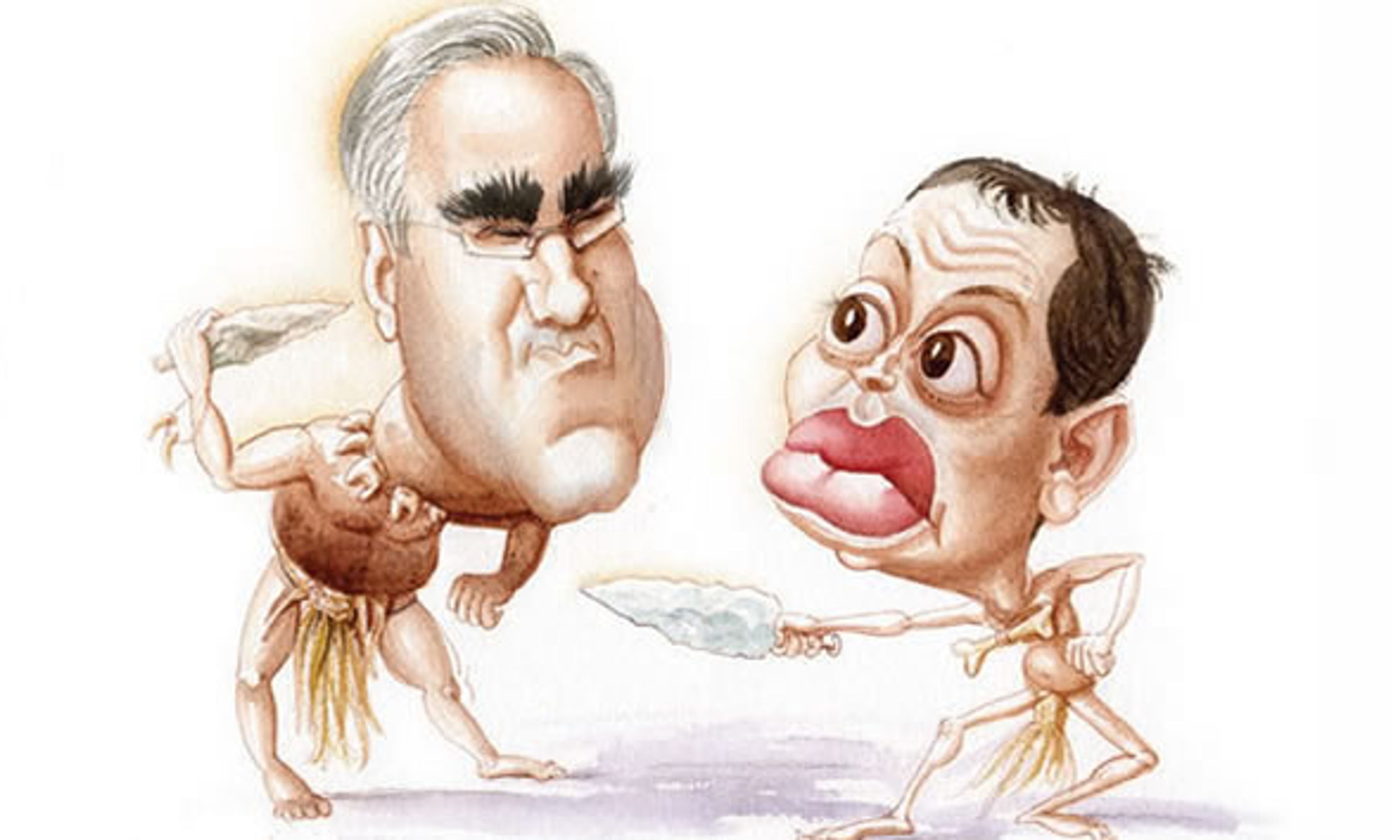
MSNBC and the blog Daily Kos are arguably the two axes along which pop progressivism maneuvers. Forged in the crucible of impotent liberal rage that was the post-Iraq Bush administration, by the 2008 election season the pair had evolved into the pistons of a well-oiled political noise machine. Kos’s guerrilla bloggers and MSNBC’s talking heads digested and regurgitated the messaging of base-agitators such as MoveOn.org, making it fit for (relatively) mass consumption en route to the docket of the Democratic congressional caucus.
But ever since MSNBC and Kos saw their man installed in Washington, they’ve found their message competing for time with the tea parties, and increasingly at odds with the White House and a skittish legislative majority wary of being trapped to the left of the American public. The strain is starting to show — most recently in a public and petulant exchange of fire between the Kos kids and the cable-news middleweight.
The first volley was, unsurprisingly, fired by MSNBC’s Keith Olbermann — the man holds grudges like Beijing holds Treasury bills. It started when Olbermann, and the rest of the ratiocinating world, panned President Obama’s June 15 remarks on the Gulf oil spill. Olbermann called the Oval Office address “a great speech if you were on another planet for the last 57 days.”
This let slip the dogs of Kos. That similarly negative reviews from fellow MSNBCers Chris Matthews and Rachel Maddow accompanied Olbermann’s was too much for one conspiratorial commenter at Daily Kos, where Olbermann had long kept a blog “diary.”
“Can’t verify, of course,” the commenter said, “but a friend in the news biz tells me he got a damaging e-mail from one of his pals at NBC. Something to the effect that their anger was pre-planned because ‘beating up on the president has been good for ratings.’”
“I haven’t checked,” the commenter continued. “But I’m hearing that Olbermann slammed the speech on Twitter before it even started.”
That this was an essentially anonymous remark, buried in a sea of comments, on a site whose raison d’être is to coalesce agitated partisans — and that it was chock-a-block with can’t verify’s, haven’t checked’s, and hearsay (for the record, Olbermann hadn’t preemptively “tweeted” a negative take on the speech) — ensured that an even-tempered man would give it nary a second thought. But Olbermann, like Russia, can have only enemies and vassals at his borders, and so he struck back.
In a farewell entry at Daily Kos titled “Check, Please,” Olbermann, in injured and embattled tones, announced his summary departure from diarist duties until such time as commenters ceased to indulge in “conspiracy theories.”
Olby wrote:
For years, from the Katrina days onward, whenever I stuck my neck out, I usually visited here as the cliched guy in the desert stopping by the oasis. I never got universal support, and never expected it, nor wanted it (who wants an automatic “Yes” machine?). But I used to read a lot about how people here would “always have my back.” . . . Now I get to read how we pre-planned our anger because “beating up on the President has been good for ratings.” . . .
To accuse me, after five years of risking what I have to present the truth as I see it, of staging something for effect, is deeply offensive to me and is an indication of what has happened here. . . .
If you want this site the way it was even a year ago, let me know and I’ll be back.
Here the reader will be permitted to fetch a fresh handkerchief . . .
Right, then. If this had been the last of it, one might well chalk it up to the caprice of a notoriously tempestuous and thin-skinned television personality. But as it turns out, there was a Concord to this Lexington.
It came some weeks later, in early July, when Kos founder Markos Moulitsas — a frequent MSNBC contributor whose gift for fifth-grade ad hominems matches or exceeds Olbermann’s — took to his site to announce that he had been “blacklisted” by the network.
Indeed, Phil Griffin, whom Moulitsas referred to as the “alleged” president of MSNBC, confirmed that he had “asked the [MSNBC] teams to take a break from booking [Moulitsas] on our shows” after he learned of an impromptu Internet smear campaign against MSNBC’s Joe Scarborough, launched by Moulitsas in May.
The forum was the “micro-blogging” website Twitter, which — whatever else it does — affords the punditocracy and their legion of followers a platform from which to sling mud at one another. Scarborough had taken to the tweets to bemoan the mainstream media’s credulous coverage of the Sestak affair, in which the White House had apparently offered a government job to a Democratic Senate candidate in Pennsylvania to avoid a messy primary battle. Moulitsas, who never met an innuendo he didn’t like, took the tweets as an opportunity to remind his followers — and Scarborough’s — that when the latter was a Florida congressman, a young female staffer of his had died under mysterious circumstances. Not a whiff of suspicion ever attached to Scarborough, but that didn’t stop Markos from suggesting that the media’s negligence in the Sestak affair was of a piece with their failure to adequately cover the “story of a certain dead intern.”
Scarborough, quite naturally, was outraged, warning via his own Twitter feed that anyone who gave airtime to Moulitsas was “extending . . . credibility to someone who regularly suggests that I’m a murderer.” That sentiment apparently found its way up the food chain, and MSNBC stalwarts have been denied the grace of Moulitsas’s emotive eyebrows and squeaky voice.
On cue and with the reflexivity of a knee joint, Moulitsas blamed the Right for his banishment. “This was not about criticizing some random MSNBC host,” he wrote. “But about criticizing the network’s token conservative.”
What to make of all this? It’d be dangerous to over-interpret — after all, Olbermann slouched back to his Daily Kos diary in a matter of days, and Moulitsas will surely return to appearing on programs that are regularly out-rated by the Cartoon Network. But the MSNBC–Kos tiff seems to suggest three lessons about the nature of the dubious movement they lead.
First, it reveals that the very instruments that birthed the “netroots” might now be broadcasting its crackup. When most non-users think of Twitter, if they think of it at all, they think of flotsam and jetsam, a place for a bored and self-indulgent generation to share its trivia 140 characters at a time — the Internet’s equivalent of reality television. But for relatively small, relatively incestuous groups like the Left’s “new media,” Twitter and Daily Kos are like a high-school cafeteria — and we’ve just witnessed a public fight between the star quarterback and the prom queen.
For better or worse, Boss Tweet now matters. Remember, it was an ill-advised tweet mourning the passing of a Hezbollah terrorist that cost a CNN senior editor her job this month. And with both the establishment and the grassroots branches of the Right rapidly closing their technology gap with the Left, these are mistakes worth learning from.
Second, it illustrates that if the coherence of a movement is dependent on emotive, paranoid, and self-obsessed personalities such as Olbermann and Moulitsas, that movement is ever at risk of incoherence. Olbermann has now entered what The New Yorker’s Nicholas Lemann, writing about Bill O’Reilly, dubbed the “Baroque period” of the political-talk-show host, when a focus on substantial issues is replaced by “self-references, obsessions, and elaborations” about the many perceived slights and injustices our besieged hero endures. Moulitsas, who has never been good at anything but cheap name-calling and false equivalencies (his impending book about conservatives is, after all, called “American Taliban”), is no longer content to reserve for the Right his frustrations at the president’s failure to hasten the arrival of social democracy in America.
Finally, it reaffirms that nothing unites a movement like opposition. When the Kos and Olbermann crowds were animated by their hatred for the hobgoblin they’d made of the Bush administration, they enjoyed their widest popularity and greatest political successes — electing a Democratic majority to Congress and Barack Obama to the White House.
But now that hope and change have met debt and doubt, and the Left has been asked to swallow bitter compromise on everything from Guantanamo Bay to the public option, movement liberalism is getting antsy, and perhaps cannibalistic.











Comments