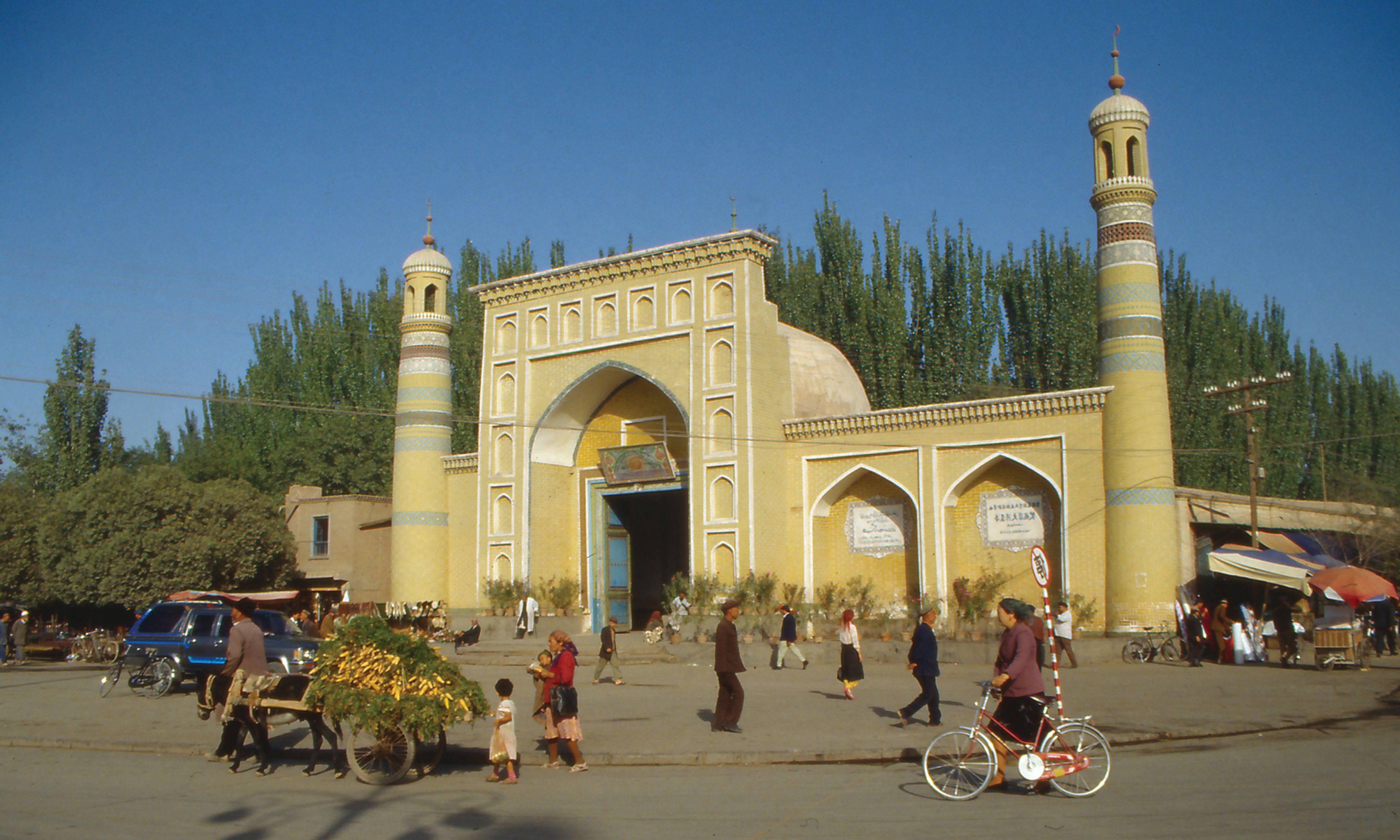
‘I find myself almost instinctively mistrusting Uyghurs. Perhaps because they are Muslim or perhaps simply because I don’t speak the language.” That is from my travel diary on May 13, 2004, my second night in Ürümqi. I had come from Nanjing, where I should have been in class on a yearlong academic fellowship. The plan was to spend a couple of weeks making a partial loop around the Uyghur homeland in the Tarim Basin before continuing into remotest western Tibet.
What I wrote embarrasses me now but perhaps one can understand the psychology of it. I had been somewhat radicalized by September 11 and I knew little of non-extremist sorts of Islam. Reading the news at an Internet café on the night of May 12, I had learned of the videotaped beheading of Nick Berg, a 26-year-old American who had gone to Iraq as an entrepreneur. I “am so troubled by it,” I wrote that first night, “that I want to run home to Utah. I don’t know why. I do not fear for my safety. China is a safe country, and although I shall be among Muslims, the Uyghurs do not have a grudge against Westerners.”
The unease began to lessen almost immediately in Turpan, an oasis southeast of Ürümqi known for grapes: “Took a long bike ride south of town. . . . Mud-style brick houses with trellises covering the courtyards, donkey carts, endless expanses of grape vines growing either up posts or along trellises (I suppose one could call them vineyards), dirt roads, long rows of tall poplars, women with scarved heads, old men in square hats who have long white beards. Passed a small mosque, and could see the people within it at evening prayers. Met a friendly middle-aged man who spoke little to no English [and] a little more Chinese, . . . who showed me the nearby karez (or underground irrigation channel). . . . ‘America,’ he said in English. ‘Good people, good people.’”
In Kashgar, the historical focal point of Uyghur culture, I found that the CCP was already destroying Id Kah Square. Home to an important mosque of the same name, it once boasted a market and rose gardens, too. Those were gone, now being replaced by a tile-and-concrete plaza. A massive statue of Mao had already gone up nearby.
The old city had not yet been razed. I do not recall any surveillance cameras. I was not once stopped by police, or asked for my passport except by clerks when checking in at hotels and, I assume, when traveling by rail or air. It was so unremarkable that I didn’t make any note of it. Grayson Slover, a young American who visited Xinjiang in 2019 and describes a very different place in his memoir Middle Country, writes of being stopped and having his papers demanded many times a day. He was detained for six hours and interrogated for getting too near a mosque that itself was near, unbeknownst then to him, to a labor-and-brainwashing-and-brutal-abuse-type concentration camp. He also discovered a QR code on the outside of a Uyghur home, next to posted photos of the residents, who, like all Uyghurs, are surveilled online and on their phones and have probably had to submit biometric data to the state.
But I “walked through some of the small streets next to the mosque last night. A jumble of donkey carts, street vendors, food stalls. Wandered through the hat section. A man insisted I come in, stuck a mink [?] hat on my head (the sort with earflaps, shaped like a hunter’s hat), and told me it was cheap at 500 yuan. Perhaps. Others sold musical instruments, carpets, brass pots. There were some Uyghur teahouses too — two-story buildings with verandas overlooking the street and decaying wooden banisters running along the verandas. Arched entryways, colored designs painted around the arches and along the roof (flowers, plants, etc.). Completely non-Chinese.”
I needed a shave, and there was a Uyghur barbershop. “Owned by a middle-aged man who works there with his two sons, both young teenagers. The shave was accomplished with a straight-edged blade, much lather, and much attention to detail. . . . Included a trimming of the hair above my ears and a nose-hair clipping. Only other customer was an old, bearded Uyghur man who came in for a head-shaving. At ten yuan, they probably ripped me off. The boy who shaved me was smirking as I left. But what to do.” I recall thinking about Nick Berg while the blade was at my throat. The juxtaposition, not the similarity.
I had enjoyed these interactions but I hadn’t made a friend. Then I met Parhat or Parhatjan: “‘Jan’ gets tacked onto masculine names and means ‘strong.’ For women, there is an ending that means ‘flower.’ . . . Parhatjan is 20. Has been a cell-phone dealer and barber. Now he teaches English, acts as a tour guide, and plans to go to the teachers’ college to learn English better. He is very sincere but tries to avoid giving offense. Said he liked the Han and only admitted he dislikes the Mao statue after I told him I hated it. Was enormously pleased when I said I’d wear long pants and long sleeves to the mosque tomorrow in order to be respectful — for this I was ‘very good.’”
Parhatjan seemed “to value above all his integrity. When I hedged and said I might not be able to go to his English class” — I thought I hadn’t actually committed — “he seemed crushed. ‘What will I tell my students?’ he asked. ‘The most important thing to me is to keep my promises. I told them I would bring an American friend.’ Of course I went.”
He remarked that “friendship is more important than money” and showed me his knives (often carried then, before all the metal detectors).
One time he scolded an apricot-seller who asked him whether he was buying for himself or for me, which implied price discrimination.
“When Parhatjan told me” as we walked through Id Kah Mosque “that anyone could pray anywhere in it because all men were equal, I am sure he meant all men — including me, including Nick Berg, including the 3,000 of September 11.” (Perhaps not the women. Equality is a gradual attainment.) “He also quoted me a line of a Uyghur poem that he likes very much: ‘Silver nests and gold nests — birds can live in them too — but they cannot breathe in them.’” I think you have to imagine a somewhat closed nest, swallow more than robin.
Three days later his uncle drove me to Tashkurgan, “a stone[’s] throw from the Sino–Pakistani border (although the town is predominantly Tajik). . . . On a hill east of town is a crumbling fort of mud and brick — at least 600 years old, according to myRough Guide. The crenellated walls and ramparts are in fairly good condition. I clambered up and walked along the top, peering through gaps in the walls to the broad valley that precedes the mountains — a cold, wet expanse of pastureland dotted with grazing sheep, yurts, and small box-shaped homes made of [adobe] brick. . . . The Tajik women wear oval-shaped hats that are perfectly flat on top; some cover the hat with a cloth or large veil. I find this very elegant — particularly the bright red hats, which are always accompanied by dresses of a matching shade. The Tajiks are darker than the Uyghurs, and have long, thin faces and long, hawkish noses.” The Muslim women throughout Xinjiang seemed not to be available socially but were often friendly selling food at bazaars. The yogurt with grape preserves or honey and the vanilla ice cream tasted like new discoveries, the Han lacking dairy. There was something made of lamb lungs and flour but a bit like polenta.
In Tashkurgan I had “dinner at a dive owned by a Kazakh man and his family. (The Kazakh women only wear a cloth veil over the back of their head.) Probably the best mutton kebabs I have ever tasted” — still the case. “Much fat is left on the meat, but no gristle, and this gives it a very rich flavor. While I waited for my food — being prepared by the wife and son of the owner — the owner himself sat down with me and made small talk. I loved this, loved his friendliness, loved the tough faces of the other men who had come in for dinner. One had a mustache and wore a big fur-lined winter hat; another wore a leather cap.”
* * *
Over the period of my stay in and around Kashgar — four nights plus the night in Tashkurgan — Parhatjan introduced me to some of “the colorful characters who work the foreign-tourist circuit.” He did not ask for or get any money from me. I think he regarded the English practice and the inherent interest as his gain. He did connect me with others, such as the uncle, who accepted reasonable fees for real services. It was an excellent little tourist economy in which the Uyghurs individually and as a group seemed to make the decisions about their own participation.
I met “‘Elvis,’ a Uyghur carpet trader of utmost courtesy who arranges tours to local houses; [Dave Zhang] of [Dave’s Inn]” — names changed as a courtesy — a Han and “a very smooth operator whose service to foreigners borders on the obsequious but who, despite seeming a bit of a phony, is full of information and happy to share it. (Knew all about hitching to Tibet, for example, and encouraged it — as did the people at the Kashgar Mountaineering Association.) They are full of intrigues, loyalties, rivalries. Parhat says [Dave] is a liar because he once accused Parhat’s former boss of speaking ill of [Dave’s Inn] to foreign travelers. When the boss denied it, [Dave] struck him. The boss did not hit him back, saying only, ‘Although I am stronger than you, I will not fight you.’”
A heartwarming little spat. Suggesting a time when the Han and the Uyghurs lived closely enough and peacefully enough to fight like normal individuals. Tensions, one assumes, were there; people resent their colonizers. An older Uyghur man I met in a park in Kashgar told me in Chinese that he did not like the Han because they were atheists whose only object in life was to make money. Complementarily, somewhere between Mt. Kailash and Shigatse a Han told me the Tibetans and the Indians had the same problem, which was that they were religious. Another, a customs officer on vacation, then “said that Tibetans were perfectly free to practice their religion and that the relationship between China and Tibet was like the relationship between America and Iraq: a more developed country helping a less developed one.”
I did not realize at the time that the gradually accelerating crackdown on the significant religious freedom and cultural autonomy of the Uyghurs in the 1980s had already begun and would eventually precipitate guerrilla-style and a few genuine terrorist attacks carried out by Uyghurs in China. I had the luck to be there toward the end of a little oasis time of peace and some freedom. Not much is known about the attacks and almost nothing about the perpetrators. In general you could say that the CCP’s increasing repression provoked some violence, to which it then responded with cultural genocide. (See The War on the Uyghurs, by Sean R. Roberts.) This is a theme of Chinese history. You will recall what the Qianlong Emperor did to the Dzungars.
The mass of Han, who are relentlessly propagandized by their government, are not the villains in all this. I had amusing and warm interactions with them all across China. When I left my camera in the hotel lobby in Kashgar and came back two hours later frantically looking for it, to give an instance, the desk clerk and a man in army fatigues, both Han, were “positively delighted. I asked [one of them, I think fatigues,] whether he planned to tell me, and he said, ‘Didn’t I tell you?’ — referring to his smile and laughter.” I can imagine Han and Uyghurs joking around that way back in 2004. What has happened since is an atrocity against the Uyghurs but the Han have lost a lot that they don’t even know about. Or maybe they do. Slover’s Airbnb host in Kashgar, a nice lady, talks about how their Uyghur neighbors used to invite her and her mother over for dinner “all the time.”
“That’s such a great story,” Slover says. “Do your neighbors still live there?”
“No, they don’t,” she says.
“I sensed she did not want to say more,” Slover concludes.
* * *
The old and beautiful mosque I saw in Kargilik — where I also experienced a fantastic sandstorm and whence I continued into Aksai Chin — has been mostly demolished. I must assume the little mosque in Turpan is gone; the smaller ones have been targeted with special zeal. Muslims cannot pray in public now anyway without drawing suspicion. When Slover visited Id Kah, he saw no Uyghurs, and a group of older Han men randomly walked in and made an ostentatious display of the Chinese flag. In my hotel room I could hear the call to prayer from the minaret. The minarets are now silent.
I wonder how specifically they have ruined the Monday market in Opal, which was mostly donkey carts on a dirt road lined on both sides with poplars. I wonder whether there are still cockfights at the margin of the animal market in Kashgar and Uyghur men still come to blows over their bets.
The women may not veil now in a less beautiful Tashkurgan.
The old men may not grow neat long beards or plausibly sit in barbershops next to Westerners with less ruly scruff.
Slover was turned away from the vestiges of Kashgar’s authentic old city, and in the “new old town” Uyghurs seem reduced to the role of song-and-dance troupes performing for Han tourists, or to comparable indignities. I saw those kinds of shows many times while lodging in Han-patronized hotels in minority regions, but I never had to go far to find the original way. More and more now across western China, merged with a techno-panopticon and a police state, only the theme-park versions exist. Don’t let anyone tell you that cultural appropriation isn’t a thing.
I have thought about Parhatjan. Is he in a camp? Did he have sisters? If so have they been sterilized? Has his father been beaten? Did a CCP cadre assigned to the home demand to share anyone’s bed? What compromises of his integrity, their integrity, have been required? Is anyone in his life unscathed?
I have no way to know. Nor will he know that I’m sitting here writing about him, grateful to him as I remember how things were but are not and never again shall be. A ghost in a dream.












Comments