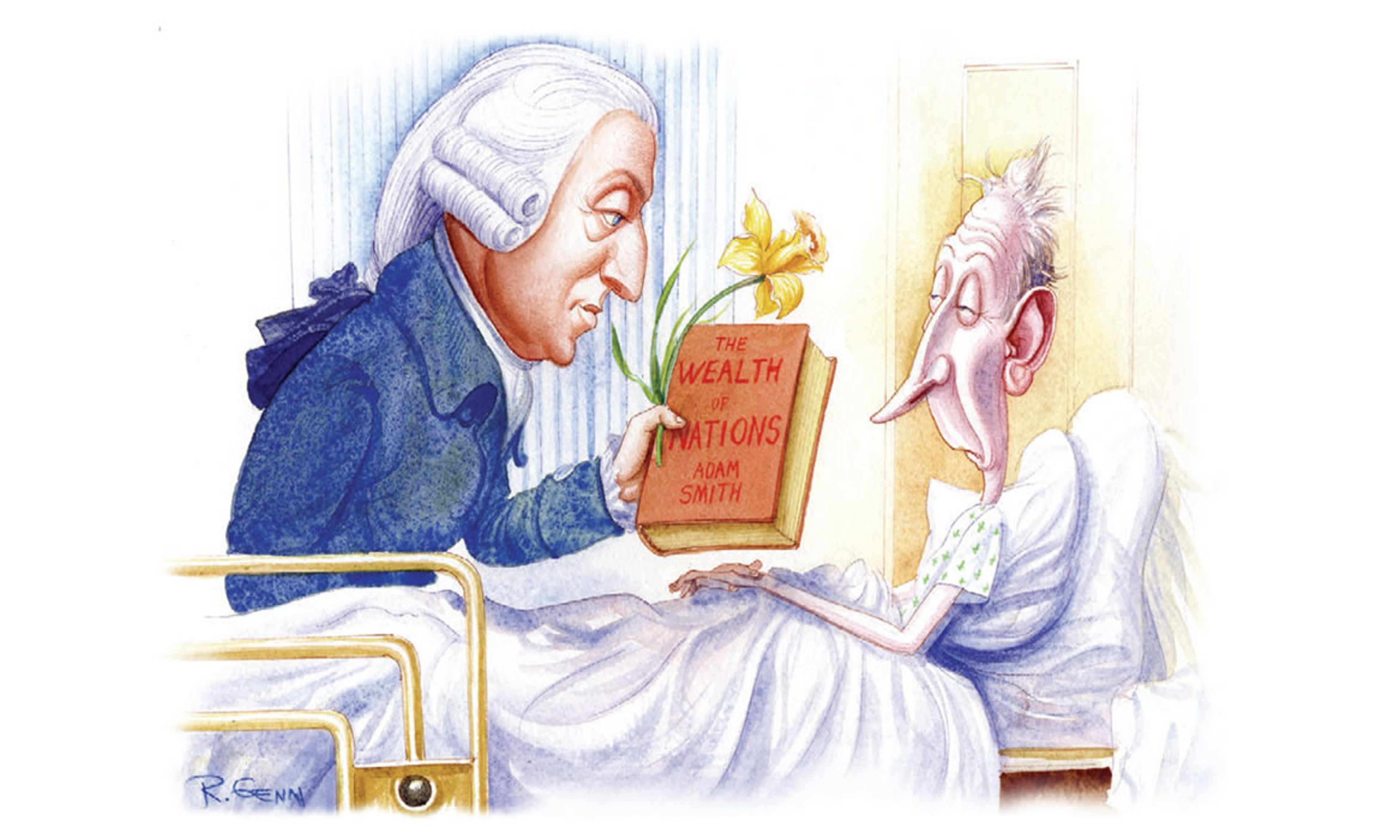
There’s a phrase that comes up a lot more when liberals talk about health-care policy than when conservatives do: “preexisting conditions.” It’s one of the trickier problems of our current system of financing health care. Let’s say that you get a long-term illness — like cancer, or diabetes — and then lose your job. How do you get insurance again? What rational insurance company is going to want your business?
Liberals have a simple-sounding solution to the problem: Make it illegal for insurance companies to discriminate based on preexisting conditions. In a recent e-mail from the White House to its supporters, the first complaint lodged against the current system was its treatment of these conditions — and the ban on discrimination was the first “basic consumer protection” demanded.
Conservatives have emphasized other concerns: chiefly the system’s escalating costs and people’s lack of control over their insurance policies. Conservatives’ preferred policy to increase patient control is to make it easier for people to buy insurance for themselves (as opposed to relying on their employers or the government). One way to accomplish this goal is to allow people to buy insurance across state lines, thus leaping over their own state’s regulations. Another is to end the tax penalty on individual insurance purchases. To reduce costs, conservatives generally favor changing tax policy so as not to reward people for buying more expensive policies.
These policies would help healthy people buy cheaper and more secure insurance policies. But the policies would not, directly, help sick people. When John McCain adopted the conservative policy mix, one of the chief criticisms — and the most defensible of the major liberal criticisms — was that it offered nothing for people with preexisting conditions and might even worsen their plight. Elizabeth Edwards said that she had one thing in common with McCain: As cancer survivors, “neither one of us would be covered by his health policy.”
While Mrs. Edwards was exaggerating, what she was getting at was that if McCain lost his insurance, or she lost hers, his plan would not guarantee that any insurance company would offer him a policy at an affordable price. Liberals’ plans would. Over time, McCain’s plan would cause employers to drop their insurance coverage as a larger and larger proportion of employees bought their own policies. Conservative reforms are more or less designed to have this effect. But one unintended effect would be that some people with preexisting conditions would lose their coverage and find themselves in an individual market where they would have few real options.
Even some Republicans in Congress who generally favor free-market health policies therefore look favorably on banning insurance companies’ screening of customers for preexisting conditions. If Democrats fail to enact comprehensive reforms, it is generally assumed that their fallback position will consist of some proposals to expand coverage and some “insurance-market reforms” — including a ban on discrimination based on preexisting conditions.
Such a ban, by itself, would be unworkable. For one thing, insurers would have an incentive to figure out hard-to-police ways of avoiding sick customers or driving them away. But there’s a deeper flaw in the idea.
Mark Pauly, a professor of health-care management at the Wharton School of Business, and his collaborators have found that individual insurance markets are reasonably good at pooling risks — if people buy policies when they are relatively healthy and insurers are allowed to charge higher prices to higher-risk customers. But if people can wait until they are sick and then get insurance at the same price that everyone else does, why would anyone pay premiums while healthy? The more people understood that logic, the more insurance markets would collapse. Healthy people would stop buying insurance; insurance premiums would therefore rise; and more healthy people would then quit.
To break this vicious circle the government would have to force healthy people to buy insurance whether or not they thought it offered them a good deal. This mandate would itself lead to other government interventions. Once the government said that everyone must buy a minimum level of insurance, every health-care provider would want his services included in that minimum package. As their lobbying succeeded, the floor on the price of insurance would rise. So would the number of people who needed subsidies to comply with the mandate.
To ban discrimination on the basis of preexisting conditions is not, then, a clean and limited reform of the insurance markets — not a mere tweak to insurance companies’ business models. It is more like a prohibition on the act of providing health insurance. What coverage is supposed to insure against is, after all, the risk that the policyholder will get sick and have to pay for medical care. When a company covers the health costs of a new, already-sick customer, the service it is providing is not insurance. Nobel laureate Kenneth Arrow grasped this point in a classic 1963 paper for the American Economic Review: “On a lifetime insurance basis, insurance against chronic illness makes sense, since this is both highly unpredictable and highly significant in costs. Among people who already have chronic illness, or symptoms which reliably indicate it, insurance in the strict sense is probably pointless.”
We have already gone some distance down the road from true insurance. What we call “insurance policies” are in large part socialized pre-payment plans for health expenses. The good news is that we have reason to expect that markets can do quite a bit to mitigate the problem of preexisting conditions over the long run. In a society with a thriving individual insurance market and a much lower degree of reliance on employer-provided insurance, people would have a strong incentive to buy insurance against the risk of major medical expenses. They would have a strong incentive to buy renewable policies (policies that they could renew at roughly the same rates, even after they got sick) early in their lives, or their children’s lives.
The only way to reconcile our highly mobile labor markets with the “lifetime insurance” Kenneth Arrow discussed is to separate insurance from employment — either by having individuals buy insurance or by having the government do it for them. Professor Pauly’s research already shows that because of the availability of renewable policies, people with individual insurance who get sick lose that coverage less often than people who have group insurance and get sick.
The finance economist John Cochrane has explained how renewable policies are compatible with a continuing choice of insurance companies and thus with competitive discipline on those companies. His insight is that a (true) health-insurance policy packages two products. The first is insurance against medical expenses that might arise over, say, the next year. The second is insurance against the risk that one’s health status will deteriorate so that the first component will cost more in subsequent years. He goes on to suggest various ways that the market could decouple these products, enabling people to buy “health status insurance” and thus combining the advantages of renewability with the ability to keep shopping around among insurers. A market of this sort is beginning to launch. Federal policy choices will determine whether it takes off or crashes.
The problem that people have in paying for the treatment of preexisting conditions is, in large part, an artifact of government interference in the market. But even if the problem would arise much less frequently in a market-driven system, it would still arise. Not everyone would buy insurance in time. And there is also the problem of those people who are already sick today: those whose preexisting conditions preexist a workable market. If they are essentially uninsurable, some other method of helping them with their medical bills will have to be found.
Many states operate “high-risk pools” for such people, but these tend to have long waiting lists. (They’re also misnamed: They’re really subsidized cost-sharing arrangements for sick people.) Federal funding could help, and even a large increase would be much cheaper than the comprehensive liberal reforms being discussed in Washington. But the states should have primary responsibility, in part because the best way to run these programs is not clear. Insurers shouldn’t be encouraged to offload their costs to these programs. Any federal assistance should also be structured carefully. Done wrong, such assistance could recreate the incentives of Medicaid, which reward states for expanding benefits and thus encourage them to bankrupt themselves.
The question of what to do about people with preexisting conditions highlights the political delicacy of free-market health-care reform. The advantages of a well-developed individual market are a reason to seek such reform on as quick a timetable as possible. On the other hand, the fact that our current system of hidden subsidies protects some of these people, albeit inefficiently, is a reason to go slow. Neither end of this dilemma offers a justification for abandoning free markets, especially since doing so is likely to retard medical innovation and the diffusion of new treatments. What people with preexisting conditions need most are cures.








Comments