It would disturb the entire ethos of this column if I were to become suddenly optimistic about the future of the movies. But tentatively, very tentatively, it’s felt like mass-market cinema this year so far is coming in above expectations.
Yes, partially it’s just the pleasure of seeing more movies in theaters than I did in Covid Time. But even as the superhero tentpoles have raked in their hundreds of millions, Hollywood in 2022 has produced a slate of reasonably successful movies that at least evokes the patterns of the 1980s and the 1990s — the greater range of genres, the more original storytelling, the talented directors given freer rein, and the sense that it’s okay to tell a story for its own sake even if it doesn’t connect to any comic-book cinematic universe.
True, the most commercially successful of these old-school movies, Top Gun: Maverick, is also the least original, while the highest-concept directorial forays — Robert Eggers’s The Northman, Jordan Peele’s Nope — either lagged at the box office or failed to quite achieve their Spielbergian aspirations. But at the risk of practicing the soft bigotry of low expectations, it’s nice to see a bunch of movies even just trying to live up to the standards of Hollywood creativity that audiences could take for granted not so long ago.
All of this is by way of introduction to Bullet Train, an action-movie spectacular that wants to revive two subgenres at once: the “Die Hard on a [fill in the blank]” movie, with fisticuffs and shoot-outs set in some distinctive building or vehicle, and the Tarantino actioner, filled with flashbacks and fast-talking eccentrics and twisty rivalries and showdowns.
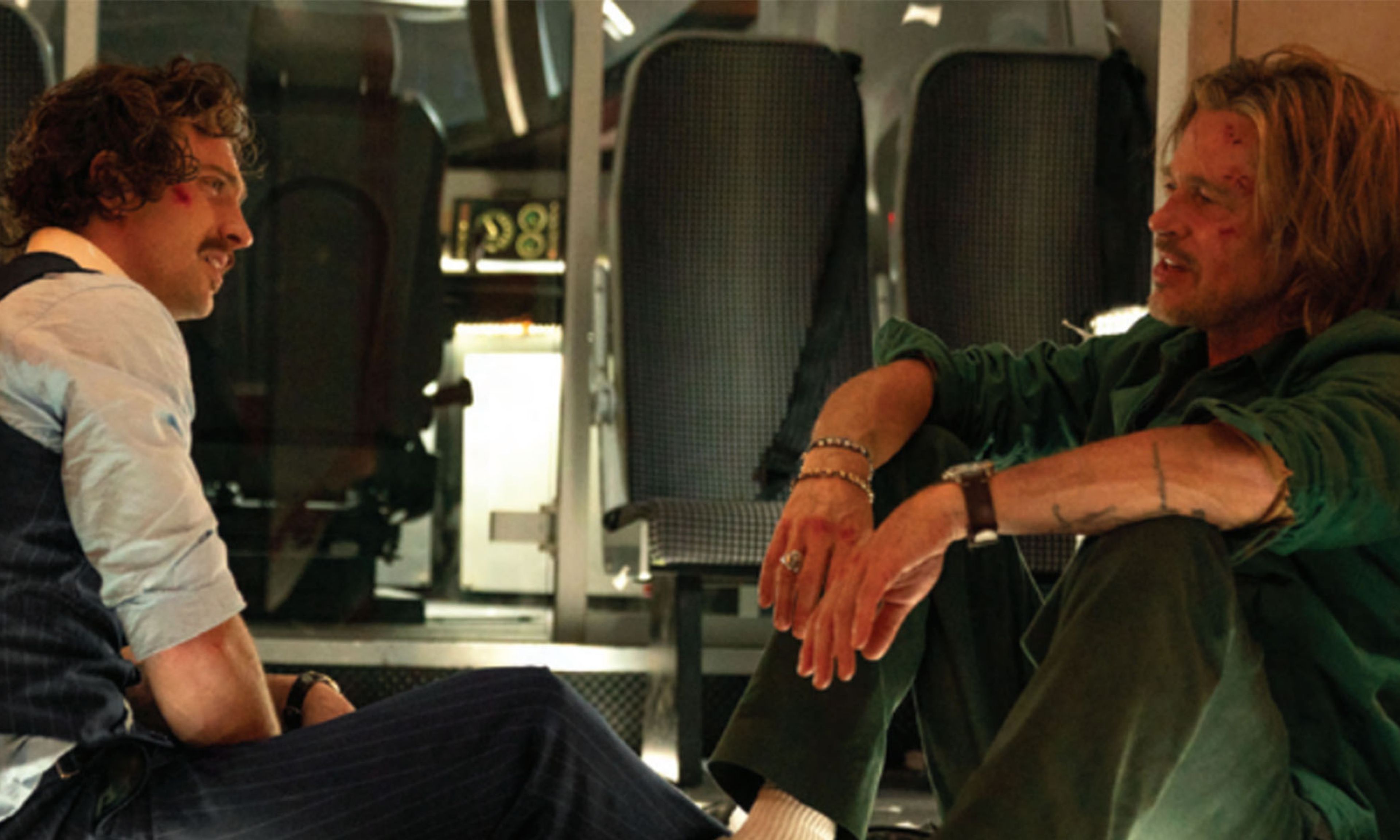
The title tells you how the blank was filled in: All of the non-flashback action takes place on a late-night Tokyo-to-Kyoto express, initially crowded and eventually empty, zipping between one-minute stops, with a motley crew of assassins, plotters, and bad actors on board.
The nominal audience surrogate is Ladybug (a code name), played by Brad Pitt, a laid-back assassin who keeps up a patter of Californian philosophy as he tries to shed the bad luck that he complains has dogged him throughout his career. Instead, his misfortune seems to accelerate the moment he boards the train: He think he’s on a simple “snatch and grab” mission, swiping a briefcase containing a million bucks and hopping off at the next stop, but he’s actually being drawn into a wild battle between minions and rivals of the White Death, a ruthless Russian transplant who’s risen to dominate the Japanese underworld.
Among those minions are Lemon and Tangerine, a pair of Brit assassins played by Brian Tyree Henry and Aaron Taylor-Johnson, who get the best lines and the best clothes and held my interest more successfully than Ladybug. They are transporting the briefcase and the White Death’s failson heir, whom they’ve rescued from a kidnapping. But their mission, like Ladybug’s, is disrupted by a slew of rivals — a cartel assassin out for revenge (Benito Antonio Martínez Ocasio, a.k.a. the rapper Bad Bunny), a father–son pair of Yakuza out for revenge (Hiroyuki Sanada and Andrew Koji), an innocent-seeming girl out for revenge (Joey King), and a venom-wielding assassin out for, well, assassination (Zazie Beetz). Also, there’s an escaped snake, an officious conductor, Sandra Bullock supplying the voice of Pitt’s handler, a pair of famous actors supplying cameos, and the White Death himself, played by Michael Shannon with all the crazy you’d expect.
The director, David Leitch, is a former stuntman who has remade himself — beginning with the first John Wick movie — as a premiere choreographer of hand-to-hand combat, and in its enclosed-space brawls Bullet Train doesn’t disappoint. (A wordless tussle in the quiet car is there presumably to pander to frequent Acela riders.)
In everything else, though, the movie feels as if it needed to be pushed a little more on its decisions. The flashbacks go on too long and the director is too pleased with their flourishes. The characters are constantly paired off, in fights or conversations, but you often lose track of what’s happening with one pair while another duo is getting their backstory filled out — even though everything seems to be happening in the same three or four cars. The movie starts with a pretty full train but uses its noncombatant passengers for gags and then makes them evaporate; the unrealism is fine but there are a lot of missed opportunities for misdirection and surprise. Shannon is entertaining but he’s also miscast: He isn’t the caricature of a Russian the movie needs — his crazy is too ineffably American.
But with all that said, Bullet Train is a summer action movie that isn’t bloated or heavy on world-building pretension, a spectacle that knows its own limitations. I wasn’t always sold, but I was mostly entertained. Sometimes, that’s enough.












Comments